


Listen to the article
The first thing that hits you at the World Cheese Awards is the smell.
As the 37th edition of the prestigious international cheese competition kicked off in Switzerland this week, visitors encountered an olfactory experience that ranged from intoxicating to challenging. With descriptions of odors ranging from “stinky socks” to “sick dog,” the event proved to be a festival for the nose as much as for the palate.
Connoisseurs, culinary experts and curious consumers gathered in Bern for the three-day event in a country where cheese is deeply woven into both national cuisine and cultural identity. The competition featured an unprecedented 5,200 cheese varieties from 46 countries, setting a new participation record with entries from as far as Australia, Austria, Bulgaria and Brazil. Nearly one-fifth of the competing cheeses were Swiss, highlighting the host country’s dairy prominence.
The competition hall created a unique mélange of aromas that initially overwhelmed visitors. But beyond the medley of scents, the individual flavors, textures and appearances of thousands of carefully crafted cheeses revealed themselves to judges and attendees.
John Farrand, managing director of Britain’s Guild of Fine Food, which organizes the event, believes skeptics simply need exposure to the vast world of cheese. “I would grab them and sit down with them and take them on that journey through cheese,” he said. “I get so many people say to me just impulsively ‘I don’t like blue cheese’ and that’s impossible really. There’s so much of a range… there’s always a blue cheese for somebody.”
Farrand described a dramatic moment when teams rolled in and cut open a 120-kg (265-pound) wheel of cheese, releasing a powerful burst of aroma. “The aroma of this Emmentaler just hit me,” he recalled. “That’s the first time that cheese has released its greatness and the aroma… just makes you hungry.”
While some visitors might avoid pungent varieties like Limburger, Taleggio, “Stinking Bishop,” or Napoleon’s reported favorite, Époisses de Bourgogne (rumored to be banned on French public transport due to its powerful smell), others seek out these bold flavors. Adventurous tasters also explored more unusual varieties made from camel, buffalo or donkey milk.
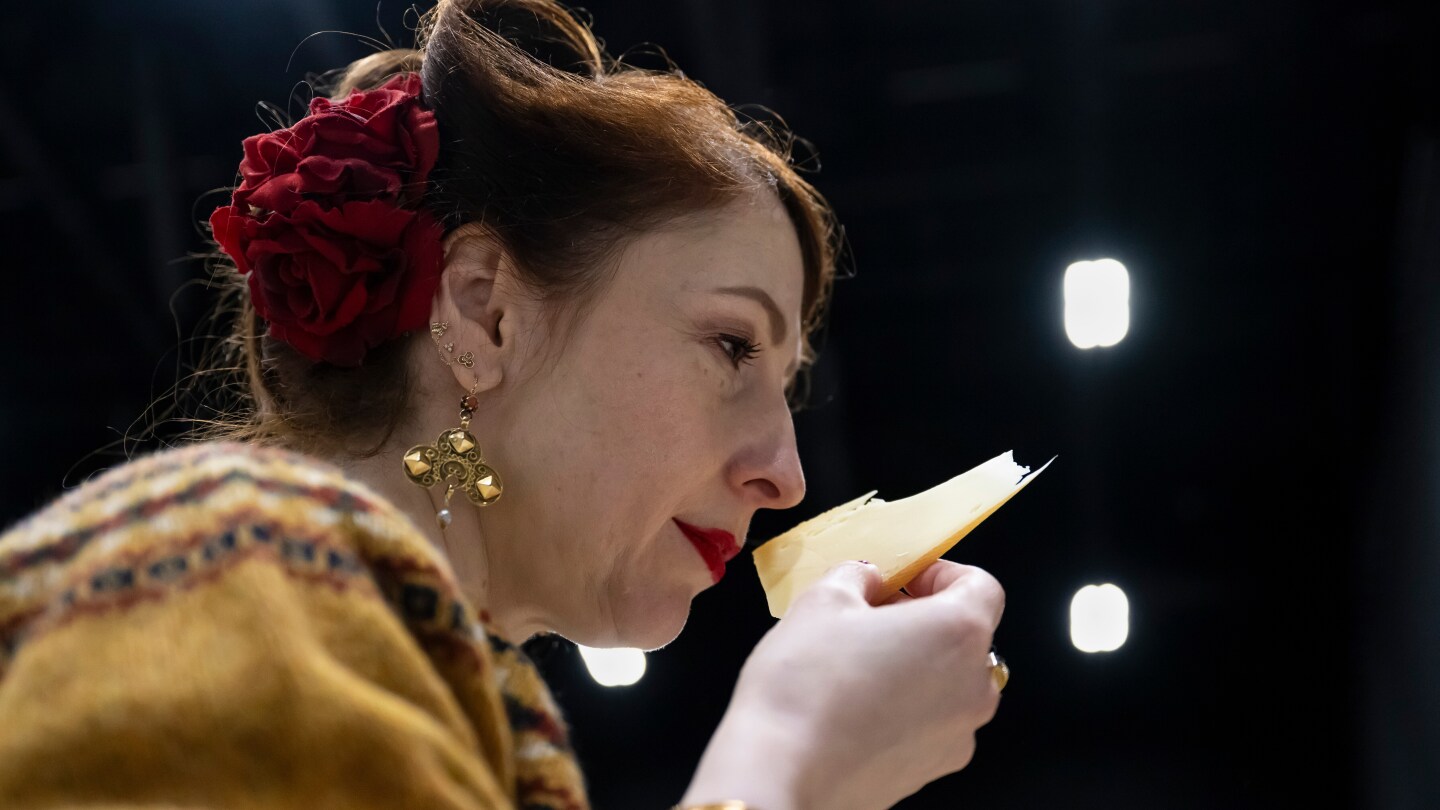
The judging process followed strict protocols. Scores of judges in yellow aprons methodically examined cheeses arranged on long, numbered rectangular tables. They sliced wedges from hard cheeses and pressed them to their noses, while using spreaders to sample soft varieties. Each judge assessed consistency, appearance, and flavor before making their selections.
To ensure impartiality, all identifying packaging was removed before judging. The 265 experts evaluated each entry on specific attributes including aroma, body, texture, flavor and “mouthfeel,” assigning gold, silver and bronze awards. Only those honored as “Super Gold” advanced to the prestigious “Super Jury” selection of 14 finalists. Both judges and public learned the origins of each cheese only after voting concluded.
Paul Thomas, a cheesemaker from Urstrom Kaese near Berlin, demonstrated the careful assessment process when evaluating a blue cheese covered with cherries, which promised hints of Manhattan cocktail flavors. After tasting, he noted being “pleasantly surprised throughout most of that flavor journey,” though he detected “a slightly off flavor toward the back of the tongue.”
This year’s top honor went to a Swiss “spezial” Gruyere from the Vorderfultigen Mountain Dairy, located about 20 kilometers south of Bern. The winning cheese, which scored 85 points from the jury, is made from raw cow’s milk, drained overnight and dry salted before being matured for more than 18 months.
A creamy, flower-sprinkled “Crémeux des Aldudes aux fleurs” from the French Basque village of Etxaldia claimed second place, while a 9-month-aged Swiss Appenzeller Edel-Würzig rounded out the top three. Other finalists represented Britain, Japan, the Netherlands, Slovakia and the United States.
Beyond the main competition, more than 20 cheeses received recognition as national or regional champions, including best American, Basque-country, Japanese and Ukrainian varieties. Additional trophies honored specific categories like outstanding cheddar, raw-milk, goat, ewe, and smoked cheeses.
While Wisconsin hosts the World Championship Cheese Contest and France holds a competition for the world’s best cheesemonger, organizers tout the World Cheese Awards as the largest cheese-only event globally. Though the competition originated in Britain, it has since traveled to Italy, Spain, Norway and now Switzerland.
Charlie Turnbull, director of the Academy of Cheese, summarized the paradox of certain varieties when examining a pungent round cheese whose aroma comes from Brevibacterium linens bacteria. “It’s challenging,” he admitted with a slight wince, comparing it to “the kind of bacteria you get in boys’ trainers when they’re about 15 years old.” Yet he emphasized that beyond the initial smell, the cheese offered wonderful flavors with “hints of fruit, lots of meaty notes, some ham stock.”
His conclusion captured the essence of the competition: “At the end of the day, taste trumps everything.”
Fact Checker
Verify the accuracy of this article using The Disinformation Commission analysis and real-time sources.

8 Comments
The World Cheese Awards sound like a true celebration of the art and science of cheesemaking. I’m curious to know if there are any notable trends or innovations that emerged from this year’s competition, and how the winning cheeses might influence the industry going forward.
It’s fascinating that nearly one-fifth of the competing cheeses were Swiss, highlighting the country’s dairy prominence. I’d love to hear more about the cultural significance of cheese in Switzerland and how that influences the cheesemaking traditions on display at this event.
It’s great to see the World Cheese Awards continue to grow in scale and diversity, with entries from as far as Australia, Austria, Bulgaria, and Brazil. I wonder if the judging process accounts for cultural and regional differences in cheesemaking traditions.
The World Cheese Awards sound like a truly immersive experience for cheese enthusiasts. I’m curious to learn more about the cultural and regional diversity represented among the 5,200 entries, and how that might shape the judging process and final selections.
Wow, 5,200 cheeses competing for the World Cheese Awards is truly impressive. I can only imagine the challenge the judges face in trying to discern the nuances between so many unique and carefully crafted entries.
What an impressive turnout for the World Cheese Awards! 5,200 cheeses from 46 countries must have created quite a sensory experience. I wonder if any unexpected or unique varieties were featured among the entries.
The description of the overwhelming aromas, from ‘stinky socks’ to ‘sick dog’, sounds both intriguing and a bit daunting! I’m curious to learn more about the judging process and what criteria are used to determine the winners in such a competitive field.
The World Cheese Awards sound like a truly immersive experience for cheese enthusiasts. I’m curious to learn more about the judging criteria and what factors go into selecting the winners in such a competitive field.