


Listen to the article
Haiti Fields Athletes for Winter Olympics Despite National Turmoil
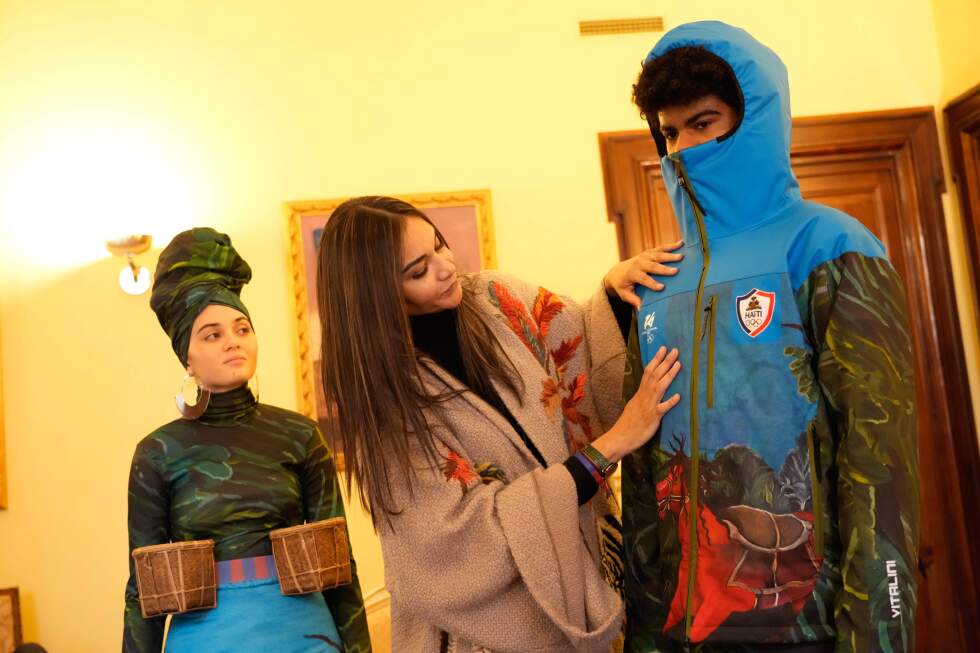
In a powerful display of resilience, Haiti has sent two athletes to compete in the Milan Cortina Winter Games, representing a Caribbean nation grappling with unprecedented challenges. The skiers will don uniforms designed by Italian-Haitian designer Stella Jean that celebrate Haitian heritage while navigating Olympic rules regarding political symbolism.
The uniforms originally featured an image of Toussaint Louverture, the former slave who led the revolution creating the world’s first Black republic in 1804. However, the International Olympic Committee ruled the image violated regulations prohibiting political symbolism, forcing Jean to adapt her design.
“Rules are rules and must be respected, and that is what we have done,” Jean told The Associated Press during an exclusive preview at the Haitian Embassy in Rome. Her creative solution involved painting over the founding father’s image while retaining the dramatic red horse against a lush tropical backdrop.
“For us, it is important that this horse, his horse, the general’s horse, remains. For us, it remains the symbol of Haiti’s presence at the Olympics,” Jean explained.
Haiti’s appearance at the Winter Olympics carries profound significance for a nation where gang violence has spiraled since President Jovenel Moïse’s 2021 assassination. Criminal groups now control approximately 90% of Port-au-Prince, the capital, amid rising rates of violence including killings, sexual assault, and the forced recruitment of children into armed groups.
“Haiti’s presence at Winter Olympics is a symbol, is a statement, not a coincidence,” said Haiti’s ambassador to Italy, Gandy Thomas. “We may not be a winter country, but we are a nation that refuses to be confined by expectation… Absence is the most dangerous form of erasing.”
Jean’s design for female delegation members features golden hoop earrings and a traditional Haitian tignon, or turban. This headwear carries historical significance, as women were once forced to cover their hair by colonial rulers who feared its beauty would outshine that of the colonizers.
“We know that in these few meters of cloth, in this uniform, we must concentrate all of history and a message,” Jean said.
Haiti’s journey to the Winter Olympics began following the devastating 2010 earthquake, when the country established its ski federation amid a global outpouring of support. The federation now includes seven athletes, with two qualifying for the Olympic competition. Both receive financial assistance through the IOC’s Olympic Solidarity program, covering training, equipment and qualification event travel expenses.
Richardson Viano, 23, made history as Haiti’s first Winter Olympian at the 2022 Beijing Games, finishing 34th in men’s slalom. Adopted by an Italian family in France at age 3, he initially competed for France before being approached by the Haitian Ski Federation—an organization he didn’t know existed. After obtaining a Haitian passport, he embraced the opportunity to represent his birth country.
“When you talk about Haiti it is in catastrophic terms… This is a way to find something nice,” Viano said by phone from Bosnia, where he was preparing for the Games.
The team also includes 25-year-old Stevenson Savart, Haiti’s first Olympic cross-country skier. Like Viano, Savart was adopted by a French family at age 3 and turned to Haiti after failing to qualify for the French team. Though he acknowledges he’s unlikely to finish near the top in the men’s 20-kilometer skiathlon in Predazzo, the opportunity fulfills a lifelong dream.
“I am very proud that I can do that for Haiti,” Savart said from his training base in France. “Having Haiti visible will give me even more energy.”
Ambassador Thomas expects these athletes’ stories to resonate both within Haiti and throughout its global diaspora. The sentiment is echoed by members of the Haitian community abroad, including Cathleen Jeanty, a 32-year-old Haitian-American from New Jersey, who plans to watch the competition despite having limited knowledge of winter sports.
“People who maybe don’t come from underrepresented communities, they don’t realize how important the cultural capital is to be able to stand elbow to elbow with your peers,” Jeanty said.
For a nation weathering profound political instability and humanitarian challenges, Haiti’s presence at the Winter Olympics serves as both a symbol of national pride and a reminder of the country’s enduring spirit against overwhelming odds.
Fact Checker
Verify the accuracy of this article using The Disinformation Commission analysis and real-time sources.

8 Comments
It’s great to see Haiti fielding a team for the Winter Olympics, especially given the instability and challenges facing the country. Sports can be a unifying force and a source of national pride.
Removing Toussaint Louverture’s image from the uniforms is disappointing, as he is a significant figure in Haiti’s history. But I’m glad the core symbolism of Haiti’s participation remains.
The athletes and designers are finding ways to celebrate Haiti’s identity despite the limitations. It’s an inspiring display of resilience and national pride.
The IOC’s decision to remove the image of Toussaint Louverture is understandable given the rules, but it’s a shame to lose that powerful representation of Haiti’s revolutionary history.
Still, the designer’s creative solution to retain the horse symbol is a clever way to maintain a visual connection to Haiti’s identity and heritage.
Competing in the Winter Olympics is an impressive feat for Haiti, a country not known for winter sports. Their participation shines a positive light on the nation’s resilience and determination.
It’s inspiring to see Haiti’s athletes representing their country at the Winter Olympics despite the challenges facing the nation. Overcoming obstacles and showcasing national pride is admirable.
I appreciate the creative design of the uniforms that pays tribute to Haiti’s heritage while navigating the Olympic rules. It’s a thoughtful compromise.