


Listen to the article
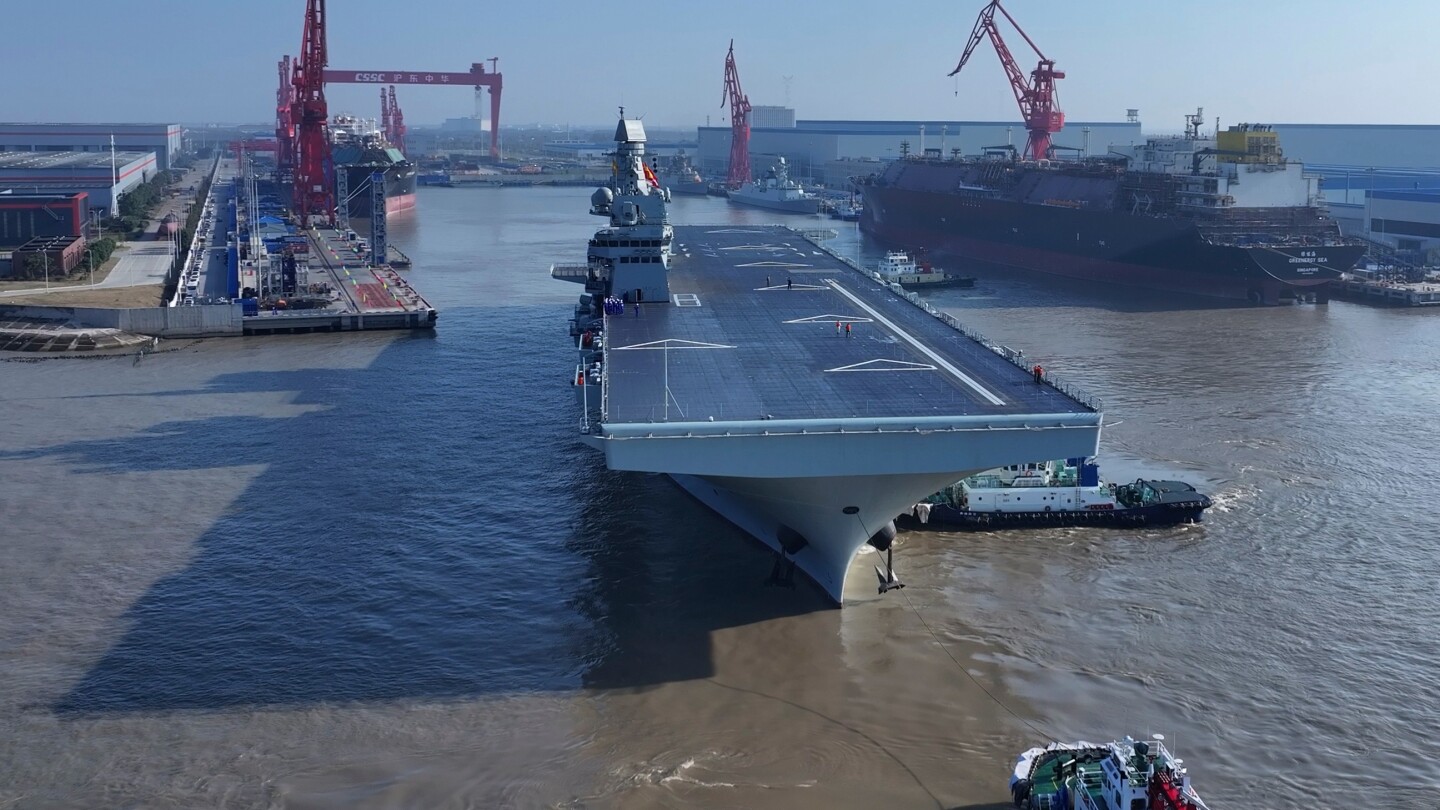
China launched sea trials for its most advanced amphibious assault ship on Friday, marking another significant step in the country’s ambitious naval expansion program. The Sichuan Type 076 vessel departed from Shanghai’s Hudong-Zhonghua Shipyard just one week after China commissioned its latest aircraft carrier, the Fujian.
The Sichuan represents a hybrid naval capability, combining features of both aircraft carriers and traditional amphibious assault ships. With a displacement of approximately 40,000 tons—roughly half the size of the Fujian—the vessel is designed to launch both aircraft and landing craft carrying troops. Both ships were indigenously designed and built, highlighting China’s growing self-sufficiency in advanced naval technology.
Military analysts note that while amphibious assault ships typically offer greater speed and operational flexibility than aircraft carriers, they provide less protection against attacks and can accommodate fewer aircraft with more limited capabilities. However, the Sichuan incorporates advanced features that set it apart from its predecessors.
Most notably, the vessel is equipped with the same electromagnetic catapult system successfully tested on the Fujian carrier. This technology represents a significant advancement over comparable American vessels like the America-class and Wasp-class amphibious assault ships, which lack catapult systems and can only operate helicopters and aircraft capable of short or vertical takeoffs and landings.
According to Chinese state media, this electromagnetic system will enable the Sichuan to launch fixed-wing aircraft in addition to helicopters and vertical takeoff planes. However, military observers remain uncertain whether the ship will be limited to launching drones or if it will be capable of deploying crewed fighter jets. These capabilities will likely become clearer during the later stages of sea trials.
China’s naval modernization program forms a central component of President Xi Jinping’s broader military development strategy. Under Xi’s direction, China has built the world’s largest navy by ship count, though it still trails the United States in key capabilities including aircraft carriers, amphibious assault ships, and other specialized vessels.
Xi has established ambitious targets for China’s military development, aiming for complete modernization by 2035 and the creation of a “world-class” force by mid-century—widely interpreted as one capable of rivaling American military power. This naval expansion comes amid increasing tensions in the Indo-Pacific region, particularly regarding Taiwan.
The Chinese leader has repeatedly stated his intention to reunify Taiwan with mainland China and has not ruled out the use of military force to achieve this goal. Military experts suggest that amphibious assault ships like the Sichuan would play a crucial role in any potential invasion of Taiwan, providing platforms for launching troops, vehicles, and air support.
However, such an operation would face significant challenges. Taiwan has invested heavily in missile defense systems and other deterrents specifically designed to counter such threats. Military analysts believe these defenses could make any amphibious assault extremely costly for Chinese forces.
China has not disclosed the expected duration of the Sichuan’s sea trials. Typically, such trials involve extensive testing of all onboard systems, propulsion capabilities, and operational functions before a vessel is formally commissioned into active service.
The rapid succession of major naval deployments—with the Sichuan trials beginning just days after the Fujian’s commissioning—underscores the accelerating pace of China’s naval development program and its growing emphasis on power projection capabilities in regional waters.
Fact Checker
Verify the accuracy of this article using The Disinformation Commission analysis and real-time sources.

9 Comments
China’s rapid naval expansion is certainly noteworthy. The Sichuan’s electromagnetic catapult system is an impressive technical achievement. It will be fascinating to see how this new amphibious assault ship complements China’s growing fleet of aircraft carriers.
The launch of the Sichuan is another step in China’s efforts to enhance its naval power projection capabilities. As an amphibious assault ship, it could play a significant role in expeditionary operations and force projection. However, the strategic implications of this development will need careful analysis.
The launch of the Sichuan is another milestone in China’s naval modernization. It will be interesting to see how this ship’s capabilities compare to traditional amphibious assault ships used by other countries. Technological advancements like the electromagnetic catapult are certainly noteworthy.
China’s naval expansion is an important story to follow. The Sichuan amphibious assault ship represents a significant addition to their fleet, with its hybrid capabilities. I wonder how this vessel will be utilized and what strategic considerations may be at play.
Interesting development in China’s naval capabilities. The Sichuan amphibious assault ship seems to offer a unique hybrid capability compared to traditional aircraft carriers. I wonder how it will perform in sea trials and what impact it could have on regional dynamics.
The Sichuan amphibious assault ship represents another step in China’s ongoing naval expansion. While the technical capabilities of this vessel are impressive, it’s important to consider the strategic implications and potential impact on regional security dynamics. Careful analysis will be needed to fully understand the significance of this development.
China’s naval ambitions, as seen in the launch of the Sichuan amphibious assault ship, are certainly a topic worth following closely. The hybrid capabilities of this vessel are intriguing, and it will be interesting to see how they are utilized. However, the broader geopolitical context must also be considered when assessing the implications of this development.
While China’s naval ambitions may raise concerns, it’s important to remember that amphibious assault ships like the Sichuan serve important defensive and humanitarian purposes too. Their versatility could make them valuable assets in a range of scenarios.
China’s naval ambitions, as exemplified by the Sichuan, are certainly worthy of close attention. While the technical advancements are impressive, it’s important to consider the broader geopolitical context and potential regional security implications. Balanced and nuanced analysis will be key in understanding the significance of this development.