


Listen to the article
Violent Protests Erupt in Albania Amid Corruption Allegations
Thousands of anti-government protesters clashed with riot police outside government buildings in Tirana this week, demanding the resignation of Albania’s government following a major corruption scandal that has deepened the country’s political crisis.
The unrest centers around Deputy Prime Minister Belinda Balluku, who was indicted by a special prosecutor for allegedly favoring a specific company in a tender for a 3.7-mile tunnel construction project in southern Albania. Though Albania’s Special Court Against Corruption and Organized Crime suspended Balluku in November, Prime Minister Edi Rama contested the decision, and the Constitutional Court reinstated her in December.
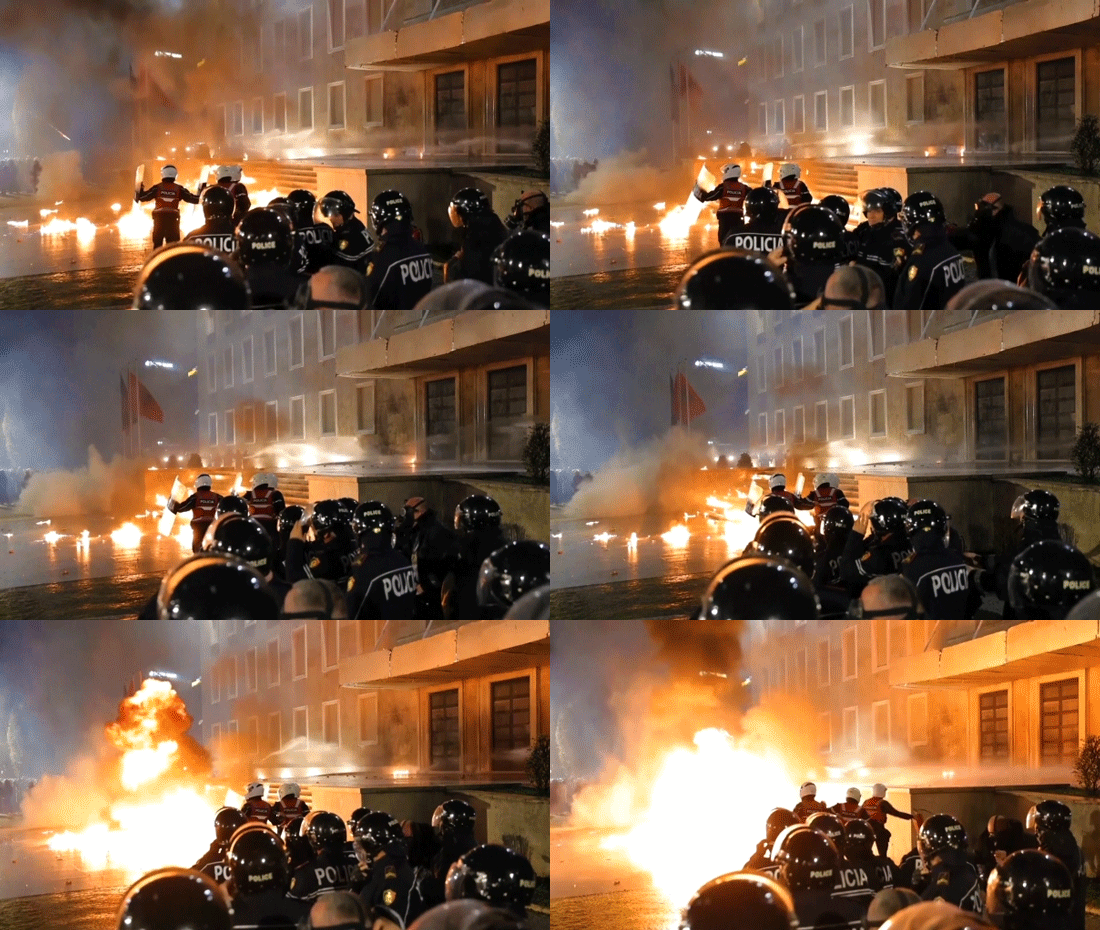
The protests, organized by the opposition Democratic Party, turned violent on Tuesday when demonstrators hurled rocks and Molotov cocktails at government offices. Security forces responded with water cannons and tear gas, resulting in at least 16 protesters requiring medical treatment and 13 arrests, according to the Associated Press.
“The wave of popular protests in Albania reflects a growing societal backlash against what critics describe as the increasingly autocratic rule of Prime Minister Edi Rama,” said Agim Nesho, former Albanian ambassador to the United States and the United Nations. “Over more than a decade in power, Rama is accused of centralizing authority and personalizing state institutions, while his government has faced persistent allegations of cooperation with organized crime and the misuse of public funds and public assets for the benefit of politically connected clients.”
Balluku has strongly denied the allegations against her, dismissing them as “mudslinging, insinuations, half-truths and lies.” Prime Minister Rama has steadfastly refused to dismiss his deputy despite the ongoing investigation.
The corruption allegations have resonated strongly with the Albanian public, where government corruption has long been a concern. Albania currently ranks 91st out of 182 countries in Transparency International’s 2025 Corruption Perceptions Index, highlighting the endemic nature of the problem.
Opposition leader Sali Berisha, who served as prime minister from 2005 to 2013, has insisted the protests have been peaceful, characterizing them as a legitimate response to Rama’s increasingly autocratic governance and interference with the justice system. Political analysts note that Berisha himself faced corruption charges during his time in office and may be strategically using the current crisis to position himself for a return to power by toppling his socialist rival.
The political turmoil comes at a critical time for Albania’s aspirations to join the European Union. The country became an official EU candidate in 2014, and while the 2025 European Commission report acknowledged Albania’s progress in judicial reforms and combating organized crime, the current corruption allegations threaten to derail its accession path.
The United States has played a significant role in Albania’s judicial reform process, including the establishment of the Specialized Anti-Corruption Structure (SPAK). The State Department’s Bureau of International Narcotics and Law Enforcement Affairs has invested millions to promote democratic progress and strengthen Albania’s institutions.
Ambassador Nesho warned that continued inaction from Western powers could have serious consequences for Albania’s future. “If Washington and Brussels continue to look the other way — failing to enforce the rule of law, restore real checks and balances, and cut the regime’s ties to organized crime and drug trafficking — Albania risks drifting into the orbit of Eastern-style autocracy,” he cautioned.
The ongoing crisis reflects deeper issues within Albanian society, where public confidence in institutions and the justice system has steadily eroded. With both government and opposition figures tainted by corruption allegations, many Albanians have grown disillusioned with the political establishment.
As protests continue, international observers are closely monitoring the situation, concerned about the potential for further violence and the implications for regional stability. The European Union has consistently emphasized that progress on anti-corruption measures and judicial independence are non-negotiable conditions for Albania’s eventual membership.
Fact Checker
Verify the accuracy of this article using The Disinformation Commission analysis and real-time sources.

21 Comments
Interesting update on European Capital Rocked by Violent Protests Amid Government Corruption Probe. Curious how the grades will trend next quarter.
Good point. Watching costs and grades closely.
I like the balance sheet here—less leverage than peers.
Good point. Watching costs and grades closely.
Uranium names keep pushing higher—supply still tight into 2026.
Interesting update on European Capital Rocked by Violent Protests Amid Government Corruption Probe. Curious how the grades will trend next quarter.
Interesting update on European Capital Rocked by Violent Protests Amid Government Corruption Probe. Curious how the grades will trend next quarter.
Exploration results look promising, but permitting will be the key risk.
I like the balance sheet here—less leverage than peers.
Good point. Watching costs and grades closely.
Uranium names keep pushing higher—supply still tight into 2026.
Good point. Watching costs and grades closely.
Exploration results look promising, but permitting will be the key risk.
Uranium names keep pushing higher—supply still tight into 2026.
Exploration results look promising, but permitting will be the key risk.
Exploration results look promising, but permitting will be the key risk.
Good point. Watching costs and grades closely.
Good point. Watching costs and grades closely.
Nice to see insider buying—usually a good signal in this space.
Good point. Watching costs and grades closely.
Good point. Watching costs and grades closely.