


Listen to the article
Egypt Intensifies Diplomatic Efforts to Prevent Lebanon-Israel Escalation
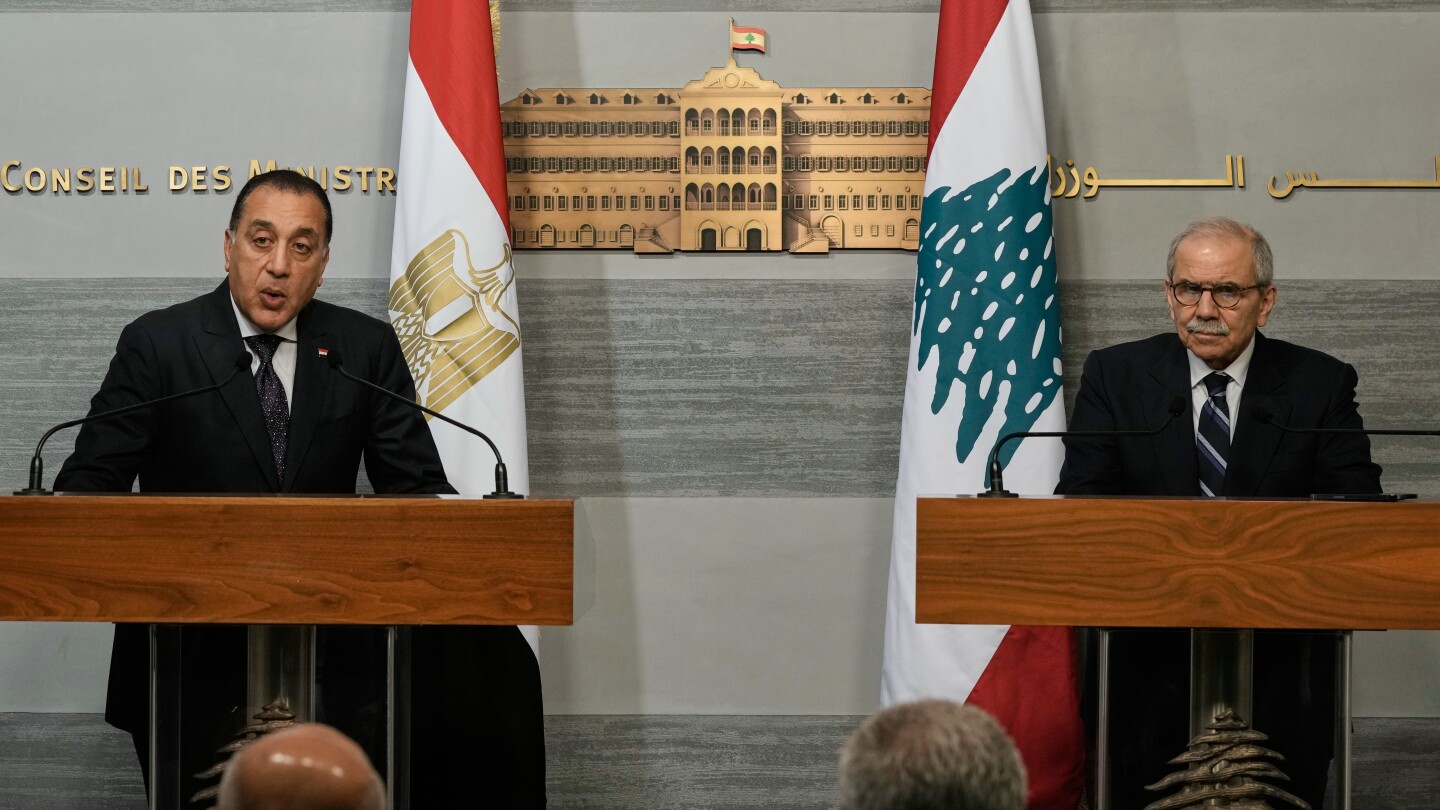
Egyptian Prime Minister Mustafa Madbouly pledged his country’s continued diplomatic efforts to prevent further escalation between Lebanon and Israel during a high-profile visit to Beirut on Friday. The visit comes amid ongoing tensions over the disarmament process of Hezbollah, the militant group that fought a year-long war with Israel.
“Egypt will spare no effort in continuing its tireless endeavors to keep Lebanon away from any escalation,” Madbouly told reporters during a joint press briefing with Lebanese Prime Minister Nawaf Salam.
Egypt, which maintains a peace treaty with Israel dating back to 1979, has emerged as a key mediator in the region. Madbouly’s trip follows similar diplomatic missions to Lebanon by Egypt’s foreign minister and intelligence chief in recent months, underscoring Cairo’s growing role in regional conflict management.
The visit coincided with the second meeting of a monitoring committee overseeing the U.S.-brokered ceasefire that ended hostilities between Israel and Hezbollah last year. This committee, which recently expanded to include civilian representatives from both Lebanon and Israel alongside military participants, met along the Lebanon-Israel border on Friday.
According to a statement from the U.S. Embassy in Beirut, the meeting focused on deepening cooperation and increasing coordination through the established mechanism. Military participants provided operational updates, while civilian representatives discussed creating conditions for displaced residents to return safely to their homes, advancing reconstruction efforts, and addressing economic priorities.
The embassy statement emphasized that all participants agreed on the critical importance of strengthening the Lebanese army as the guarantor of security in the southern border area known as the South Litani Sector. This reinforces the Lebanese government’s stated goal of having the entire border area south of the Litani River cleared of Hezbollah’s armed presence by year’s end.
“Meeting participants reaffirmed that progress on security and political tracks remain mutually reinforcing and essential to ensuring long-term stability and prosperity for both parties,” the embassy noted.
The latest Israel-Hezbollah conflict erupted on October 8, 2023, just a day after Hamas-led militants attacked southern Israel. Hezbollah initially fired rockets into Israel in solidarity with Hamas, prompting a massive Israeli response. The situation escalated dramatically in September 2024, when Israel launched widespread bombardment across Lebanon that severely weakened Hezbollah, followed by a ground invasion.
Despite the official ceasefire, Israel has continued almost daily airstrikes, primarily targeting Hezbollah members. These operations have resulted in 127 civilian casualties, according to the office of the UN High Commissioner for Human Rights, highlighting the fragility of the current arrangement.
Adding to the tensions, the Israeli military released information on Friday about a Hezbollah operative captured from Lebanon last year. The military claimed that Imad Amhaz played a significant role in the group’s secretive maritime force and received specialized training in both Iran and Lebanon for maritime operations.
A Hezbollah official, speaking on condition of anonymity, declined to comment on the video released by Israel, referring to Amhaz only as “a Lebanese citizen who was kidnapped.”
The ongoing tension between Lebanon and Israel underscores the complexity of the disarmament process and the challenges facing regional mediators like Egypt. The success of these diplomatic efforts remains crucial for stability in a region that has seen repeated cycles of violence.
As the Lebanese government works toward asserting its authority over all its territory through its national army, international support from countries like Egypt could prove essential in navigating the delicate balance of power and preventing a return to open hostilities.
Fact Checker
Verify the accuracy of this article using The Disinformation Commission analysis and real-time sources.

14 Comments
It’s encouraging to see Egypt taking such an active role in trying to de-escalate the tensions between Lebanon and Israel. Their experience in regional diplomacy could be invaluable in finding a peaceful resolution to this complex conflict.
Egypt’s position as a regional power with ties to both sides gives them the potential to play a constructive role in this situation. Their diplomatic efforts are much needed.
Interesting to see Egypt taking an active role in mediating the tensions between Lebanon and Israel. As a regional power with ties to both sides, they could play a constructive part in de-escalating the situation and preventing further conflict.
Egypt’s experience in regional diplomacy may prove invaluable in this case. Their involvement could help facilitate dialogue and find a peaceful resolution.
The tensions over Hezbollah’s disarmament are clearly a major concern. Egypt’s diplomatic efforts to keep Lebanon away from escalation with Israel are commendable. Ongoing regional stability should be the priority.
Egypt’s role as a mediator in this situation is crucial. Their peace treaty with Israel gives them unique leverage to try and find a peaceful resolution.
Egypt’s diplomatic efforts to prevent an escalation between Lebanon and Israel are timely and necessary. The Hezbollah disarmament issue is highly sensitive, so having a neutral arbiter like Egypt involved could be crucial.
Egypt’s longstanding peace treaty with Israel gives them a unique perspective and leverage in this situation. Their involvement as a mediator is a welcome development.
It’s good to see Egypt stepping up as a regional peacemaker. Their involvement in the monitoring committee overseeing the ceasefire is a positive sign. Hopefully, they can help broker a lasting solution.
Egypt’s regional influence and diplomatic experience make them well-positioned to facilitate dialogue and prevent further tensions from spiraling out of control.
Egypt’s involvement in this conflict management process is an important development. As a regional power with ties to both sides, their diplomatic initiatives could help defuse tensions and prevent further escalation.
Navigating the complexities of the Lebanon-Israel conflict requires experienced mediation. Egypt’s willingness to play this role is a positive step forward.
The disarmament of Hezbollah is a highly sensitive issue, so Egypt’s efforts to keep Lebanon away from escalation are much needed. Maintaining regional stability should be the priority.
Navigating the delicate balance between Lebanon and Israel will require careful diplomacy. Egypt’s role as a neutral mediator could be crucial in this context.