


Listen to the article
German Church’s “Holy Bodies”: Centuries-Old Skeletons Continue to Captivate Visitors
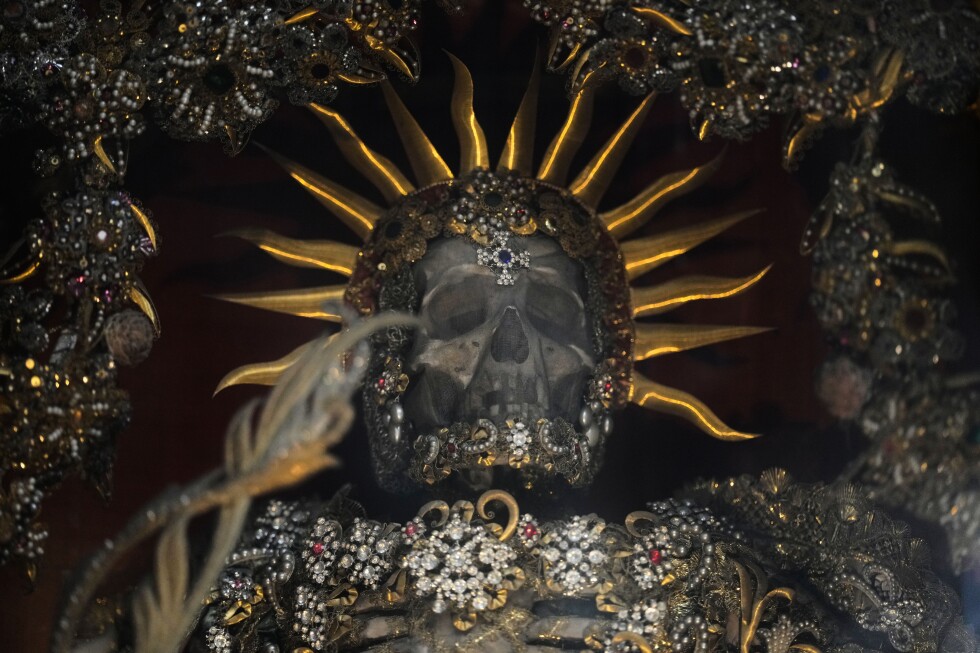
It is a sight that sends shivers down the spines of many visitors: four complete skeletons draped in silk and brocade, adorned with precious stones, filigree gold, silver and lace that have been on display for centuries at the Catholic monastery church of Banz in southern Germany.
The skeletons — known as Vincenzius, Valerius, Benedictus and Felix Benedictus — are the remains of so-called catacomb saints that were brought to the Benedictine monastery near the Bavarian town of Bad Staffelstein from Rome in the late 17th and 18th century.
“It’s actually a little creepy,” whispers church custodian Anita Gottschlich as she looks at one of the skeletons. It seems to be staring right back at her through its hollow eye sockets.
“I notice that when older people come here who visited as children, they always look for the Holy Bodies, because they can still remember them,” she adds, noting the enduring fascination these ornate relics hold for visitors of all ages.
While they may seem unfamiliar or even disturbing to some, catacomb saints — or Holy Bodies — remain a common sight in many Baroque Catholic churches and monasteries across Bavaria. These elaborately decorated skeletons, often presented in glass coffin-like cabinets, can also be found in neighboring Austria, Switzerland, Czechia, and Italy.
Origins in Roman Catacombs
According to legend, these relics are the remains of early Christian martyrs discovered in the 16th century in unmarked graves within Rome’s catacombs.
“At the time, the church simply designated them all as saints,” explains Catholic priest Walter Ries, who oversees several parishes around Bad Staffelstein, including the congregation of 211 members belonging to the monastery church. “And, of course, in many countries, including Germany, people wanted to have such holy remains, such relics, simply because this enhanced the status of their own church or monastery and perhaps turned it into a place of pilgrimage.”
This reverence for relics represents a stark contrast to the monastery’s current state. Founded by Benedictine monks in 1070, the monastery flourished for hundreds of years until its dissolution in 1803. Today, only the church remains active; the monastery building now houses a political foundation.
“A great deal has changed over the course of the centuries,” Ries reflects. “Back then, these relics were very important, but today they really aren’t anymore.”
Comfort Amid Historical Suffering
The veneration of catacomb saints during the late 17th and 18th centuries came at a particularly traumatic time in European history. Vast stretches of the continent, including Bavaria, were still recovering from the devastating Thirty Years’ War, which had begun as a religious conflict between Catholics and Protestants. The war resulted in an estimated 4 to 8 million deaths from battle, famine, and disease.
“That was a terrible time,” Ries explains. “And so people tried to open the gates of heaven through the Baroque. That’s why everything was designed so beautifully. It was an escape from the present, which was often so terrible. That’s also why these eerie skeletons were so beautifully draped and depicted as lifelike as possible.”
The abbots of the Banz monastery sent emissaries to Rome in 1680 and again in 1745, who successfully returned with four skeletons. These were then meticulously decorated by nuns in the nearby town of Bamberg, who adorned them with gold, precious stones, and elaborate textiles to transform the grim remains into objects of spiritual significance and artistic beauty.
Special Occasions Only
To ensure that viewing the Holy Bodies remains a special experience, they are kept hidden from view most of the year behind wooden panels depicting the respective skeletons. Only on special occasions, such as All Saints’ Day, are the covers removed to reveal the actual remains to believers.
Historian Günter Dippold, who has extensively researched the catacomb saints and the Banz monastery, explains that the elaborate decoration “is not meant to show the dead body of a saint, but rather to show his glorified body.”
“It is therefore intended to show the faithful who view it what we will look like after the resurrection, after being raised from the dead, when we no longer have our earthly bodies but rather glorified ones,” Dippold adds.
This distinctive tradition represents an important chapter in Catholic religious art and practice. While contemporary Catholics may not venerate these relics with the same intensity as their ancestors did, the Holy Bodies continue to serve as powerful historical artifacts that bridge the physical and spiritual realms in a uniquely Baroque fashion.
For modern visitors to the monastery church of Banz, these centuries-old skeletons offer a glimpse into a time when the veneration of saints’ remains provided spiritual comfort amidst earthly suffering. Though religious practices have evolved, these ornate relics remain powerful testaments to humanity’s enduring quest to understand and transcend mortality through faith and art.
Fact Checker
Verify the accuracy of this article using The Disinformation Commission analysis and real-time sources.

6 Comments
Fascinating to see how Catholic churches in Bavaria have preserved and displayed these elaborately decorated skeletons for centuries. I wonder what the historical and cultural significance of these ‘catacomb saints’ is to the local community.
These ornate relics do seem a bit unsettling at first, but it’s clear they hold deep meaning and fascination for many visitors, both young and old. The church’s caretaker provides an interesting perspective on their enduring appeal.
The idea of ‘catacomb saints’ is certainly a unique and unexpected aspect of Catholic church traditions in this region. I wonder how the local community has reconciled the macabre nature of these decorated skeletons with their spiritual and artistic value over the centuries.
The caretaker’s observation that even younger visitors are drawn to these ‘Holy Bodies’ suggests an enduring fascination, despite their unsettling appearance. It would be interesting to explore the evolving cultural perspectives on these relics over time.
The article highlights an intriguing juxtaposition – the somber reality of human mortality adorned in opulent, artistic fashion. I’m curious to learn more about the origins and symbolism behind these ‘Holy Bodies’ displayed in Bavarian churches.
It’s fascinating how these centuries-old skeletons continue to captivate visitors, evoking both a sense of unease and historical intrigue. The church’s preservation of these relics speaks to their deep cultural and religious significance.