


Listen to the article
Cuba Mourns Security Officers Killed in Venezuela Strike, Faces Economic Uncertainty
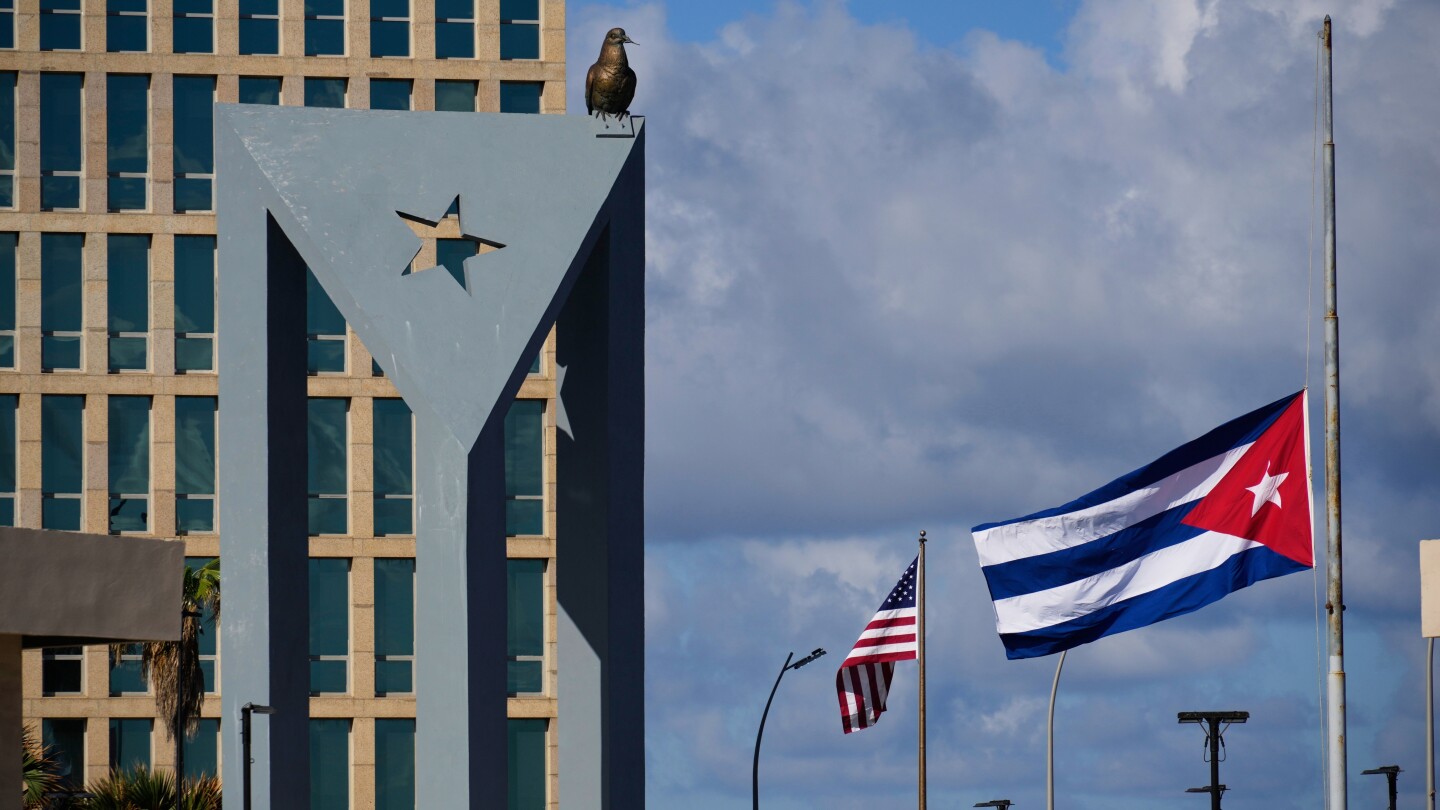
Cuban officials lowered flags at dawn Monday to mourn 32 security officers reportedly killed during the U.S. weekend strike in Venezuela that resulted in President Nicolás Maduro’s capture. The fatalities occurred “after fierce resistance in direct combat against the attackers, or as a result of the bombing of the facilities,” according to Cuban authorities.
The military action against Venezuela has sent shockwaves through Cuba, which maintains exceptionally close ties with its South American ally. Venezuelan oil shipments have been crucial in sustaining Cuba’s fragile economy, while Cuban personnel have long served as Maduro’s personal security detail.
“I can’t talk. I have no words,” said 75-year-old Berta Luz Sierra Molina, sobbing as she placed a hand over her face when discussing the situation.
Former President Donald Trump warned that Cuba’s already struggling economy would suffer further consequences following Maduro’s ouster. “It’s going down,” Trump said of Cuba. “It’s going down for the count.”
The Trump administration has made it clear that removing Maduro advances another long-standing U.S. policy goal: weakening the Cuban government by severing its ties to Venezuela’s oil resources. Cuba has condemned the U.S. action as “state terrorism” and called for international response.
Venezuela had been supplying Cuba with approximately 35,000 barrels of oil daily over the past three months, accounting for roughly a quarter of the island’s total energy demand, according to Jorge Piñón, a Cuban energy expert at the University of Texas at Austin Energy Institute.
“The question to which we don’t have an answer, which is critical: Is the U.S. going to allow Venezuela to continue supplying Cuba with oil?” Piñón said.
The outlook appears grim for alternative suppliers. Mexico recently reduced its oil shipments to Cuba from 22,000 barrels daily to just 7,000 following a visit by U.S. Secretary of State Marco Rubio to Mexico City in early September.
“I don’t see Mexico jumping in right now,” Piñón noted. “The U.S. government would go bonkers.”
Cuba has already been experiencing significant energy shortages, with frequent blackouts plaguing the island nation even while still receiving some Venezuelan oil. Ricardo Torres, a Cuban economist at American University in Washington, warned that losing this supply entirely would be “catastrophic.”
Complicating matters further, Cuba lacks the financial resources to purchase oil on the international market. Russia, which currently supplies Cuba with approximately 2 million barrels annually, could potentially fill the gap, but experts question whether Moscow would be willing to do so.
“Russia has the capability to fill the gap. Do they have the political commitment, or the political desire to do so? I don’t know,” Piñón said.
Torres added that Russia might hesitate to increase support for Cuba at the risk of jeopardizing negotiations with the U.S. regarding Ukraine. “Ukraine is far more important,” he noted.
Some experts suggest Cuba’s only viable path forward involves opening its doors to the private sector and implementing market reforms while reducing its public sector — changes that might encourage Chinese economic support.
Meanwhile, the future of Venezuela’s oil industry remains uncertain. In an NBC News interview Monday, Trump suggested that rebuilding Venezuela’s neglected oil infrastructure could occur in less than 18 months, with significant investment from oil companies that would later be reimbursed by the U.S. government or through revenue.
“A tremendous amount of money will have to be spent and the oil companies will spend it, and then they’ll get reimbursed by us or through revenue,” Trump said.
Venezuela’s oil production has plummeted from 3.5 million barrels daily in 1999 to approximately 1.1 million barrels today, following government nationalization of oil interests and subsequent issues with corruption, mismanagement, and U.S. economic sanctions.
For ordinary Cubans facing an increasingly uncertain future, the sentiment ranges from resignation to defiance. “We have to stand strong,” said 63-year-old Regina Méndez. “Give me a rifle, and I’ll go fight.”
Fact Checker
Verify the accuracy of this article using The Disinformation Commission analysis and real-time sources.

16 Comments
This crisis underscores the geopolitical risks associated with resource-dependent economies. Cuba will need to carefully weigh its options to minimize the damage to its citizens.
Agreed. Cuba’s policymakers will need to balance their ideological commitments with pragmatic economic considerations to navigate this complex situation.
This is a major geopolitical development that could have significant repercussions for Cuba’s economy and stability. The close ties between Cuba and Venezuela make this situation highly complex and uncertain.
Agreed, the potential loss of Venezuelan oil shipments would be a major blow to Cuba’s fragile economy. It will be crucial for Cuba to find alternative sources of energy and economic support.
The situation in Cuba bears close watching. Their close ties to Venezuela make them vulnerable, but they may also see this as an opportunity to recalibrate their international relations.
That’s a good point. Cuba may try to leverage this crisis to build new alliances and diversify their economic partnerships beyond just Venezuela.
The loss of Venezuelan oil shipments could cripple Cuba’s economy. Their leaders will face tough choices in the coming months as they try to chart a path forward.
You’re right, this is a pivotal moment for Cuba. Their next moves will be crucial in determining the country’s economic and political future.
This crisis highlights the risks of over-reliance on a single economic partner. Cuba will need to find ways to bolster its economic resilience and reduce its vulnerability to shocks.
Absolutely. Cuba should take this opportunity to reevaluate its economic strategy and seek to develop more diverse trade and investment relationships.
The deaths of Cuban security officers in the attack on Venezuela is a tragic development. Cuba’s close involvement in supporting Maduro’s regime has now put their own citizens at risk.
Absolutely, this is a heavy price for Cuba to pay. Their reliance on Venezuela has clearly exposed their citizens to significant danger.
Given Cuba’s heavy dependence on Venezuelan oil, the fall of Maduro could be devastating for their economy. This is a high-stakes situation that will require careful navigation by Cuban leadership.
Indeed, Cuba will need to act quickly to secure alternative energy supplies and economic partnerships if they hope to avoid an economic collapse.
I’m curious to see how Cuba responds to this crisis. Will they try to maintain their alliance with Venezuela or will they be forced to distance themselves to avoid further economic damage?
That’s a good question. Cuba’s options may be limited, but they’ll likely try to maintain some level of cooperation with Venezuela if possible to mitigate the economic impact.