


Listen to the article
Independent Researcher Claims Roman Bust is Michelangelo’s Work, Experts Skeptical
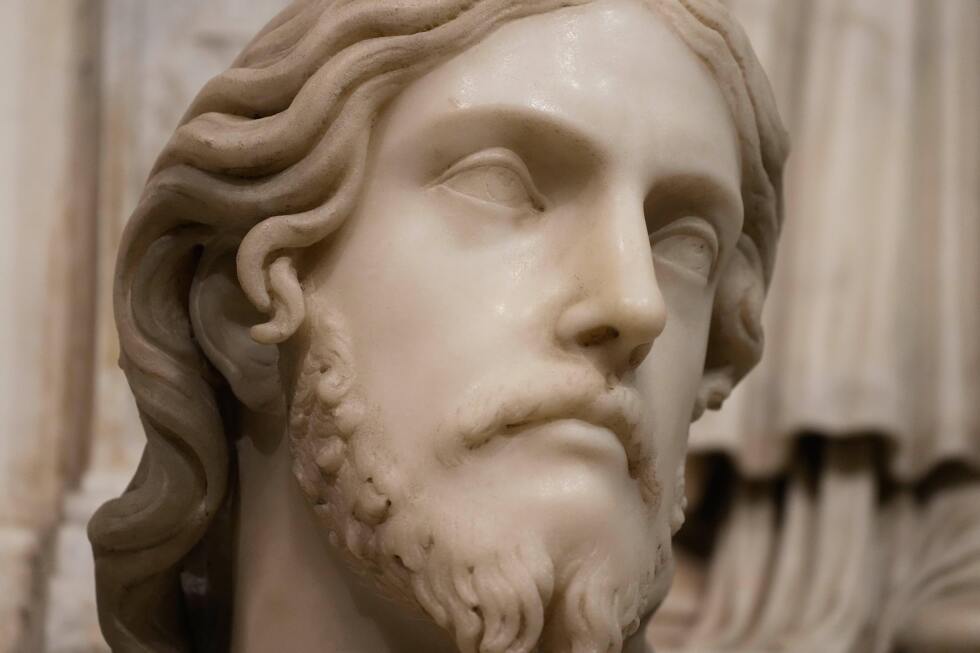
An independent researcher has stirred controversy in the art world by claiming that a marble bust of Christ in a Roman church is the work of Michelangelo, the renowned Renaissance master. Valentina Salerno announced her findings at a press conference on Wednesday, unsettling Renaissance scholars who remain skeptical of her claims.
The attribution comes at a particularly sensitive time, as a recently attributed Michelangelo sketch of a foot – itself disputed by some experts as merely a copy – sold for $27.2 million at Christie’s auction. With such astronomical prices at stake, many leading experts have declined to comment on Salerno’s theory.
Salerno published her research on academia.edu, a non-peer-reviewed social networking site for academics, rather than through traditional scholarly channels. Her timing coincides with heightened public interest in Michelangelo, as Friday marks the 550th anniversary of his birth, prompting numerous exhibitions and commemorations celebrating his artistic legacy.
While Italy’s Culture Ministry was invited to Salerno’s press conference, it did not attend. The Carabinieri art squad has refrained from commenting on the statue’s authenticity but noted it is being protected, with a sign reading “Alarm armed” now displayed beside the sculpture.
“We hope that this asset, which belongs to our cultural heritage regardless of whether it can be attributed to Michelangelo Buonarroti or not, is part of the national heritage that we are responsible for defending,” said Lt. Col. Paolo Salvatori of the Carabinieri.
The bust in question resides in the Basilica of Sant’Agnese Fuori le Mura and is currently listed by Italy’s Culture Ministry as an anonymous work from the 16th-century Roman school. Salerno is not the first to suggest a Michelangelo connection – in 1996, Michelangelo expert William Wallace noted in ArtNews that the 19th-century French author Stendhal had once declared the bust to be Michelangelo’s work, though Wallace dismissed this attribution.
Salerno claims to have discovered documentary evidence that correctly attributes the work to Michelangelo, arguing that a 1984 scholarly assessment erroneously rejected this connection. “I have provided and will continue to provide a whole series of documentary evidence on this,” she stated, suggesting the bust was modeled on Michelangelo’s close friend, Tomaso De’ Cavalieriis.
What makes Salerno’s background unusual is her lack of formal credentials in art history – she is an actress and fiction author who began researching Michelangelo ten years ago while writing a novel. Her published research claims to have uncovered evidence of a secret “pact of indissolubility” among Michelangelo’s students to preserve his works after death, including a chamber accessible only with three keys held by different students.
Her work attracted attention from Cardinal Mauro Gambetti, who runs St. Peter’s Basilica. He appointed Salerno to a scientific committee formed in 2025 to discuss a potential Vatican exhibition commemorating Michelangelo’s birth anniversary. The committee includes renowned experts like Barbara Jatta, director of the Vatican Museums, and Hugo Chapman of the British Museum, many of whom have distanced themselves from Salerno’s claims.
William Wallace, a committee member and professor at Washington University in St. Louis, acknowledged that Salerno’s methodology has merit and that non-credentialed researchers in Europe often produce solid work. He agreed with her assertion that Michelangelo entrusted his remaining works to students rather than destroying them – a commonly held misconception. However, Wallace disputes Salerno’s conclusion that a treasure trove of undiscovered Michelangelo works exists, noting that the artist was primarily focused on architectural projects in his final years.
Italy has a long history of claimed “new discoveries” about famous artists, with Wallace estimating that approximately 45 attributions to Michelangelo have been made since 2000, none of which have stood the test of time. “Every single one arrived with the headline, ‘The greatest discovery of the time,’ or ‘It will change everything we think about Michelangelo,'” Wallace noted. “And then five years later, we can’t even remember what it was.”
For now, the marble Christ in Sant’Agnese remains under heightened security as the debate over its creator continues, highlighting the enduring fascination with one of history’s greatest artists and the high stakes involved in attributing works to his hand.
Fact Checker
Verify the accuracy of this article using The Disinformation Commission analysis and real-time sources.

10 Comments
The astronomical prices fetched by confirmed Michelangelo works certainly raise the stakes and incentives around questionable attributions. I can understand the hesitancy of experts to lend credibility to this claim without rigorous vetting. Hopefully the research can stand up to intense scrutiny.
The timing of this announcement, coinciding with Michelangelo’s 550th birthday celebrations, does raise some eyebrows. While exciting, the scholarly community will need time to thoroughly examine the evidence before any definitive conclusions can be drawn.
Fascinating discovery, though I can understand the skepticism from Renaissance scholars. Authenticating lost Michelangelo works is notoriously tricky, with many attributions being disputed over the years. I’m curious to see what further research uncovers on this bust’s origins.
This is a bold and intriguing claim, but one that will require extensive scholarly review before it can be considered credible. The art world has seen many disputed Michelangelo attributions over the years, so the skepticism from Renaissance experts is understandable. I look forward to seeing how this case develops.
It’s wonderful to see continued interest and excitement around Michelangelo’s work, even 550 years after his birth. While this particular attribution may or may not pan out, it highlights the ongoing fascination with uncovering ‘lost’ masterpieces from the Renaissance. The art world will be watching closely.
This is a high-stakes claim that would shake up the art world if proven true. Given the astronomical prices Michelangelo’s works command, I can understand why experts may be hesitant to weigh in without more rigorous vetting. Hopefully the research can withstand scrutiny.
Agree, the financial incentives make it critical that any attribution is backed by strong, verifiable evidence. Rushing to judgement could lead to costly mistakes.
I’m always fascinated by discoveries that challenge accepted art historical narratives. Even if this particular attribution doesn’t hold up, it speaks to the ongoing mysteries and debates that continue to swirl around Michelangelo’s prodigious output. The search for ‘lost’ masterpieces is endlessly compelling.
This seems like a bold claim that, if validated, could be a major coup for the independent researcher. However, the skepticism from established Renaissance experts is understandable given the high stakes and the non-traditional publishing route. Rigorous peer review will be crucial.
Absolutely. Extraordinary claims require extraordinary evidence, especially when dealing with an artist as renowned as Michelangelo. The research will need to withstand intense scrutiny from the scholarly community.