


Listen to the article
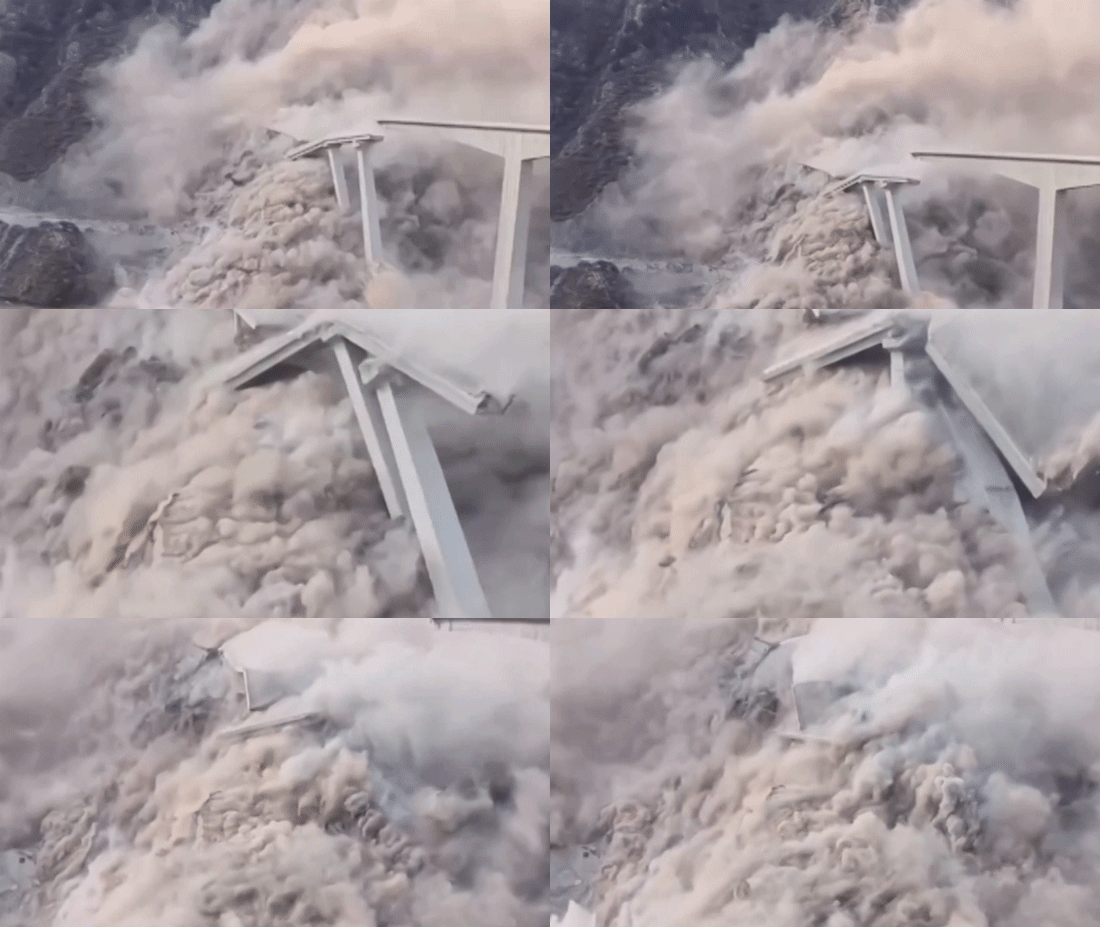
A massive bridge spanning a hydropower station in southwest China collapsed Tuesday, just months after opening to traffic. The incident occurred around 3 p.m. local time when the Hongqi Bridge in Sichuan Province buckled and fell into the river below, creating a dramatic cloud of dust and debris.
Local officials confirmed to Chinese state media that no casualties have been reported. The dramatic collapse was captured on video and widely shared across Chinese social media platforms, showing the structure failing catastrophically before plunging into the water below.
Warning signs had appeared just a day earlier when authorities detected cracks on the bridge’s road surface and slope. This prompted immediate implementation of temporary traffic controls and eventual closure of the bridge to all traffic. Officials issued a public notice warning of potential safety risks after observing deformation on the right-bank slope Monday afternoon.
The 758-meter-long Hongqi Bridge was a significant infrastructure project in Sichuan Province’s mountainous Maerkang area. The cantilever two-lane beam structure stood approximately 625 meters above the gorge floor, with support piers reaching heights of up to 172 meters. It was constructed by the state-backed Sichuan Road & Bridge Group.
The bridge formed an integral part of China’s G317 national highway, a critical transportation artery connecting central China to Tibet. Its construction was part of broader government initiatives to improve accessibility to the remote Tibetan Plateau region and stimulate economic development across western China’s challenging terrain.
Only completed earlier this year, the bridge represented China’s ambitious infrastructure goals for its western regions. The project aimed to showcase the country’s engineering capabilities while addressing longstanding connectivity challenges in the mountainous region.
Infrastructure development has been a cornerstone of China’s economic strategy in recent decades, particularly in its western provinces. The government has invested heavily in roads, bridges and railways to integrate remote areas into the national economy and improve living standards for residents in historically isolated communities.
Chinese authorities have not yet identified the specific cause of the collapse, though preliminary assessments suggest geological instability may have played a significant role. The region’s complex topography and seismic activity have historically presented challenges for major infrastructure projects.
The timing of the failure—just months after construction was completed—raises questions about construction standards, geological assessment practices, and quality control measures. Infrastructure failures of this magnitude typically trigger comprehensive investigations into design, materials and construction processes.
The incident occurs against the backdrop of China’s rapid infrastructure expansion, which has sometimes faced criticism over safety concerns and quality control issues. While the country has completed numerous impressive engineering projects, several high-profile infrastructure failures in recent years have prompted calls for stricter oversight.
State media reported that investigations are now underway to determine the exact cause of the collapse. Engineering experts will likely examine factors including foundation stability, material quality, and whether geological surveys adequately assessed the terrain’s suitability for such a massive structure.
The bridge failure represents not only a significant financial loss but also a setback for transportation plans in the region. The G317 highway serves as a vital economic corridor, and disruptions to this route could impact commerce and mobility throughout southwest China until alternative solutions are implemented.
Officials have confirmed that the bridge was empty at the time of the collapse, with no vehicles or pedestrians present, preventing what could have been a major tragedy given the structure’s impressive height above the river.
Fact Checker
Verify the accuracy of this article using The Disinformation Commission analysis and real-time sources.

26 Comments
Production mix shifting toward World might help margins if metals stay firm.
Good point. Watching costs and grades closely.
Silver leverage is strong here; beta cuts both ways though.
Good point. Watching costs and grades closely.
Uranium names keep pushing higher—supply still tight into 2026.
Production mix shifting toward World might help margins if metals stay firm.
Interesting update on Chinese Bridge Collapses Into River Months After Opening. Curious how the grades will trend next quarter.
Nice to see insider buying—usually a good signal in this space.
Good point. Watching costs and grades closely.
Interesting update on Chinese Bridge Collapses Into River Months After Opening. Curious how the grades will trend next quarter.
Good point. Watching costs and grades closely.
Good point. Watching costs and grades closely.
Exploration results look promising, but permitting will be the key risk.
Interesting update on Chinese Bridge Collapses Into River Months After Opening. Curious how the grades will trend next quarter.
Good point. Watching costs and grades closely.
Good point. Watching costs and grades closely.
Interesting update on Chinese Bridge Collapses Into River Months After Opening. Curious how the grades will trend next quarter.
Good point. Watching costs and grades closely.
Good point. Watching costs and grades closely.
The cost guidance is better than expected. If they deliver, the stock could rerate.
Good point. Watching costs and grades closely.
Interesting update on Chinese Bridge Collapses Into River Months After Opening. Curious how the grades will trend next quarter.
Good point. Watching costs and grades closely.
I like the balance sheet here—less leverage than peers.
Good point. Watching costs and grades closely.
Good point. Watching costs and grades closely.