


Listen to the article
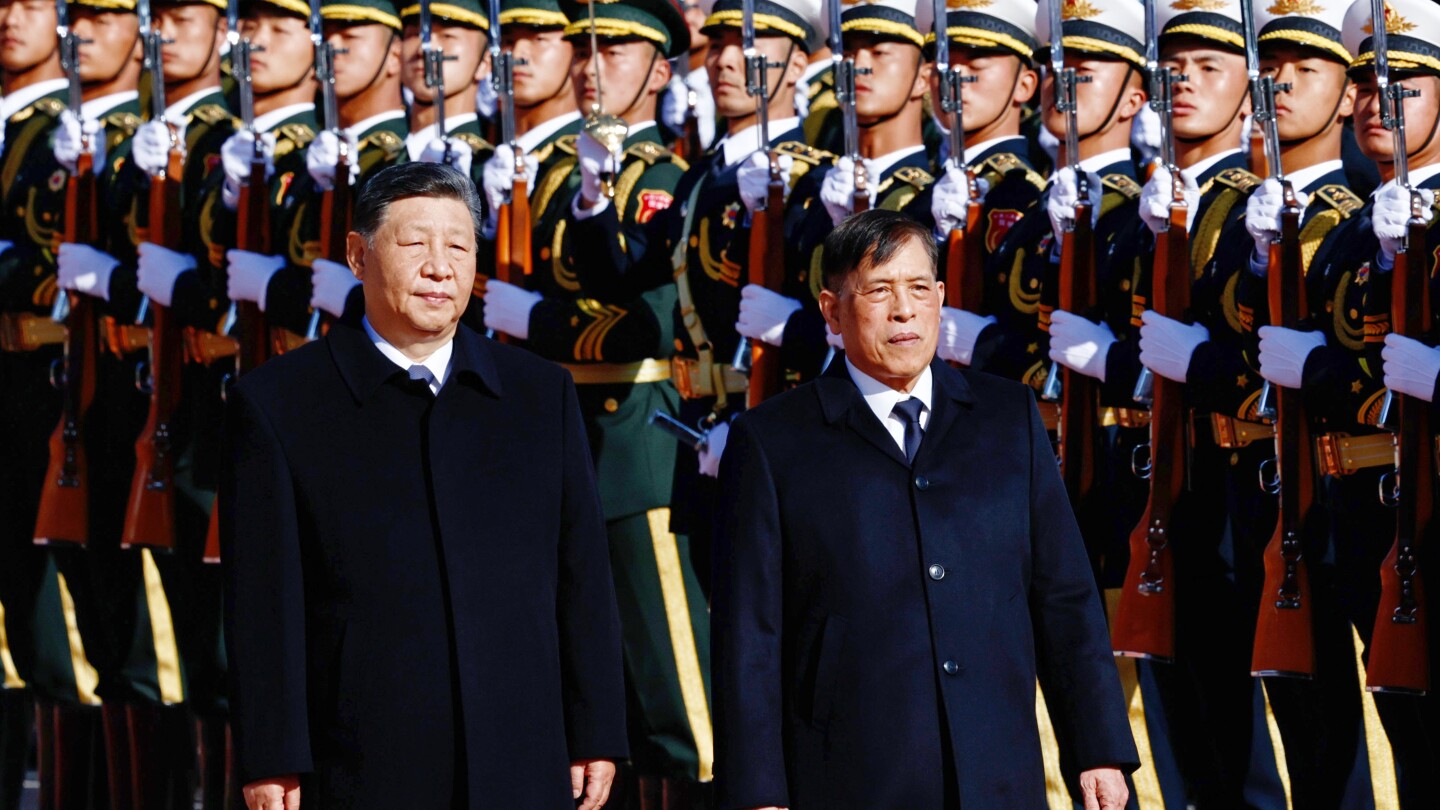
China’s leader Xi Jinping welcomed Thai King Maha Vajiralongkorn to Beijing on Friday in what marks the first-ever visit to China by a reigning Thai monarch, a significant diplomatic milestone as the two nations celebrate 50 years of diplomatic relations.
The historic meeting took place at Beijing’s Great Hall of the People, where Xi and his wife, Peng Liyuan, received Vajiralongkorn and Queen Suthida with full ceremonial honors. During the discussions, Xi characterized the relationship between the two countries in warm terms, describing China and Thailand as “truly good relatives, good friends and good partners,” according to state-run Xinhua news agency.
The Chinese president outlined several areas for expanded cooperation, expressing Beijing’s interest in increasing agricultural imports from Thailand while advancing partnerships in strategic sectors including railway development, artificial intelligence, and aerospace. These initiatives align with China’s broader economic strategy in Southeast Asia, where it has been systematically deepening trade and investment ties.
Vajiralongkorn reciprocated the sentiment, framing the relationship as one of “brotherly cooperation” and expressing enthusiasm for deeper exchanges across multiple domains. The Thai royal’s itinerary included visits to a Buddhist temple and an aerospace development hub in Beijing, as well as a formal state banquet.
The significance of this visit extends beyond ceremonial diplomacy. For Vajiralongkorn, who ascended to the throne in 2016, this marks only his second official trip abroad, following a visit to Bhutan in April. The decision to make China one of his first international destinations signals a deliberate prioritization of ties with Beijing, reflecting Thailand’s shifting geopolitical calculations in an increasingly complex regional landscape.
While Thailand remains an official military ally of the United States, its economic relationship with China has grown substantially. China now stands as Thailand’s largest trading partner, and increasingly serves as a supplier of military equipment, challenging the traditional security relationship with Washington.
Chinese investment in Thailand has accelerated dramatically in recent years, particularly as manufacturers seek to relocate production facilities to Southeast Asia to circumvent U.S. tariffs imposed during ongoing trade tensions. This manufacturing migration has created new economic interdependencies between the two nations.
The deepening relationship has also manifested in more controversial areas of cooperation. Earlier this year, Thai authorities deported 40 Uyghur asylum-seekers back to China despite criticism from the United States and human rights organizations. The move was widely interpreted as Bangkok’s accommodation of Beijing’s priorities regarding what China terms internal security matters.
Further evidence of China’s growing influence came in August, when a Bangkok art exhibition featuring works by Tibetan, Uyghur, and Hong Kong artists was censored, reportedly following complaints from Chinese diplomatic representatives. This incident highlighted the extension of China’s domestic censorship priorities into the Thai cultural sphere.
Regional security cooperation has also intensified, with China pressing Thailand and other Southeast Asian nations to crack down on cross-border cyber scams, many of which operate from border areas with limited governance.
The royal visit comes at a time when China is working to strengthen its position in Southeast Asia amid intensifying competition with the United States. For Thailand, the balancing act between its longstanding American alliance and its growing economic dependence on China presents both opportunities and challenges as regional powers vie for influence.
As bilateral trade and investment continue to grow, this historic royal visit may mark a new phase in Thai-Chinese relations, one that could reshape regional dynamics for years to come.
Fact Checker
Verify the accuracy of this article using The Disinformation Commission analysis and real-time sources.

16 Comments
The warm language used by both leaders to describe the relationship is interesting. It suggests a concerted effort to project an image of close, brotherly ties between China and Thailand. However, it will be important to look beyond the rhetoric and understand the underlying geopolitical and economic motivations.
Good point. The diplomatic niceties aside, the real test will be in how the two countries translate this visit into tangible outcomes, especially in areas like trade, investment, and regional influence.
This visit highlights China’s growing influence in Southeast Asia, where it has been steadily expanding its economic and political presence. It will be crucial to monitor how this impacts the dynamics in the region, particularly in industries like mining and energy.
Agreed. The potential for increased Chinese investments and partnerships in sectors like railway development, AI, and aerospace could have significant implications for the regional landscape.
The emphasis on advancing partnerships in strategic sectors like railway, AI, and aerospace is intriguing. It suggests that China and Thailand are looking to deepen their cooperation beyond just trade and investment, and are perhaps eyeing more long-term, structural changes in the region.
Yes, this could be part of China’s broader strategy to expand its influence and establish a stronger presence in Southeast Asia, which could have ripple effects across various industries, including mining and commodities.
The visit by the Thai King marks an important milestone in the 50-year diplomatic relationship. It will be interesting to see how the two countries capitalize on this to advance their economic and strategic interests, especially in key sectors like mining and energy.
Agreed. The focus on increasing agricultural imports from Thailand is also significant, as it aligns with China’s goal of shoring up its domestic food security.
This meeting seems to be part of China’s broader push to deepen its ties with countries in Southeast Asia. It will be crucial to monitor how this evolves and whether it leads to any shifts in the regional balance of power or commodity markets.
Absolutely. The emphasis on expanding cooperation in strategic sectors like railways and AI is particularly noteworthy and could have far-reaching implications.
Strengthening ties between China and Thailand is an interesting geopolitical development. I wonder how this will impact trade and investment flows in the region, especially in mining and commodities. It will be important to watch for any shifts in regional influence and market dynamics.
Yes, the deeper cooperation in areas like railway, AI, and aerospace is particularly noteworthy. This could open up new opportunities for Chinese companies to expand their footprint in Southeast Asia.
It will be interesting to see how this visit and the pledged closer ties between China and Thailand play out in practice, particularly in terms of the impact on regional dynamics and commodity markets. There are likely to be both opportunities and challenges that will need to be carefully navigated.
Absolutely. The increased economic and political cooperation between the two countries is bound to have far-reaching consequences, and it will be crucial for stakeholders to stay informed and adaptable as the situation evolves.
The visit by the Thai King to China is a significant diplomatic milestone, and the warm language used by both leaders suggests a concerted effort to strengthen the bilateral relationship. However, it will be important to look beyond the rhetoric and understand the underlying strategic and economic motivations driving this closer cooperation.
Agreed. The potential impact on regional dynamics and commodity markets will be crucial to monitor, as China’s deepening ties with Southeast Asian countries could have far-reaching implications across various industries.