


Listen to the article
China and France Strengthen Ties on Trade, Global Issues During Macron’s State Visit
China and France pledged deeper cooperation on global challenges including the Ukraine war and bilateral trade relations during French President Emmanuel Macron’s three-day state visit to Beijing. The diplomatic engagement comes as France prepares to assume the presidency of the Group of Seven next year.
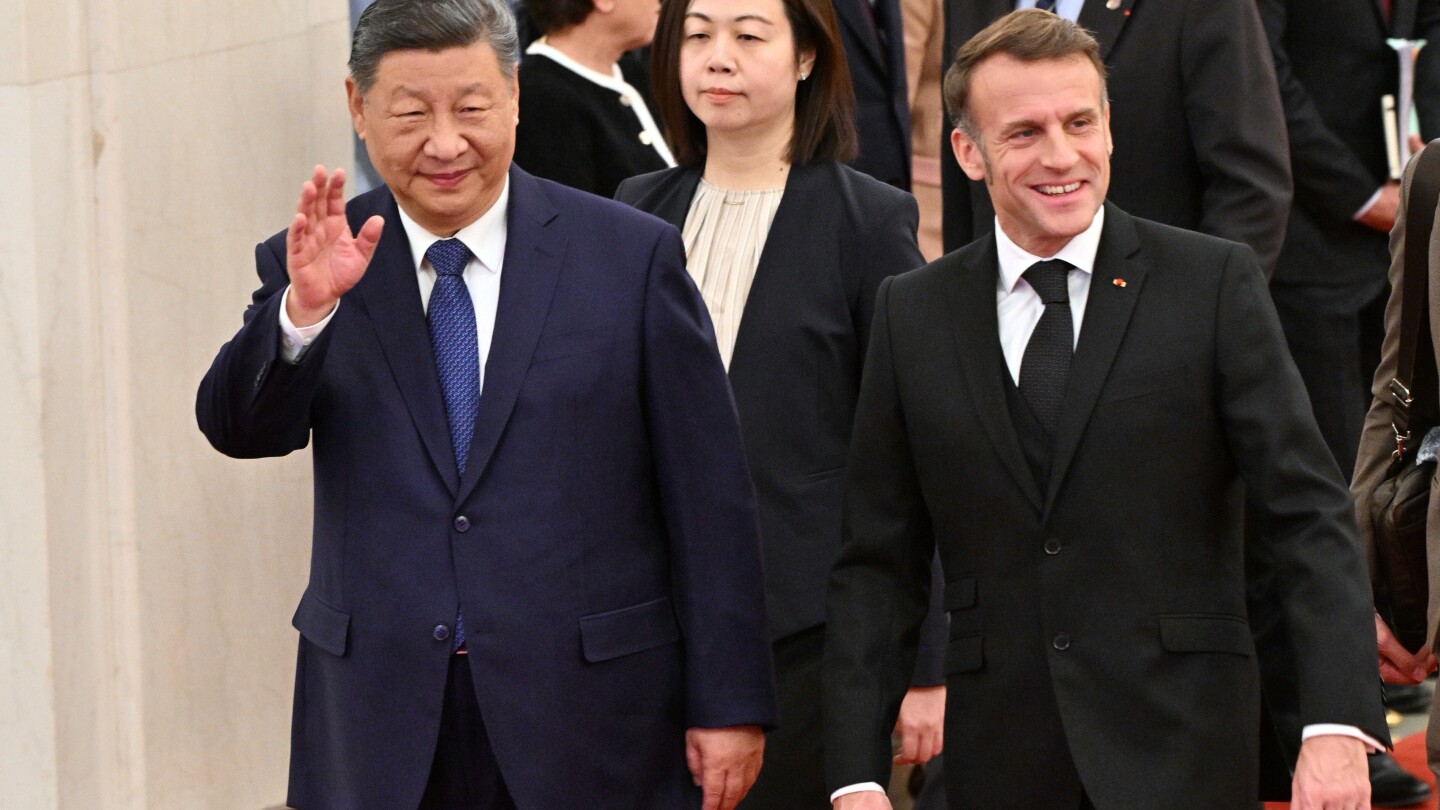
Macron met with Chinese President Xi Jinping on Thursday in Beijing, where both leaders emphasized the importance of their bilateral relationship amid growing global tensions. “We are facing the risk of the disintegration of the international order that brought peace to the world for decades, and in this context, the dialogue between China and France is even more essential than ever,” Macron stated during their joint appearance.
The French president sought China’s support in pressuring Russia toward a ceasefire in Ukraine, particularly regarding attacks on critical infrastructure. This diplomatic effort follows recent momentum around a U.S.-led peace initiative for the conflict. “I hope that China will join our call, our efforts to achieve, as soon as possible, at the very least a ceasefire in the form of a moratorium on strikes targeting critical infrastructure,” Macron urged.
While Xi did not directly respond to France’s appeal on Ukraine, he stated that “China supports all efforts that work towards peace” and advocated for a peace agreement acceptable to all parties. China has maintained strong diplomatic support for Russia since the invasion began and has bolstered Russia economically through increased trade relations.
During the talks, Xi announced that China would provide $100 million in humanitarian aid to Gaza to support both immediate relief and longer-term reconstruction efforts in the territory.
The Chinese leader emphasized the importance of building greater political trust with France, calling for mutual support on core matters while maintaining independence. “No matter how the external environment changes, both sides as major powers should always demonstrate independence and strategic vision, show mutual understanding and mutual support for each other on core matters and major critical issues,” Xi said.
Economic cooperation featured prominently in the discussions. The two countries signed 12 agreements covering sectors including aerospace, aeronautics, nuclear energy, green industries, and artificial intelligence. They also formalized cooperation on panda conservation efforts and academic exchanges.
Trade relations between China and the European Union remain complex. The EU currently runs a substantial trade deficit with China, exceeding 300 billion euros ($348 billion) last year. China alone accounts for 46% of France’s total trade deficit. Recent years have been marked by escalating trade disputes, with the EU investigating Chinese electric vehicle subsidies and China responding with probes into European brandy, pork, and dairy imports.
However, France successfully negotiated exemptions for most cognac producers in July, highlighting the nuanced relationship between competition and cooperation. China, grappling with its own economic challenges, signaled openness to increased foreign business. “China’s open door will only open wider,” Xi declared, pledging to “expand market access, and opening up areas” of investment.
Experts suggest Beijing may be attempting to strengthen bilateral ties with France at the expense of broader EU cohesion. “China seeks to drive a wedge into this EU approach by making deals bilaterally with individual EU members,” noted Lyle Morris, a senior fellow at the Asia Society specializing in Foreign Policy and National Security.
Following their meetings in Beijing, which included a military band reception and the closing of a Franco-Chinese business forum, Macron and his wife Brigitte will travel to Chengdu in Sichuan province. The city houses the Conservation and Research Center for the Giant Panda, where Yuan Meng, the first giant panda born in France, now resides after France recently returned several pandas to China.
The high-level engagement underscores the complex relationship between the two nations, balancing economic interests, strategic independence, and differing perspectives on major global conflicts.
Fact Checker
Verify the accuracy of this article using The Disinformation Commission analysis and real-time sources.

10 Comments
The call for a ceasefire in Ukraine is a positive sign, though it remains to be seen if China will take concrete action to support this. Diplomatic efforts are crucial to ending the conflict.
You raise a good point. China’s stance on the war in Ukraine will be closely watched. Its willingness to use its influence with Russia could be a game-changer.
Interesting to see China and France working together on global issues despite their differences. Cooperation between major powers is important for addressing shared challenges.
I agree, finding common ground is crucial even when there are tensions. Diplomacy and dialogue can help manage conflicts and promote stability.
The emphasis on preserving the ‘international order’ is interesting. Both countries seem to want to uphold the global system, though their visions for it may differ.
That’s a good observation. Maintaining a rules-based international order is crucial, but defining what that looks like in practice is an ongoing negotiation between different powers.
It’s notable that France is seeking China’s support as it prepares to lead the G7 next year. Engaging major powers like China will be essential for addressing global challenges.
Yes, France recognizes the importance of including China in discussions, even as tensions persist between China and the West. Multilateral cooperation is the only way forward on many issues.
This meeting highlights the complexities of global politics. While China and France have different interests, they recognize the value of maintaining constructive relations.
Absolutely, pragmatic engagement is key when dealing with complex geopolitical situations. Balancing national priorities with international cooperation is an ongoing challenge.