


Listen to the article
Cambodia and China held their inaugural “2+2” Strategic Dialogue Mechanism meeting in Phnom Penh on Wednesday, bringing together the foreign and defense ministers from both nations to strengthen political and security cooperation.
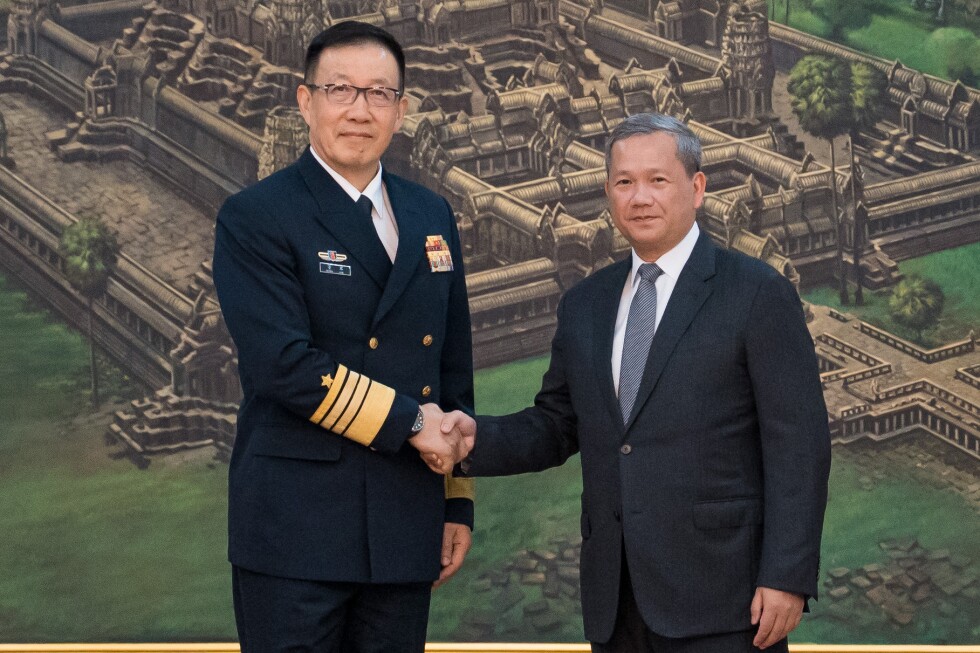
Chinese Foreign Minister Wang Yi and Defense Minister Dong Jun traveled to Cambodia for discussions with their counterparts, Cambodian Foreign Minister Prak Sokhonn and Defense Minister Tea Seiha. This high-level dialogue format represents a significant step in formalizing security cooperation between the two Asian nations.
The dialogue mechanism stems from an initiative proposed by Chinese President Xi Jinping during his state visit to Cambodia in April 2023. The format reflects China’s growing diplomatic efforts in Southeast Asia, where Beijing has been systematically expanding its influence. China established a similar ministerial-level “2+2” dialogue with Indonesia last year, indicating a pattern in its regional diplomatic strategy.
According to the Chinese Foreign Ministry, Wang’s regional tour will continue with visits to Thailand and Myanmar following his engagements in Cambodia, highlighting China’s continued focus on strengthening ties across Southeast Asia.
The Chinese delegation’s itinerary in Cambodia extends beyond the formal dialogue sessions. Both ministers are scheduled to meet separately with Cambodia’s Senate President Hun Sen, the long-serving former prime minister who continues to wield significant power, and his son, current Prime Minister Hun Manet. On Thursday, Wang Yi will engage in more detailed discussions with Foreign Minister Prak Sokhonn, focusing on implementing existing cooperation frameworks and addressing regional security issues.
Cambodian officials did not immediately release details about the content of these high-level meetings.
The deepening Cambodia-China relationship has significant economic dimensions. China stands as Cambodia’s largest investor and aid provider, making it Phnom Penh’s most crucial economic partner in the region. Bilateral trade reached $19.73 billion last year, though the balance heavily favors China. This economic relationship has helped cement Cambodia’s position as Beijing’s closest political ally in Southeast Asia.
The strengthening ties have raised concerns among regional analysts and Western governments, particularly regarding the Chinese-funded upgrade of Cambodia’s Ream Naval Base. Located strategically on the Gulf of Thailand, the base underwent significant renovations last year, including the completion of a new pier capable of accommodating larger vessels, a dry dock for repairs, and other enhanced facilities.
The United States government has publicly expressed concerns that the naval base renovation might secretly grant China exclusive military access, effectively providing Beijing with a strategic outpost in a critical maritime region. Such an arrangement would significantly alter the regional security balance in the South China Sea and Gulf of Thailand.
Cambodian officials, including Prime Minister Hun Manet, have repeatedly denied these allegations. During the opening ceremony for the expanded base in April 2023, Hun Manet explicitly rejected claims that the facility would serve as a Chinese military outpost, insisting that the expansion project was conducted transparently.
In what appeared to be a demonstration of continued engagement with various maritime partners, Cambodia hosted the USS Cincinnati at the renovated naval base three months ago. The American warship, with approximately 100 crew members, became the first U.S. Navy vessel to dock at the facility since the completion of the Chinese-funded upgrades.
The “2+2” dialogue format represents another milestone in the comprehensive strategic partnership between Cambodia and China, signaling deeper coordination on defense and foreign policy matters in a region of increasing geopolitical competition.
Fact Checker
Verify the accuracy of this article using The Disinformation Commission analysis and real-time sources.

12 Comments
This new China-Cambodia “2+2” dialogue format is an interesting development that speaks to Beijing’s efforts to deepen security and political ties in the region. It will be important to follow how this plays out and impacts the broader geopolitical dynamics in Southeast Asia.
You make a fair point. China’s growing influence in Southeast Asia, as evidenced by initiatives like this new dialogue mechanism with Cambodia, is certainly a trend worth monitoring closely. It has the potential to reshape regional power dynamics in significant ways.
Interesting to see China strengthen its diplomatic and security ties with Cambodia. This seems part of a broader regional strategy to expand influence in Southeast Asia. I wonder how this will impact the geopolitical dynamics in the region.
You’re right, China is clearly making a concerted effort to build stronger alliances across Southeast Asia. It will be important to watch how this shifts the balance of power in the region.
The establishment of this China-Cambodia “2+2” dialogue is a clear indication of Beijing’s desire to solidify its presence and influence in Southeast Asia. It will be fascinating to see how this affects the region’s geopolitical landscape, particularly in relation to the interests of other major powers like the United States.
You raise a valid point. China’s diplomatic push in Southeast Asia, exemplified by this new dialogue format with Cambodia, reflects its strategic ambitions in the region. The potential impact on regional dynamics and the responses of other key players will be crucial to follow.
China’s growing engagement in Southeast Asia is certainly noteworthy. The new “2+2” dialogue format with Cambodia likely aims to deepen political and security cooperation between the two countries. I’m curious to see how this affects regional dynamics, especially with other major powers like the US.
Agreed, the rise of China’s influence in the region is a significant geopolitical shift that bears close observation. These types of high-level dialogues provide insights into Beijing’s strategic priorities.
The meeting between China’s foreign and defense ministers with their Cambodian counterparts highlights the importance Beijing places on strengthening ties in Southeast Asia. It will be interesting to see how this shapes regional security and economic cooperation moving forward.
You raise a good point. China’s diplomatic initiatives in the region, like this new “2+2” dialogue, suggest it is actively working to expand its sphere of influence. The implications for the broader geopolitical landscape are worth watching closely.
China’s growing engagement with Cambodia through this new ministerial-level dialogue mechanism seems to be part of a broader strategy to solidify its position in Southeast Asia. It will be crucial to monitor how this affects the regional balance of power and relationships with other major players like the US and its allies.
Absolutely, China’s diplomatic push in Southeast Asia is a significant development that warrants close observation. The potential geopolitical and economic ramifications of these types of high-level dialogues are worth closely analyzing.