


Listen to the article
Buddhist Monks’ Peace Walk Across America Captivates Communities
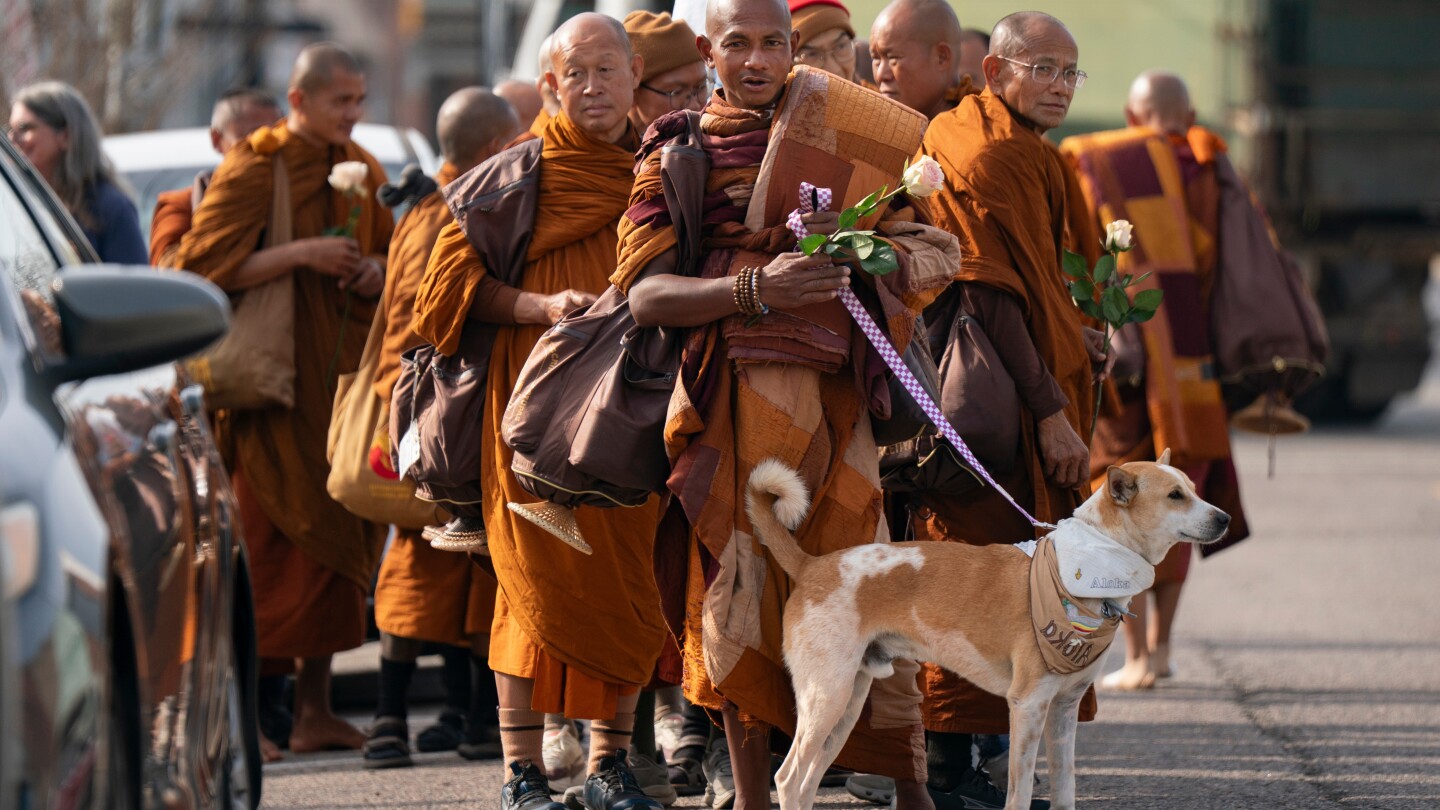
A group of Buddhist monks walking from Texas to Washington D.C. have captured the attention of thousands as they make their way through the American South on a 2,300-mile journey for peace. Dressed in flowing saffron and ocher robes, the monks and their rescue dog Aloka have become an unexpected source of solace for many Americans seeking respite from national division and conflict.
The journey, which began on October 26, 2025, at the Huong Dao Vipassana Bhavana Center in Fort Worth, Texas, is scheduled to conclude in mid-February in the nation’s capital. There, the monks plan to petition Congress to recognize Buddha’s day of birth and enlightenment (Vesak) as a federal holiday.
“My hope is, when this walk ends, the people we met will continue practicing mindfulness and find peace,” said the Venerable Bhikkhu Pannakara, the group’s soft-spoken leader who is completing the trek barefoot despite injuries from stepping on rocks, nails, and glass.
The 18 monks, who practice Theravada Buddhism, have attracted growing crowds at each stop along their route through six states. Their message of peace and mindfulness has resonated across ideological lines, with thousands gathering in churchyards, town squares, and city halls to meet them. Their social media accounts have amassed millions of followers who track their daily progress.
Last Saturday, the monks received an especially warm welcome in Columbia, South Carolina, where they chanted on the State House steps and received an official proclamation from Mayor Daniel Rickenmann before thousands of onlookers.
Physical Challenges and Dedication
The journey has not been without hardship. On November 19, as the monks walked along U.S. Highway 90 near Dayton, Texas, a distracted truck driver struck their escort vehicle, injuring two monks. One monk lost his leg in the accident, reducing the group from 19 to 18.
At their stop in Saluda, South Carolina, Audrie Pearce was moved to tears after driving four hours from Little River to see the monks. “There’s something traumatic and heart-wrenching happening in our country every day,” said Pearce, who describes herself as spiritual but not religious. “I looked into their eyes and I saw peace. They’re putting their bodies through such physical torture and yet they radiate peace.”
The monks have maintained their practice of sleeping outdoors in tents throughout the journey, regardless of weather conditions. While this walk is Pannakara’s first in the United States, he previously walked across several South Asian countries, including a 112-day journey through India in 2022.
During that Indian trek, Pannakara met Aloka, an Indian Pariah dog whose name means “divine light” in Sanskrit. Once a stray, the dog followed Pannakara and other monks from Kolkata to the Nepal border. When Aloka fell critically ill during the journey, Pannakara nursed him back to health. Now, the monk says Aloka inspires him to continue when he feels like giving up.
Community Connections
The monks’ presence has sparked unexpected gatherings in small towns across the South. In Opelika, Alabama, the Rev. Patrick Hitchman-Craig hosted them at his United Methodist congregation on Christmas night. He anticipated a small turnout but was stunned when approximately 1,000 people arrived.
“Anyone who is working for peace in the world in a way that is public and sacrificial is standing close to the heart of Jesus, whether or not they share our tradition,” said Hitchman-Craig. “I was blown away by the number of people and the diversity of who showed up.”
The following day, about 200 people gathered at Collins Farm in Cusseta, Alabama, to greet the monks. Judy Collins Allen, whose family operates the farm, described an unusual sense of community among strangers. “There was a calm, warmth and sense of community among people who had not met each other before and that was so special,” she said.
A Tradition of Peace Walks
According to Brooke Schedneck, professor of religion at Rhodes College in Memphis, the tradition of peace walks in Theravada Buddhism originated in the 1990s with Venerable Maha Ghosananda, a Cambodian monk who led marches through landmine-riddled areas to foster healing after his country’s civil war and genocide.
“These walks really inspire people and inspire faith,” Schedneck explained. “The core intention is to have others watch and be inspired, not so much through words, but through how they are willing to make this sacrifice by walking and being visible.”
Long Si Dong, a spokesperson for the Fort Worth temple, emphasized that their Congressional appeal for recognizing Vesak would “acknowledge it as a day of reflection, compassion and unity for all people regardless of faith.” Pannakara has repeatedly stated that the monks aren’t seeking to convert people to Buddhism but rather to help individuals achieve peace in their lives.
For many attendees, the impact has been profound. Becki Gable drove nearly 400 miles from Cullman, Alabama, to meet the monks in Saluda, seeking solace after losing her daughter and parents. “I just felt in my heart that this would help me have peace,” she said.
Following Pannakara’s teaching, Gable now begins each day by writing five words on a piece of paper: “Today is my peaceful day.”
Fact Checker
Verify the accuracy of this article using The Disinformation Commission analysis and real-time sources.

14 Comments
As someone who practices mindfulness meditation, I find this story very uplifting. The monks’ message of inner peace and compassion is something we could all benefit from in these turbulent times. I hope their journey brings them a sense of fulfillment.
Agreed. Even if they don’t succeed in getting Vesak recognized as a holiday, the monks’ journey is still an important reminder to slow down, be present, and cultivate more kindness in our daily lives.
Walking 2,300 miles barefoot through various terrains despite injuries – that’s an incredible feat of physical and mental discipline. The monks’ commitment to their beliefs and mission is truly admirable.
Absolutely. The fact that they’ve attracted growing crowds at each stop is a testament to the power of their message and the way it resonates with people seeking more peace and mindfulness in their lives.
What a heartwarming and uplifting story! The image of these Buddhist monks walking across America with their rescue dog companion is just beautiful. I hope their message of peace and mindfulness resonates with many Americans during these divisive times.
Absolutely. Their journey is a wonderful reminder that even small acts of compassion and presence can have a profound impact. I’m inspired by their commitment to their beliefs and their desire to share them in a peaceful, non-confrontational way.
What an inspiring story! Buddhist monks walking across America to spread a message of peace and mindfulness – that’s truly uplifting. I hope their journey inspires others to practice more compassion and find inner tranquility.
Agreed, their peaceful pilgrimage is a wonderful reminder to slow down and appreciate the simple things in life. The presence of their rescue dog Aloka adds such a heartwarming touch.
This is a fascinating initiative. I’m curious to learn more about the monks’ specific plans to petition Congress regarding recognizing Vesak as a federal holiday. That would be a significant milestone for Buddhists in the US.
Yes, that’s an intriguing goal. I wonder if they’ll be able to gather enough public support to make that happen. It could really help raise awareness and acceptance of Buddhist traditions in mainstream American society.
This is a really interesting and unexpected news story. I’m curious to learn more about the specific Buddhist traditions and practices of this group of monks. Their pilgrimage across America is quite remarkable.
Yes, I’d love to get more details on their Theravada Buddhist beliefs and how those inform their approach to this journey. It would be fascinating to understand their spiritual motivations and the rituals or meditations they engage in along the way.
I’m a bit skeptical about their ability to influence Congress to establish Vesak as a federal holiday. That seems like an uphill battle, given the current political climate. But I’m hopeful their journey will at least raise awareness and inspire more interfaith dialogue.
That’s a fair point. Changing federal holiday policies is notoriously difficult, even for well-established religions. But you’re right that raising awareness and promoting interfaith understanding are still valuable outcomes, regardless of the legislative result.