


Listen to the article
British Court Overturns Ban on Palestine Action Group, Government Plans Appeal
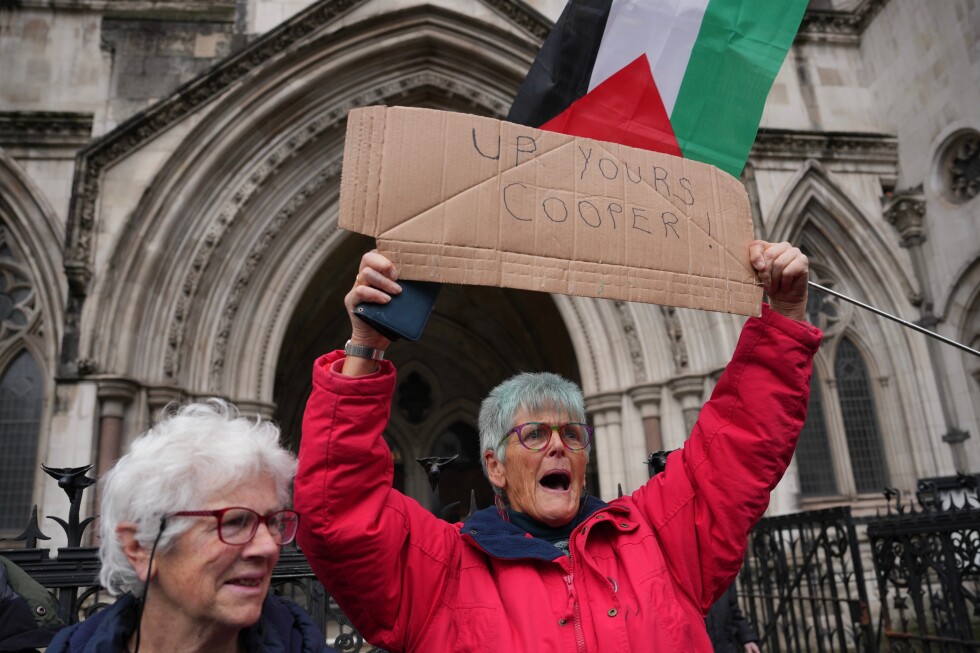
Britain’s High Court delivered a significant blow to the government on Friday, ruling that its controversial decision to classify the pro-Palestinian protest group Palestine Action as a terrorist organization was unlawful. Despite the ruling, the judges kept the ban temporarily in place pending a further hearing while the government prepares an appeal.
In their judgment, Justices Victoria Sharp, Jonathan Swift, and Karen Steyn determined that “the nature and scale of Palestine Action’s activities” did not meet the threshold of “level, scale and persistence” that would justify such extreme classification. The court explicitly stated it was “satisfied that the decision to proscribe Palestine Action was disproportionate.”
The government’s decision to ban the group came after activists broke into a Royal Air Force base in June to protest British military support for Israel’s military campaign in Gaza. This action placed Palestine Action in the same legal category as groups like al-Qaida and Hamas, making membership or support punishable by up to 14 years imprisonment.
The ban has had far-reaching consequences in British society. Since its implementation, authorities have arrested more than 2,700 people at protests simply for holding signs expressing support for the group. Of these, more than 250 individuals have been charged under the Terrorism Act, raising serious concerns about civil liberties in the UK.
Human rights and civil liberties organizations have strongly criticized the government’s approach, arguing that the arrests of peaceful protesters violate fundamental rights of free speech and assembly. Critics maintain that the ban represents a dangerous overreach of counterterrorism powers to suppress legitimate political dissent.
Palestine Action co-founder Huda Ammori celebrated the court’s decision, calling it “a monumental victory both for our fundamental freedoms here in Britain and in the struggle for freedom for the Palestinian people.” Ammori added that the government’s decision “will forever be remembered as one of the most extreme attacks on free speech in recent British history.”
Yasmine Ahmed, UK director of Human Rights Watch, characterized the ruling as “a shot in the arm for British democracy,” arguing that the government had inappropriately used anti-terrorism legislation to stifle legitimate criticism of Israel’s actions.
The government, however, remains steadfast in defending the ban. Home Secretary Shabana Mahmood expressed disappointment with the court’s decision, stating, “I disagree with the notion that banning this terrorist organization is disproportionate.” Mahmood emphasized that “the proscription does not prevent peaceful protest in support of the Palestinian cause,” and confirmed the government’s intention to challenge the judgment in the Court of Appeal.
Since its formation in 2020, Palestine Action has engaged in direct action protests targeting military and industrial sites in the UK, including breaking into facilities owned by Israeli weapons manufacturer Elbit Systems UK. Government officials claim these actions have caused millions of pounds in damage and potentially impact national security.
The High Court acknowledged in its ruling that “a very small number of its actions have amounted to terrorist action,” but concluded that “regardless of proscription, the criminal law is available to prosecute those concerned.” This suggests the court believes existing criminal statutes are sufficient to address any illegal activities without resorting to terrorism designations.
The judges have given lawyers until February 20 to prepare for a hearing that will determine whether the ban should remain in force pending a potential appeal. In response to the judgment, London’s Metropolitan Police announced they would temporarily cease arresting people for expressing support for Palestine Action, but would continue gathering evidence for possible future enforcement.
The case highlights growing tensions between security concerns and civil liberties in the UK, particularly regarding protests related to the Israel-Gaza conflict, which has increasingly polarized public opinion across Britain and much of Europe.
Fact Checker
Verify the accuracy of this article using The Disinformation Commission analysis and real-time sources.

11 Comments
This is a complex issue with valid concerns on both sides. While the group’s tactics may be controversial, the court’s finding that the terrorist designation was unjustified is significant. It underscores the need for a balanced, evidence-based approach to such matters.
I agree, a nuanced perspective is warranted here. The court’s judgment seems to indicate the government overstepped in its designation, but the appeal process will clarify things further.
The High Court’s ruling that the government acted illegally in outlawing this protest group is an important development. It suggests the authorities may have gone too far in their efforts to crack down on the group’s activities. The appeal process will be one to follow closely.
Interesting ruling. It seems the court found the government’s decision to designate this group as a terrorist organization was disproportionate given the nature and scale of their activities. Curious to see how the appeal process unfolds.
Yes, the court’s stance that the government’s actions were ‘disproportionate’ is quite notable. It will be important to monitor if the appeal leads to a different outcome.
This case seems to highlight the complexities involved when governments seek to restrict the activities of protest groups, even those with controversial tactics. The court’s finding that the terrorist label was disproportionate merits close attention as the appeal unfolds.
Absolutely. The nuances at play here are significant, and the court’s pushback on the government’s actions is a meaningful check on potential overreach. The appeal will be crucial in determining the final outcome.
The court’s ruling that the terrorist designation was disproportionate is an important check on government overreach, even in sensitive geopolitical matters. It will be informative to see how the appeal unfolds and whether the initial decision is upheld.
This case highlights the delicate balance between security concerns and civil liberties. While the government may have had legitimate worries, the court’s view that the terrorist label was excessive carries weight. The appeal process should aim to find a measured, lawful approach.
Agreed. The government’s appeal will need to carefully justify its position in light of the court’s findings that the designation was disproportionate. An objective, evidence-based approach is crucial in such sensitive matters.
The court’s rejection of the government’s terrorist designation for this group is a noteworthy development. It suggests the authorities may have overreached in their efforts to crack down on the group’s activities. The appeal process will be important to watch.