


Listen to the article
From Rapper to Prime Minister: Engineer Balendra Shah Set to Lead Nepal
Balendra Shah, a 35-year-old structural engineer and former rap artist, is poised to become Nepal’s next prime minister following his party’s landslide victory in parliamentary elections earlier this month. Shah’s Rastriya Swatantra Party (RSP) captured approximately two-thirds of the 275 seats in Nepal’s lower House of Representatives, marking the first time in decades that a single party has won such an overwhelming majority.
Shah, widely known as “Balen,” was unanimously selected as the party leader by elected RSP members on Thursday. The president is expected to officially appoint and swear him in as prime minister on Friday, cementing a remarkable political rise for the former outsider.
The election results reflect deep public frustration with Nepal’s established political parties, which many voters blame for endemic corruption and chronic instability in the Himalayan nation of 30 million. Shah’s victory represents a significant shift in Nepal’s political landscape, particularly after youth-led protests toppled the previous government last year.
“Finally we have a young, good and clean leader,” said Susil Singh, an office worker in Kathmandu. “He asked us for our support and we gave him our votes. Now he is going to bring the country back on track.”
Shah first gained national political prominence after winning Kathmandu’s mayoral race as an independent candidate in 2022. During his tenure, he earned praise for addressing the capital’s garbage crisis, removing illegal street vendors, and advancing road expansion projects. Critics, however, accused his administration of demolishing homes and businesses without adequate planning or compensation.
Before entering politics, Shah built a modest following as a rapper whose lyrics often criticized corruption and social injustice. In his song “Nepal Smiling,” which gained popularity on social media platforms, Shah envisions a more just country, singing: “May the country be a beautiful garden.” In another track titled “Sacrifice,” he takes a sharper tone, rapping: “All the people who defend the country are idiots. All leaders are thieves… plundering the country.”
Though Shah did not directly participate in the bloody youth-led uprising last September that led to dozens of deaths, he publicly supported the largely Generation Z demonstrators. As tensions escalated, he called for calm and restraint while backing negotiations that helped establish an interim government.
Shah’s decisive mandate could provide him with the political capital needed to pursue substantial reforms. During his campaign, which relied heavily on social media rather than traditional speeches, he emphasized economic reforms and promised to expand access to education and healthcare for Nepal’s poorest citizens.
The new prime minister made headlines during the election by directly challenging former Prime Minister Khadga Prasad Oli in a southeastern district, defeating the veteran politician by a substantial margin. This victory was widely interpreted as a sign of voter anger toward Nepal’s entrenched political establishment.
Despite the strong mandate, analysts caution that Shah’s limited experience in national governance could present challenges.
“Balen Shah does not have the experience of government operation and lacks the complex knowledge of running the state,” said Hari Bahadur Thapa, a Kathmandu-based author who specializes in corruption and governance issues. However, Thapa noted that Shah may benefit from having a weakened opposition, making it potentially easier to push legislation through parliament.
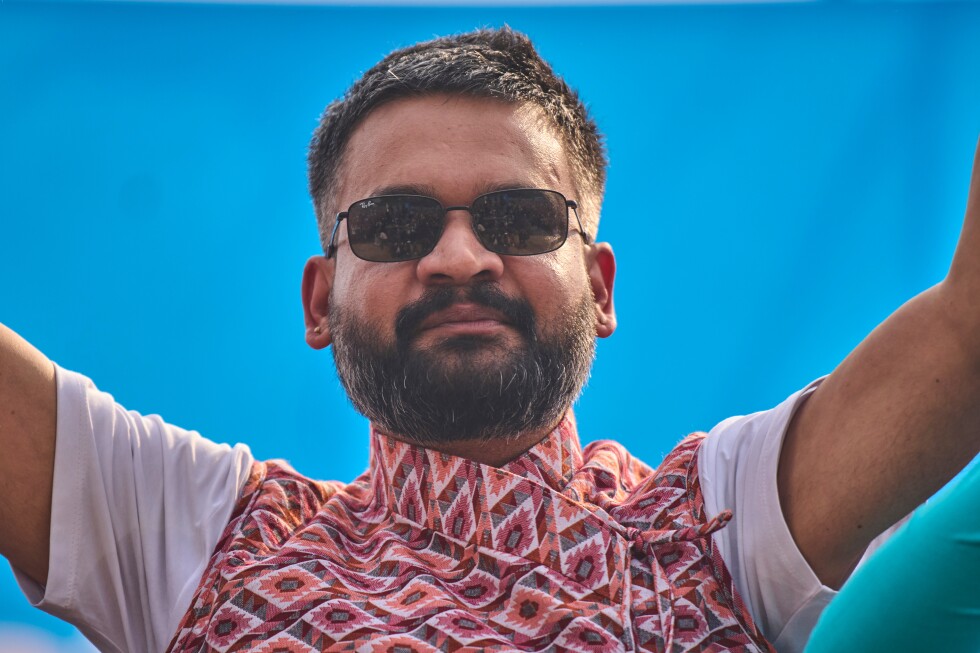
Shah’s distinctive appearance—often dressed in black and wearing dark sunglasses—and his reluctance to give traditional campaign speeches set him apart from conventional Nepali politicians. For many supporters, particularly younger voters disillusioned with traditional parties, his political ascent represents a clean break from Nepal’s entrenched political order.
As Shah prepares to take office, many supporters like Singh hope he will tackle corruption and deliver justice to those killed during last year’s protests. His administration faces significant challenges, including managing high public expectations while navigating the complex realities of governing a country with persistent economic challenges and political divisions.
Fact Checker
Verify the accuracy of this article using The Disinformation Commission analysis and real-time sources.

8 Comments
Nepal’s young population likely saw Balen Shah as a breath of fresh air compared to the country’s entrenched political class. His engineering expertise and anti-corruption platform seem to have resonated strongly. This changing of the guard could have far-reaching implications.
The shift towards political outsiders like Shah reflects a global trend of voters seeking alternatives to the status quo. His engineering expertise could bring a pragmatic, solutions-oriented approach to Nepal’s challenges. However, governing a diverse nation will require deft political skills.
The election results signal a rejection of Nepal’s traditional political establishment. Shah’s party winning a supermajority is a remarkable achievement. I’m curious to see his policy agenda and whether he can fulfill his promises to tackle corruption and instability.
Fascinating to see a political outsider like Balen Shah rise to prominence in Nepal. His engineering and rap background provide a unique perspective that could drive much-needed reforms. Curious to see how he navigates the challenges of leading a diverse nation.
Nepal’s politics have been marred by instability for too long. While Shah’s rise is promising, he’ll need to carefully balance reforms with maintaining stability. Curious to see his plans for revitalizing the economy and improving public services.
The election results highlight the public’s frustration with traditional political parties in Nepal. Shah’s victory as a political newcomer reflects a desire for fresh leadership and a crackdown on corruption. This could have ripple effects across the region.
You’re right, Nepal’s voters seem eager for change. Shah’s background as an engineer and his anti-corruption platform likely resonated strongly. It will be interesting to see how he leverages his mandate to address the country’s chronic instability.
Shah’s background as a former rapper adds an interesting wrinkle to his political rise. Perhaps his ability to connect with the youth vote played a role in his landslide victory. It will be fascinating to see how he leverages that rapport to drive change in Nepal.