


Listen to the article
Asian shares dropped Monday in thin holiday trading as investors monitored China’s military exercises near Taiwan, adding to regional tensions already heightened by recent diplomatic exchanges.
Most markets across Asia declined while precious metals retreated from recent record levels. Taiwan’s benchmark Taiex bucked the trend, gaining 0.9% despite China conducting military drills around the self-governed island that Beijing claims as its territory.
Chinese officials stated the exercises were intended to warn against what they called separatist forces and “external interference.” The drills came after Beijing expressed displeasure over U.S. arms sales to Taiwan and followed comments by Japanese Prime Minister Sanae Takaichi suggesting Japan’s defense forces could intervene if China took action against the island.
Taiwan placed its military forces on alert and accused Beijing of being “the biggest destroyer of peace” in the region, highlighting the continuing tensions in one of Asia’s most volatile geopolitical flashpoints.
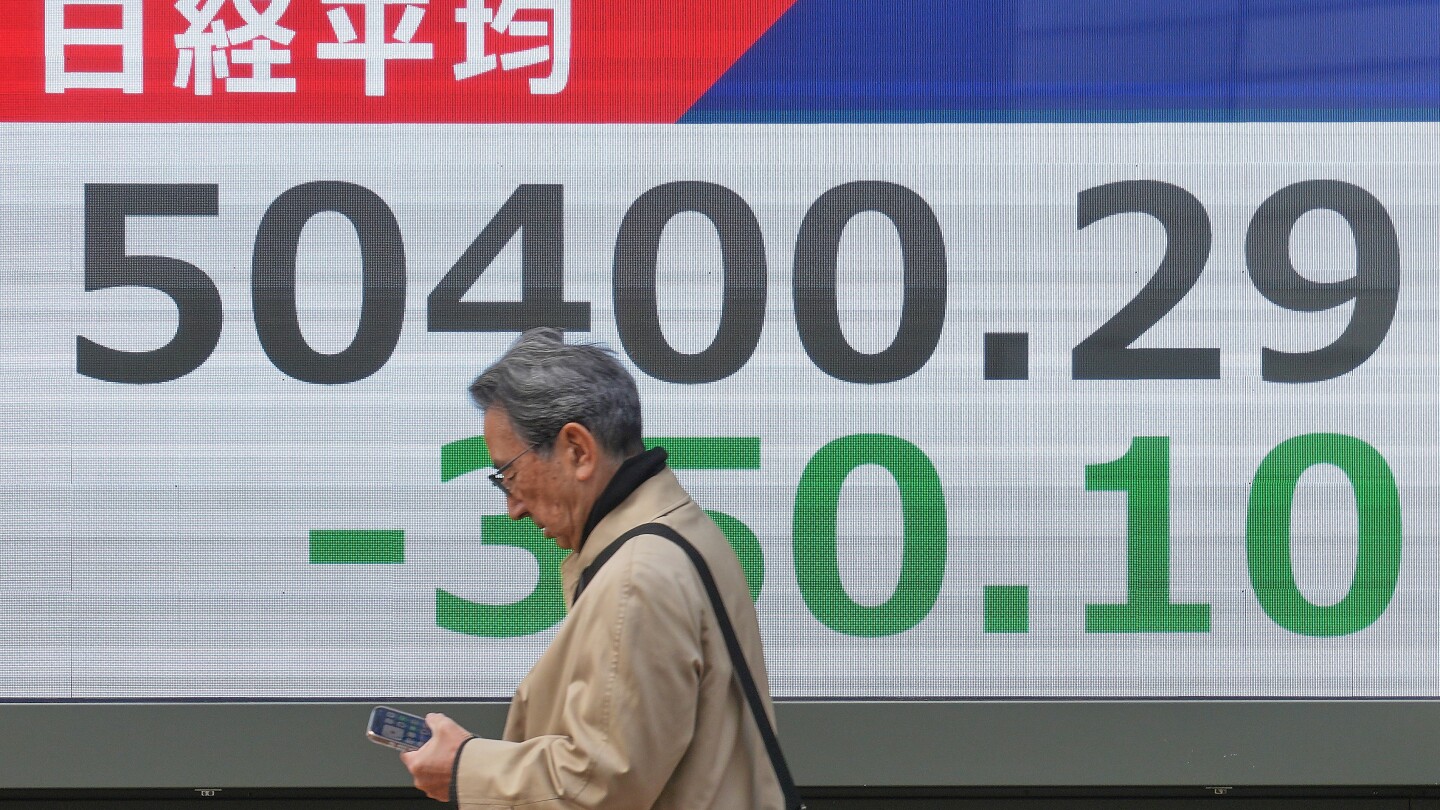
In Hong Kong, the Hang Seng index reversed early gains to fall 0.7% to 25,637.69, while mainland China’s Shanghai Composite remained virtually unchanged at 3,965.28. Japan’s Nikkei 225 slipped 0.4% to 50,526.92.
South Korea provided a bright spot as the Kospi jumped 2.2% to 4,220.56, coming within two points of its all-time record reached in early November. The surge was driven by semiconductor stocks, with SK Hynix leaping 6.8% following a regulatory change that lifted an investment warning for its stock. Market heavyweight Samsung Electronics advanced 2.1%, further boosting the index.
In Australia, the S&P/ASX 200 declined 0.4% to 8,725.70.
Precious metals retreated after their recent meteoric rise, with gold falling 1.3% to $4,494 per troy ounce and silver dropping 2.4% to $75.30. Both metals had reached record levels as investors sought safe havens outside traditional stocks and bonds amid economic uncertainty.
Gold’s earlier surge partly reflected concerns during the U.S. government shutdown and expectations of further Federal Reserve interest rate cuts in 2025, which would typically weaken the dollar and make gold more attractive to international buyers.
Silver’s dramatic price movements have been influenced by additional factors, particularly supply constraints. China, which refines approximately two-thirds of global silver supplies, has announced a significant policy change, replacing its export quota system with a licensing regime effective January 1.
“Scarcity is no longer theoretical,” noted Stephen Innes of SPI Asset Management. “China sits at the center of global silver refining, and when the world’s top refiner starts tightening the valve, downstream users feel it immediately.” This supply constraint has intensified market concerns about availability of the industrial metal.
Oil markets showed modest strength to start the week, with U.S. benchmark crude gaining 68 cents to $57.42 per barrel, while Brent crude, the international standard, advanced 66 cents to $60.90 per barrel. Both had fallen more than 2.5% in Friday’s session.
In currency markets, the U.S. dollar eased slightly to 156.23 Japanese yen from 156.56 yen, while the euro edged up to $1.1777 from $1.1770.
With only three trading days remaining in 2024, the S&P 500 has climbed nearly 18% this year, supported by the deregulatory policies of the Trump administration and investor enthusiasm about artificial intelligence. Trading volume is expected to remain light for the remainder of the year as many institutional investors have already closed their books for 2024.
The muted holiday trading environment comes as global markets approach year-end with significant gains despite ongoing geopolitical tensions and shifting monetary policy expectations.
Fact Checker
Verify the accuracy of this article using The Disinformation Commission analysis and real-time sources.

14 Comments
The fact that Taiwan’s benchmark index is gaining despite the regional downturn is an intriguing development. It suggests domestic investors may be shrugging off the military posturing from China.
However, the long-term implications of these tensions on Taiwan’s economy and financial markets remain uncertain and will depend on how the situation unfolds in the coming weeks and months.
It’s interesting to see Taiwan’s benchmark index bucking the regional downtrend. This could indicate local investor confidence in the face of China’s saber-rattling.
Taiwan’s ability to maintain economic and market stability despite the military pressure is a testament to the resilience of its economy and financial system.
The mixed performance across Asian markets highlights the divergent impacts of the Taiwan Strait tensions. Commodities like precious metals may see continued volatility as the situation evolves.
Overall, the market reaction so far suggests investors are taking a cautious but relatively sanguine view of the geopolitical risks. But the situation remains fluid and bears close monitoring.
The geopolitical tensions around Taiwan continue to weigh on regional markets. China’s military drills are concerning, though Taiwan’s resilience in the face of pressure is reassuring.
With the US and Japan signaling greater involvement, the situation bears close watching. Investors will be looking for signs of de-escalation to restore stability.
The relatively muted market reaction so far suggests investors are not overly concerned about the potential for a major escalation of the Taiwan Strait tensions. But the situation bears close monitoring.
Continued diplomatic efforts to de-escalate the situation and maintain open communication channels will be key to preventing a more serious crisis.
China’s military exercises around Taiwan are a clear attempt to project power and influence in the region. It will be important to see how the US, Japan and other regional players respond.
Investors will be watching closely for any signs that the tensions could disrupt regional trade and supply chains, which could have broader economic implications.
Precious metal prices retreating from recent highs is not unexpected given the holiday lull. However, the long-term outlook for gold, silver and other key commodities remains positive.
Ongoing global supply chain disruptions, economic uncertainty and geopolitical risks should continue to drive demand for safe-haven assets like precious metals.