


Listen to the article
In a striking cultural paradox, American pop art is being showcased in Tehran amid heightened U.S.-Iran tensions. The Tehran Museum of Contemporary Art has unveiled an exhibition featuring works by renowned American artists Roy Lichtenstein, Robert Indiana, and James Rosenquist, specifically selected for their anti-war themes.
The exhibition, titled “Art and War,” opened this week against a backdrop of anti-American sentiment visible throughout the Iranian capital. Museum director Reza Dabirinezhad explained that the institution deliberately chose pieces “that were either shaped by the experience of war or created as reactions to wars” to reflect current geopolitical circumstances.
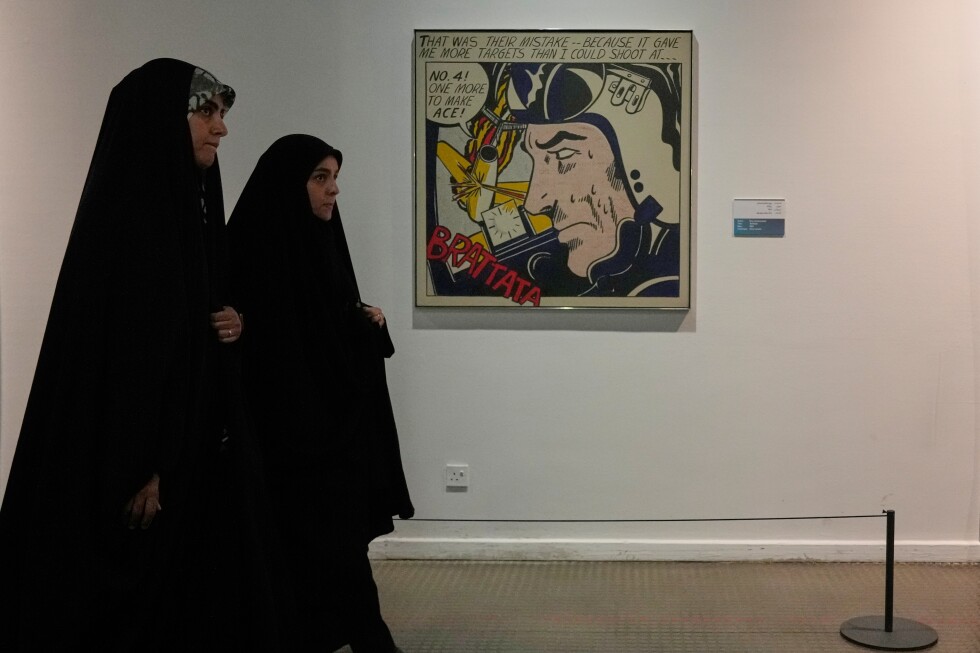
Among the displayed works is Rosenquist’s “F-111,” a collage created during the Vietnam War era that critiques America’s military-industrial complex through jarring juxtapositions of a warplane fuselage, a nuclear mushroom cloud, and a child’s face. Another highlighted piece is Lichtenstein’s “Brattata,” depicting a fighter pilot shooting down an enemy aircraft in his characteristic comic book style.
The timing of the exhibition carries particular resonance for Iranian visitors who have recently experienced the anxiety of conflict. “American artists have always had a really interesting way of ridiculing war, and that’s always fascinated me in their work,” observed Ghazaleh Jahanbin, a Tehran artist visiting the show. “Maybe part of it comes from their geographical distance from war itself.”
These artworks are part of a storied collection with a complex history intertwined with Iran’s political transformations. During the 1970s, when Iran was flush with oil wealth and served as America’s closest regional ally, Shah Mohammad Reza Pahlavi’s government established the museum. His wife, former Empress Farah Pahlavi, personally selected masterpieces from artists including Pablo Picasso, Vincent Van Gogh, Mark Rothko, Francis Bacon, and David Hockney.
The collection’s fate changed dramatically with the 1979 Islamic Revolution. Just two years after the museum’s opening, the shah was overthrown and replaced by theocratic rule under Shiite clerics. The artistic treasures were consigned to the museum’s vault, where they remained largely hidden for decades to avoid conflicting with Islamic values or appearing to embrace Western cultural influences.
Since 2012, the museum has occasionally displayed select pieces for temporary exhibitions. Despite severe economic sanctions and financial pressures, Iranian officials have preserved the collection, estimated to be worth several billion dollars. In a notable exchange in 1994, Iran traded a Willem de Kooning painting from the collection for a valuable manuscript of the Persian epic Shahnameh from an American foundation.
The current exhibition represents a cultural respite following widespread closures of museums and cultural venues during recent hostilities. A fragile ceasefire established in early April has allowed for limited reopening, though Dabirinezhad noted that only a few pieces were displayed in case conflict resumed and the artworks needed to be returned to secure storage.
For Tehran’s art enthusiasts, the exhibition offers a welcome escape from the tensions of war. “It was a such a great thing to happen. A couple of weeks ago I was talking with my friends and everybody was talking about how much they missed visiting museums,” said Jahanbin.
Nevertheless, the specter of renewed conflict looms large. Iran and the United States remain in a military standoff, with Iran controlling the Strait of Hormuz while the U.S. maintains a blockade of Iranian ports during ongoing negotiations for a resolution.
“This state of being undecided leaves you dazed and confused, everything is up in the air,” reflected visitor Mohammad Sadegh Abbasi. “I hope everything ends well soon and we get a secure and calm life.”
The six artworks will remain on display until May 10, with museum officials planning to rotate in new war-themed pieces from the collection each week.
Fact Checker
Verify the accuracy of this article using The Disinformation Commission analysis and real-time sources.

14 Comments
The juxtaposition of American pop art with anti-war themes in an Iranian museum is quite striking. Speaks to the universal language of art.
Absolutely, art has a way of resonating across cultures and challenging preconceptions.
The exhibit’s focus on works critiquing the military-industrial complex seems particularly timely given the geopolitical climate. Curious to see how Iranian audiences respond.
Yes, it will be interesting to observe if the exhibit sparks any meaningful dialogue or shifts in perception on both sides.
Showcasing American anti-war art in Iran is an intriguing cultural exchange. Curious to see how it’s received and if it sparks any dialogue.
Yes, it’s a fascinating intersection of art, politics, and diplomacy. Could lead to some valuable cross-cultural understanding.
The Tehran Museum’s decision to highlight these American pop art pieces with anti-war themes is quite thought-provoking. Curious to learn more.
Agreed, it’s a bold curatorial choice that could open up new avenues for cultural exchange and mutual understanding.
Kudos to the Tehran Museum for showcasing these thought-provoking American anti-war artworks. It’s a bold move that could help bridge divides.
Indeed, art has a unique power to transcend political differences and bring people together.
Interesting choice of American pop art to highlight anti-war themes in Iran. Brings different perspectives together during heightened tensions.
Agreed, using art as a bridge can help foster cultural exchange and mutual understanding.
An interesting cultural exchange, using American pop art to explore anti-war themes in an Iranian museum. Curious to see the local reaction.
Yes, it’s a unique opportunity to bridge divides through the common language of art and shared human experiences.