


Listen to the article
In a historic maritime engagement, the U.S. Navy has deployed its Mk 48 torpedo in combat for the first time since World War II, sinking the Iranian warship IRIS Dena with a single shot. The incident has thrust this longstanding undersea weapon back into the spotlight, highlighting its continued relevance in modern naval warfare.
“In the Indian Ocean, an American submarine sunk an Iranian warship that thought it was safe in international waters. Instead, it was sunk by a torpedo. Quiet Death,” War Secretary Pete Hegseth told reporters at a Wednesday press conference.
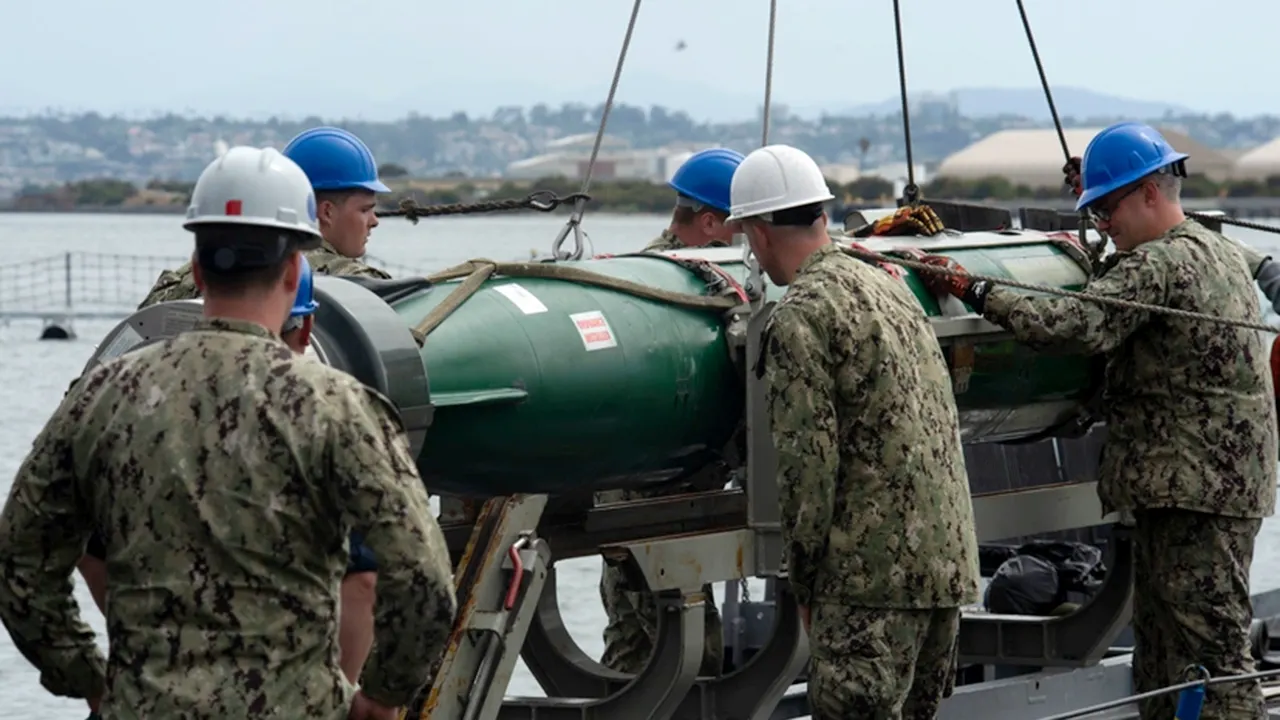
The Mk 48 torpedo, which first entered operational service in 1972, has served as the Navy’s principal undersea weapon for over five decades. According to naval specifications, it’s designed to “defeat all threat surface ships and submarines in all ocean environments,” demonstrating remarkable longevity in the U.S. naval arsenal.
The weapon’s physical specifications are imposing. Measuring 21 inches in diameter and weighing approximately 3,744 pounds, the Mk 48 carries a 650-pound high-explosive warhead capable of devastating damage against naval targets. According to the Department of the Navy’s fiscal year 2025 budget estimates, each torpedo costs about $4.2 million.
What makes the Mk 48 particularly effective is its sophisticated guidance system. Defense contractor Lockheed Martin, one of the primary manufacturers of the torpedo, notes that it can be guided in real time via wire connection from the launching submarine. This allows operators to update targeting information and adjust its course even after launch. Should the wire connection be lost, the torpedo switches to autonomous homing mode, relying on digital guidance systems and onboard signal processing to independently track and pursue its target.
The Mk 48’s longevity can be attributed to its continuous evolution. Over the decades, the torpedo has undergone numerous upgrades through hardware variants known as “Mods.” Each new modification has integrated improved sensors, guidance systems, control mechanisms, and propulsion technologies to keep the weapon relevant against emerging threats.
Currently, the U.S. Navy deploys the Mod 7 configuration, which was developed in partnership with the Royal Australian Navy. According to the Department of War’s Fiscal Year 2024 Annual Report by the Director of Operational Test and Evaluation, Mod 8 is already in development, while Mod 9 is being pursued as a rapid prototyping effort.
Beyond hardware improvements, the Mk 48 receives regular software updates through a program known as Advanced Processor Builds (APBs). These updates enhance the torpedo’s tactics, classification algorithms, and operator interfaces, improving its performance in increasingly complex undersea environments where detection avoidance and target discrimination are paramount challenges.
The strike against the IRIS Dena represents a significant moment in naval warfare history. It marks the first deployment of a submarine-launched torpedo against an enemy vessel by U.S. forces since the conclusion of World War II, demonstrating both the continued relevance of submarine warfare and the effectiveness of this continuously updated weapons platform.
The aftermath of the attack was documented by the Sri Lankan Navy, which reported finding an oil slick, life rafts, and bodies in the water following the engagement. The incident occurred amid escalating tensions between the United States and Iran in the region.
Naval analysts note that while missile systems have dominated naval combat discussions in recent decades, this engagement demonstrates that traditional torpedo technology remains a critical component of undersea warfare. The successful strike validates the U.S. Navy’s continued investment in upgrading and maintaining its torpedo arsenal despite the weapon’s age.
The incident also underscores the strategic importance of submarine capabilities in modern naval operations, where stealth, precision, and devastating power can be delivered with minimal warning – capabilities embodied in both the submarine platform and its primary weapon, the Mk 48 torpedo.
Fact Checker
Verify the accuracy of this article using The Disinformation Commission analysis and real-time sources.

8 Comments
An American submarine sinking an Iranian warship with a ‘Quiet Death’ torpedo is certainly dramatic. I’m curious to learn more about the strategic implications of this capability.
The successful deployment of the Mk 48 torpedo against an Iranian naval target is a significant milestone. It will be intriguing to see how this impacts the regional balance of power.
The technological prowess of the US Navy’s undersea warfare capabilities is clearly on display in this incident.
While the technical details of the Mk 48 torpedo are interesting, the loss of life in this incident is sobering. Hopefully, both sides can deescalate the situation and avoid further conflict.
The geopolitical ramifications of this event are worth monitoring closely in the coming days and weeks.
The sinking of an Iranian warship by a US submarine using the Mk 48 torpedo is a significant event. It will be interesting to see how Iran responds and if this escalates regional tensions.
Fascinating development in naval warfare. The Mk 48 torpedo’s remarkable longevity and capabilities are impressive. I wonder how this will impact the balance of power in the region.
This incident highlights the continued importance of advanced undersea weapons in modern naval conflicts.