


Listen to the article
Separatist Leader’s Ally Poised to Win Bosnian Serb Presidency Following Controversial Election
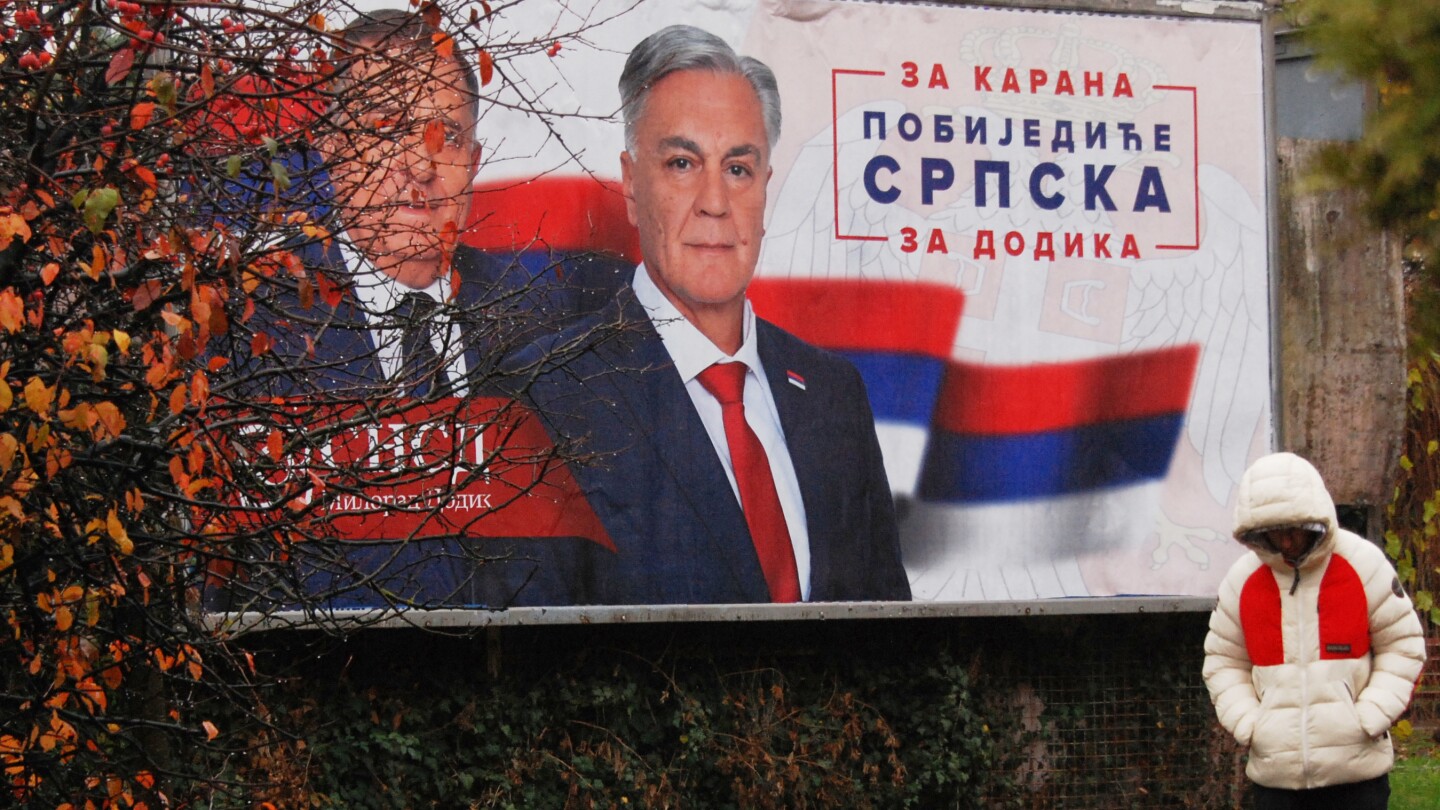
An ally of controversial Bosnian Serb leader Milorad Dodik has emerged as the frontrunner in Sunday’s snap presidential election in Republika Srpska, the Serb-controlled entity of Bosnia-Herzegovina. Preliminary results from Bosnian election authorities show Sinisa Karan leading with approximately 50% of votes, narrowly ahead of his main opponent, Branko Blanusa, who secured around 47%.
The election was called after Dodik was removed from the presidential office in August, following his conviction by a Bosnian court for defying orders from the international High Representative for Bosnia. The court sentenced Dodik to a year in prison and banned him from holding public office for six years. Rather than serve jail time, Dodik paid a fine and relinquished his presidential position while maintaining control of his political party, the Party of Independent Social Democrats.
Despite his removal from office, Dodik remained a dominant force throughout the campaign and was quick to claim victory for Karan as results began to emerge. “They wanted to bring down Dodik in an unfair process and now they got two Dodiks and they will watch us every day,” he declared defiantly on election night.
Karan, embracing his mentor’s rhetoric, promised supporters, “We will continue where we left off,” signaling that he intends to pursue policies aligned with Dodik’s controversial agenda.
Meanwhile, Blanusa has challenged the integrity of the election, alleging media bias in favor of his opponent. “If there had not been manipulations, I would have declared victory tonight,” he said, though earlier in the day he had characterized the campaign environment as “fair and tolerant.”
The election highlights the ongoing political tensions in Bosnia-Herzegovina, a country still grappling with the aftermath of the 1992-1995 ethnic conflict that claimed more than 100,000 lives and displaced millions. Bosnia’s complex political structure was established through the U.S.-brokered Dayton Peace Agreement, which divided the country into two autonomous entities: Republika Srpska, controlled by Bosnian Serbs, and the Federation of Bosnia and Herzegovina, jointly administered by Bosniaks and Croats.
Dodik has long been a divisive figure in Bosnian politics, advocating for the eventual separation of Republika Srpska from Bosnia-Herzegovina. His separatist rhetoric and actions led to sanctions from the United States and Britain, though the U.S. lifted its sanctions last month after Dodik agreed to step down from the presidency.
Throughout his political career, Dodik has repeatedly clashed with international representatives overseeing the peace agreement, including the current High Representative, Christian Schmidt, whose decisions Dodik has declared illegal in Republika Srpska.
The High Representative’s office plays a crucial role in Bosnia, overseeing the implementation of the 1995 peace agreement and wielding significant authority, including the power to remove officials deemed to be obstructing the peace process.
Dodik actively campaigned for Karan, telling voters that “I will remain with you to fight for our political goals” and that Karan’s “victory will be my victory too,” reinforcing perceptions that Karan would effectively serve as Dodik’s proxy in office.
Political analysts view the election as a referendum on Dodik’s nationalist policies rather than a genuine contest of new ideas for the region’s future. The close result suggests that while Dodik’s influence remains strong, there is substantial opposition to his separatist agenda within Republika Srpska.
As Bosnia approaches the 30th anniversary of the Dayton Agreement, this election underscores the fragile nature of the country’s peace and the persistent ethnic divisions that continue to challenge its stability and development. The international community watches closely, concerned that renewed separatist rhetoric could further destabilize this vulnerable region of the Balkans.
Fact Checker
Verify the accuracy of this article using The Disinformation Commission analysis and real-time sources.

18 Comments
This election outcome reinforces the deep political divisions within Bosnia-Herzegovina. The continued dominance of nationalist forces like Dodik’s party is a worrying sign for the country’s long-term stability.
The international community must find ways to encourage greater cooperation and compromise between the country’s competing ethnic factions to prevent a renewed outbreak of conflict.
The victory of Dodik’s ally is a clear setback for efforts to promote greater integration and cooperation within Bosnia-Herzegovina. This election result will likely embolden Dodik’s push for increased autonomy or even secession.
The international community must find ways to engage with all parties in Bosnia to find a path forward that respects the country’s constitutional framework and the rights of all its citizens.
This election in Republika Srpska seems to be a proxy battle for the influence of Milorad Dodik, the controversial separatist leader. It will be interesting to see how the international community reacts to the victory of Dodik’s ally.
Dodik has long been a thorn in the side of the Bosnian state. His party’s continued dominance raises concerns about the stability of the region.
This election result highlights the ongoing political tensions in Bosnia-Herzegovina and the influence of nationalist, separatist forces like Dodik’s party. It will be crucial for the international community to closely monitor the situation.
Maintaining the delicate balance of power and ethnic representation in Bosnia’s political institutions is essential for preserving the country’s stability and preventing a resurgence of conflict.
The victory of Dodik’s ally is a clear sign that the separatist leader still wields significant influence in Republika Srpska. This election result will likely embolden Dodik’s secessionist agenda.
It’s crucial that the international community remains engaged and works to uphold the Dayton Accords, which are the foundation for Bosnia’s fragile peace.
This election outcome reflects the enduring influence of nationalist and separatist forces in Republika Srpska. It will be a significant challenge for the international community to navigate these complex political dynamics and promote greater unity in Bosnia.
Preserving the fragile peace and territorial integrity of Bosnia-Herzegovina remains a critical priority for the EU and other international actors invested in the region’s stability.
The victory of Dodik’s ally is a concerning development for Bosnia’s fragile political landscape. This election highlights the ongoing tensions between nationalist and pro-unity forces in the country.
It remains to be seen whether the international community will take any action to counter Dodik’s influence and push for greater integration of Republika Srpska within Bosnia.
Dodik’s continued political maneuvering is troubling for Bosnia’s future. This election underscores the challenges of maintaining a functioning multi-ethnic state in the face of nationalist ambitions.
The international community will need to tread carefully in responding to these developments to avoid further inflaming ethnic tensions in the region.
The victory of Dodik’s ally is a concerning development that could further undermine Bosnia’s fragile unity. It remains to be seen how this will impact the country’s relations with the EU and other international actors.
Dodik’s continued defiance of the Bosnian state and its international obligations is a significant challenge that will require a nuanced and patient diplomatic response.