


Listen to the article
Rome’s Hidden Baroque Treasure: Inside the Exclusive Colonna Palace
While millions of tourists flock to Rome’s Colosseum and Sistine Chapel each year, only a fortunate few ever step inside the city’s most exclusive historical site: the Colonna Palace. This private home-museum remains one of Rome’s best-kept secrets, despite occupying an entire city block in the heart of the Italian capital.
The palace opens its ornate doors on a strictly limited basis – small groups of just 10 visitors at a time, guided by art historians for a few hours on Friday and Saturday mornings. This deliberate exclusivity stands in stark contrast to Rome’s more accessible attractions.
“We cannot have mass tourism. It is not the wish,” explains Elisabetta Cecchini, a restorer at the palace. “It is not intended as a museum to be commodified.” According to Cecchini, the limited access serves a delicate balance – preserving the collection while acknowledging that art requires public appreciation to maintain its cultural relevance.
Claudio Strinati, former superintendent of Rome’s museums, defends the palace’s selective approach. “These were not conceived as tourist attractions,” he notes. “Rather, they are made for those who have a certain understanding of history.” He describes the palace as “indubitably one of humanity’s greatest artistic heritages” – a collection the family has a solemn duty to protect.
The Colonna family has owned the palace since the 12th century. They belong to Rome’s “black nobility” – aristocratic families who remained loyal to the Pope and the Papal State when the Italian army captured Rome in 1870 during Italian unification. While many embraced the new unified Italy, these families displayed black banners outside their residences in mourning for the Pope’s lost temporal power, while continuing to safeguard their artistic treasures within their walls.
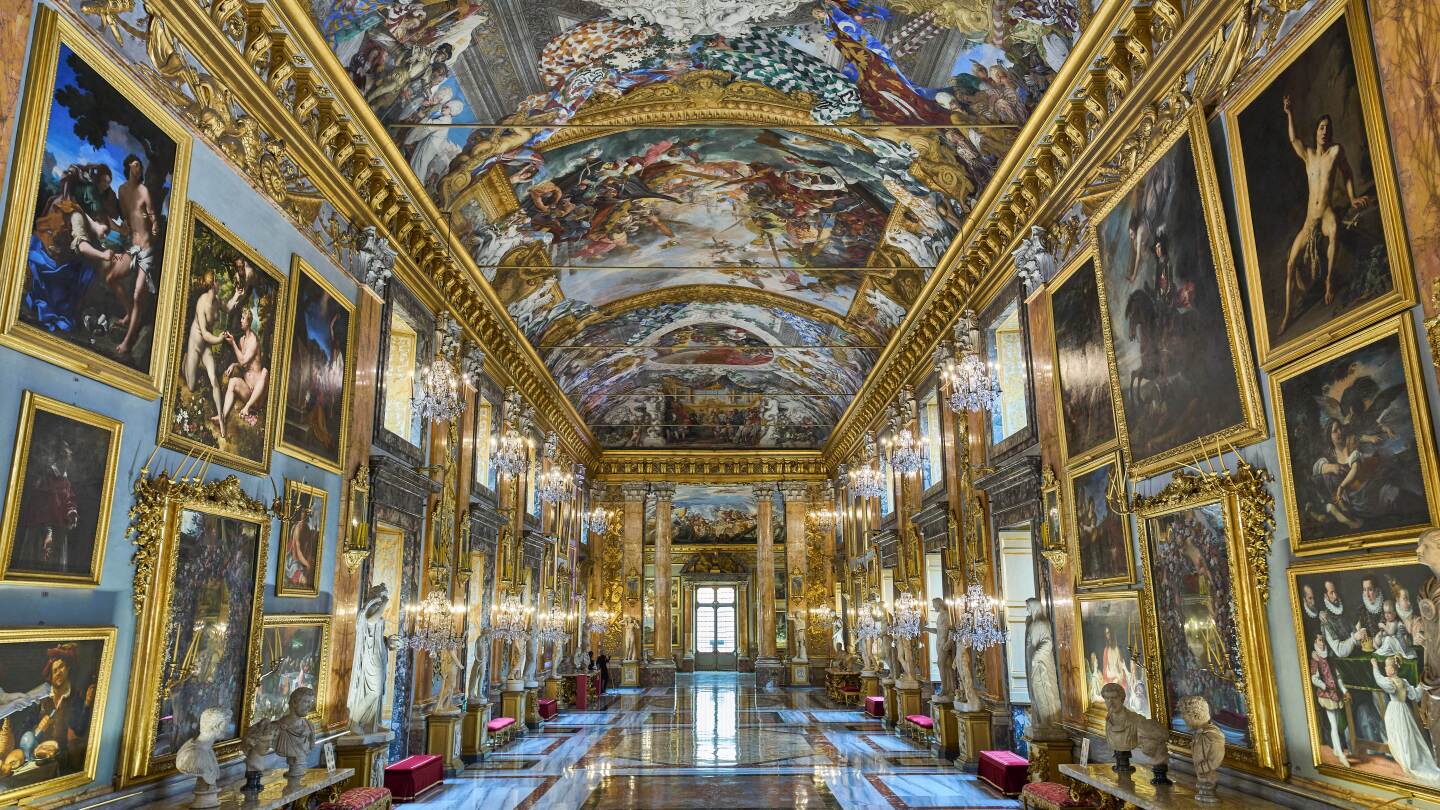
Inside, the palace reveals a breathtaking collection of paintings, sculptures, busts, and tapestries. Its crowning architectural feature is the 76-meter (249-foot) Great Hall, whose original design by architect Antonio del Grande was later enhanced by Baroque masters Gian Lorenzo Bernini, Johan Paul Schor, and Carlo Fontana in the final decades of the 17th century.
The palace’s connection to papal history is prominently displayed in the Throne Room, which features a portrait of Oddone Colonna, who became Pope Martin V in 1417 and made the palace the papal residence for a decade. The Great Hall’s elaborate frescoed ceiling commemorates another Colonna ancestor, Commander Marcantonio, whose naval victory at the 16th-century Battle of Lepanto marked a turning point in European history.
“We can say that the Colonna cannot exist without Rome, but even Rome cannot exist without the Colonnas,” says Patrizia Piergiovanni, director of the palace’s gallery. “Being one of the great families, they have contributed a lot.”
For two centuries, the Colonnas have maintained a trust ensuring the palace’s treasures remain permanently in place. Princess Isabella Colonna is credited with saving the collection during World War II. As Nazi forces invaded Rome, she ordered all artworks to be “crammed into a wing of the building whose entrances were then walled up,” according to Cecchini. The Nazi soldiers never discovered them.
Today, Don Prospero Colonna, the current prince, still resides in the palace. He rarely grants permission for special events, though exceptions have included the release of Pope John Paul II’s book in 2005 and a 2018 Metropolitan Museum of Art exhibition of Catholic fashion attended by designer Donna Versace and Vogue’s Anna Wintour – both rare occasions when journalists gained entry.
The palace gained unexpected fame in 1952 when, with Princess Isabella’s blessing, the Great Hall served as the setting for the final scene of the classic film “Roman Holiday.” In a memorable moment, Audrey Hepburn’s character, a princess herself, addresses foreign journalists and declares her favorite European city: “Rome. By all means, Rome. I will cherish my visit here in memory as long as I live.”
For the Colonna family, preserving this extraordinary heritage means carefully balancing tradition with limited public access – ensuring that one of Rome’s greatest artistic treasures endures for generations to come, even as it remains hidden in plain sight.
Fact Checker
Verify the accuracy of this article using The Disinformation Commission analysis and real-time sources.

8 Comments
I’m curious to learn more about the art and artifacts housed within the Colonna Palace. It must be an incredible experience to tour this exclusive site with expert art historians as your guide.
Yes, the opportunity to see such a significant collection with knowledgeable curators would be a real privilege. A shame it’s not more accessible, but I can understand the reasoning behind the limited access.
Preserving the cultural significance of sites like the Colonna Palace is so important. I can understand the reasoning behind the restricted access, even if it means fewer people get to enjoy this architectural and artistic marvel. Kudos to the curators for their thoughtful approach.
Fascinating insight into the Colonna Palace, a true hidden gem in the heart of Rome. I can understand the desire to preserve its exclusivity and cultural significance rather than commodifying it for mass tourism.
This article highlights the dilemma many historic sites face – balancing preservation with public access. While the Colonna Palace’s exclusivity may be frustrating for some tourists, it’s admirable they are prioritizing the integrity of the collection.
The Colonna Palace sounds like a true hidden gem in Rome. It’s great that they are able to find a way to share this cultural treasure with the public, even if on a limited basis. Wish I could visit and experience it firsthand.
The Colonna Palace sounds like a remarkable example of Italy’s rich architectural and artistic heritage. It’s great that they are able to strike a balance between preservation and public access, even if it’s on a limited scale.
Agreed, preserving these kinds of historical treasures while still allowing some public appreciation is a delicate challenge. It’s good to hear they are taking a thoughtful approach.