


Listen to the article
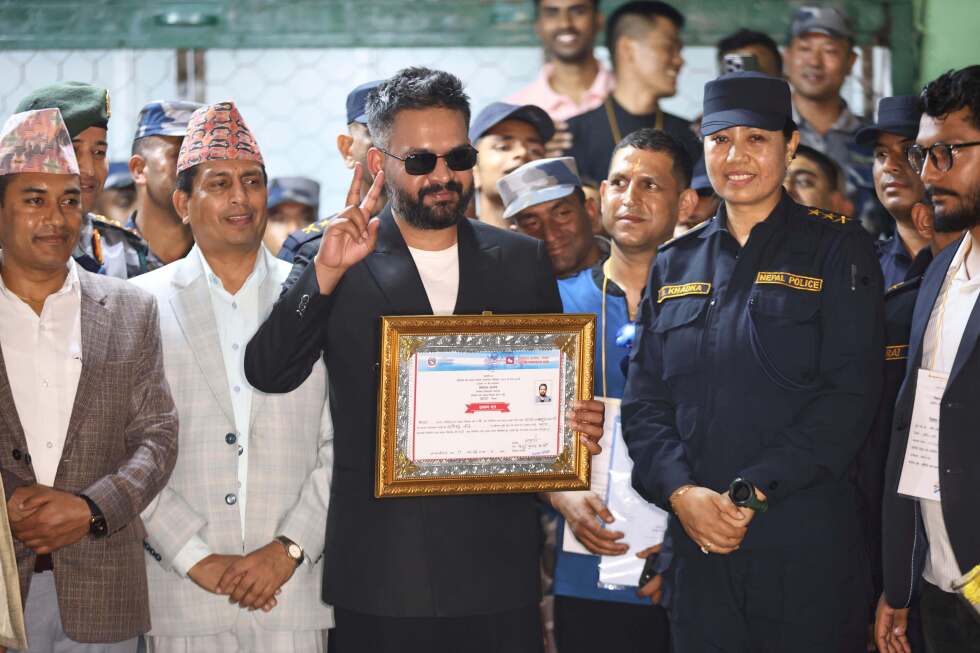
Nepali voters have delivered a seismic political shift as the Rastriya Swatantra Party (RSP), a political movement formed just four years ago and led by a former rapper, secured a landslide victory in the country’s parliamentary elections.
According to results published Sunday by Nepal’s Election Commission, the RSP had already won 117 of the 165 directly elected seats and was leading in eight other constituencies. The party also dominated the proportional representation component, securing approximately 51% of the 110 seats allocated through this system.
The scale of the victory marks an extraordinary political transformation in Nepal, where two traditional parties – the Nepali Congress and the Communist Party of Nepal (Unified Marxist-Leninist) – have alternated power for decades. These established political forces have been relegated to the sidelines, collectively securing just 36 seats in the results announced so far.
Balendra Shah, a popular rapper-turned-politician who won Kathmandu’s mayoral race in 2022, is the RSP’s prime ministerial candidate. Shah emerged as a prominent figure during the 2025 uprising that ousted former Prime Minister Khadga Prasad Oli’s government following widespread protests against corruption and ineffective governance.
Nepal’s electoral system combines direct representation with proportional allocation. Voters cast two ballots – one for a candidate in their constituency and another for their preferred political party. The 275-member House of Representatives consists of 165 directly elected members, with the remaining 110 seats distributed proportionally based on each party’s share of the vote.
The RSP’s commanding position will likely allow it to form a single-party government, a rarity in Nepal’s typically fragmented political landscape. Local media outlets have characterized the results as revolutionary, with headlines such as “People’s ballot revolt; shift in political paradigm” from the Annapurna Post capturing the historic significance.
Despite the jubilant atmosphere, the party has taken a somber approach to its victory. RSP officials have asked candidates and supporters to refrain from celebratory rallies out of respect for those who lost their lives during last year’s youth-led protests, which played a crucial role in catalyzing political change.
“The future prime minister has clearly spoken that there will be no compromise when it comes to developing the country,” said Khagendra Chapagain, an RSP party member and volunteer at the party’s Kathmandu headquarters. “Our first agenda is to develop the nation, and focus will be on health, education and the fight against corruption.”
The RSP’s meteoric rise reflects deep public frustration with Nepal’s traditional political establishment. The movement gained significant momentum following widespread protests triggered by a social media ban, which evolved into a broader popular revolt against perceived government corruption and ineffective leadership. The protests turned deadly when security forces opened fire on demonstrators, resulting in dozens of fatalities and hundreds of injuries.
Political analysts caution that the RSP faces significant challenges despite its electoral triumph. “The problem or challenge with this new party would be to deliver things, given the limited resources and limited institutional support,” noted independent analyst Keshab Prasad Poudel. “Because people have high expectations, that doesn’t necessarily mean that the new party can fulfill it.”
The election represents a generational shift in Nepali politics, with younger voters – particularly Gen Z – playing a decisive role in rejecting established political forces in favor of candidates promising genuine reform and accountable governance.
Officials continue counting votes, with final results expected later this week. The outcome signals a clear mandate for change in this strategically important Himalayan nation, which sits between regional powers India and China and has long struggled with political instability and economic development challenges.
Fact Checker
Verify the accuracy of this article using The Disinformation Commission analysis and real-time sources.

7 Comments
The rise of the Rastriya Swatantra Party is a remarkable political story. As a former rapper, Balendra Shah seems to have really connected with Nepali voters, especially the younger generation. I’ll be interested to see how this impacts Nepal’s approach to mining, energy, and other key economic sectors.
Fascinating to see a political newcomer like the Rastriya Swatantra Party secure such a decisive victory in Nepal. As a former rapper, their leader Balendra Shah seems to have really resonated with the electorate. It will be interesting to see what policy changes they propose for the mining and energy sectors.
Yes, it’s a remarkable political shift. The RSP’s populist platform clearly struck a chord with Nepali voters. I’m curious to learn more about their plans for mining and energy – those industries are so important for Nepal’s economy.
Wow, this is a major political shakeup in Nepal. The Rastriya Swatantra Party’s landslide victory signals a real hunger for change among Nepali voters. I wonder if they will take a more progressive stance on issues like mining regulations, renewable energy development, and environmental protections.
A landslide victory for an upstart political party in Nepal is quite noteworthy. Given the RSP’s roots in the anti-government protests, I wonder if they will take a more critical stance on issues like mining regulations and environmental protection. It could signal a sea change in Nepali politics.
Good point. The RSP’s success may indicate a desire for greater transparency and accountability in how Nepal’s natural resources are developed and managed. I’ll be curious to see if they pursue any policy reforms in that direction.
A former rapper leading a new political party to a landslide win in Nepal? That’s certainly an unexpected and intriguing outcome. I’m curious to learn more about the Rastriya Swatantra Party’s platform and how they plan to address issues surrounding the country’s mining, commodities, and energy sectors.