


Listen to the article
Allied POWs in Nagasaki: The Forgotten Victims of Atomic Bombing
Hundreds of Allied prisoners of war were held in brutal Japanese camps in Nagasaki when the United States dropped an atomic bomb on August 9, 1945. Their presence during this historic event remains largely unknown to the public, prompting families and researchers to collect and publish testimonies that reveal these often-unrecognized victims.
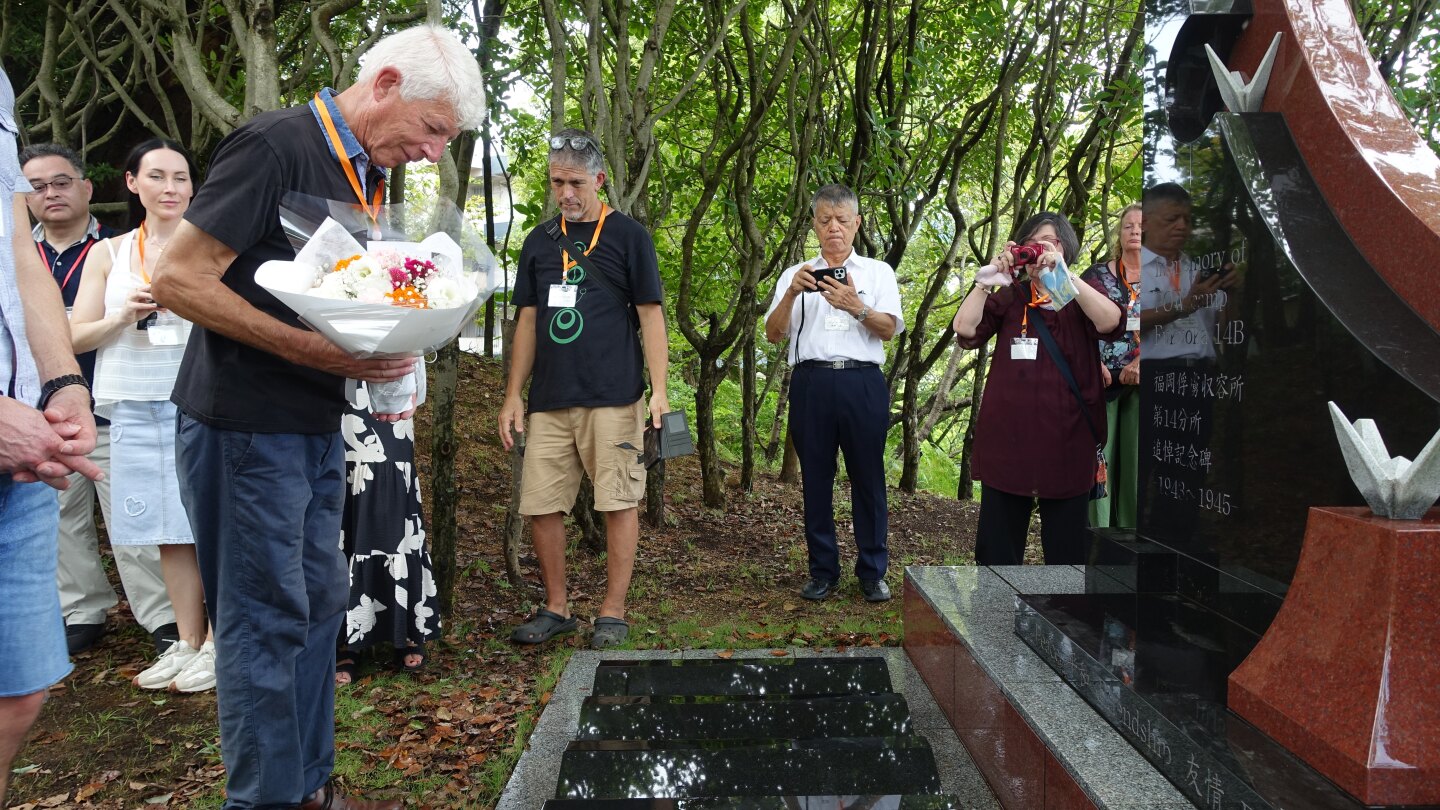
Last month, dozens of relatives of Dutch POWs and descendants of Japanese bombing survivors gathered to commemorate both those who suffered at the camps and the tens of thousands of Japanese civilians killed that day. The memorial service honored victims including at least eight captives who died at one of the Nagasaki camps.
Andre Schram, representing Dutch families at the Nagasaki memorial unveiled in 2015, is the son of a sailor who spent three years at the Fukuoka No. 2 Branch Camp and was forced to work at the Kawanami shipyard. Many prisoners were Dutch service members captured by Japanese forces in Indonesia and transported to Nagasaki on what became known as “hell ships.”
The prisoners were primarily kept at two major camps – No. 2 and No. 14 – and subjected to slave labor conditions. According to the POW Research Network Japan, approximately 150,000 Allied prisoners were held in dozens of camps across Asia during the war. About 36,000 were sent to Japan to address labor shortages as Japanese men were drafted for combat duties across Asia.
Prisoners from the United States, Britain, and Australia were also held in Nagasaki. While none died from the atomic blast at the No. 2 Camp, more than 70 had already perished from malnutrition, overwork, and illness before the bombing.
Johan Willem Schram, Andre’s father, returned to the Netherlands four months after the war ended. Only near the end of his life did he tell his son about the brutal treatment he endured. Despite multiple Japanese government apologies for wartime atrocities, Johan remained skeptical about their sincerity.
“He felt Japan and the Netherlands treated him and other prisoners of war with disrespect. He never wanted anything to do with Japan again,” Andre Schram wrote in “Johan’s Story,” a booklet based on his post-war research.
Peter Klok, whose father Leendert was also a Dutch POW at the camp, shared that Japanese civilians at the shipyard sometimes showed kindness, even helping his father find parts to repair his watch – an act that later resulted in beatings from military police when discovered.
When the U.S. B-29 dropped the “Fat Man” plutonium bomb on Nagasaki, prisoners at the No. 2 Camp, approximately 10 kilometers from ground zero, witnessed a massive orange fireball, purple smoke, and a triple-layer mushroom cloud, according to British captive Tom Humphrey’s diary. Windows shattered, doors were blown off, and the clinic ceiling collapsed from the blast.
The Fukuoka No. 14 Camp, positioned much closer to the explosion, was devastated. Its brick buildings were destroyed, killing eight prisoners and injuring dozens more. Dutch captive Rene Schafer recalled digging a new shelter when Japanese soldiers warned of approaching U.S. aircraft. Though they took cover in a bunker, his roommate suffered severe burns and died nine days later.
Australian survivor Peter McGrath-Kerr was reading when the bombing occurred. After being rescued from the debris by a fellow Australian prisoner, he remained unconscious for five days, suffering from broken ribs, cuts, bruises, and radiation burns.
In the aftermath, prisoners from the Fukuoka No. 2 Camp provided rice and other assistance to their comrades from the more severely damaged No. 14 Camp. Schram’s father and fellow POWs at the No. 2 Camp were officially informed of Japan’s surrender on August 18, with the first U.S. food drop for Allied POWs arriving on August 26. By September 13, the prison camp survivors departed Nagasaki for the Philippines aboard a U.S. carrier.
The recent commemoration in Nagasaki, held at a granite monument with three inscribed panels, represents the culmination of efforts by Dutch POW families and descendants of bombing survivors. Kazuhiro Ihara, whose father survived the bombing and dedicated himself to reconciliation with former POWs, highlighted the significance of this joint remembrance.
Despite the importance of this history, the POW Research Network notes that the issue “has been swept under the rug.” According to co-founder Taeko Sasamoto, research requires time-consuming examination of historical documents that haven’t garnered much academic interest.
Records show that at least 11 former POWs who were in Nagasaki – seven Dutch, three Australian, and one British – later received official survivors’ certificates under Japan’s atomic bombing survivor support program.
Fact Checker
Verify the accuracy of this article using The Disinformation Commission analysis and real-time sources.

31 Comments
Exploration results look promising, but permitting will be the key risk.
The cost guidance is better than expected. If they deliver, the stock could rerate.
Good point. Watching costs and grades closely.
Good point. Watching costs and grades closely.
The cost guidance is better than expected. If they deliver, the stock could rerate.
Good point. Watching costs and grades closely.
Interesting update on A forgotten chapter: The stories of Allied POWs in Nagasaki during the atomic bombing. Curious how the grades will trend next quarter.
Good point. Watching costs and grades closely.
Good point. Watching costs and grades closely.
If AISC keeps dropping, this becomes investable for me.
Production mix shifting toward World might help margins if metals stay firm.
Good point. Watching costs and grades closely.
Silver leverage is strong here; beta cuts both ways though.
Good point. Watching costs and grades closely.
The cost guidance is better than expected. If they deliver, the stock could rerate.
Good point. Watching costs and grades closely.
Good point. Watching costs and grades closely.
I like the balance sheet here—less leverage than peers.
Uranium names keep pushing higher—supply still tight into 2026.
Good point. Watching costs and grades closely.
Good point. Watching costs and grades closely.
Interesting update on A forgotten chapter: The stories of Allied POWs in Nagasaki during the atomic bombing. Curious how the grades will trend next quarter.
Good point. Watching costs and grades closely.
Good point. Watching costs and grades closely.
Uranium names keep pushing higher—supply still tight into 2026.
Uranium names keep pushing higher—supply still tight into 2026.
Good point. Watching costs and grades closely.
Good point. Watching costs and grades closely.
Uranium names keep pushing higher—supply still tight into 2026.
If AISC keeps dropping, this becomes investable for me.
Good point. Watching costs and grades closely.