


Listen to the article
A Bosnian rock band’s satirical song about immigration has found unexpected new life as the soundtrack to the nation’s World Cup journey, uniting a country still grappling with deep ethnic divisions more than three decades after war tore it apart.
Dubioza Kolektiv, a genre-bending band known for weaving political and social causes into their music, never imagined their 2011 hit “USA” would become a rallying cry for Bosnia-Herzegovina’s national soccer team. But when fans unfurled banners with the song’s lyrics during crucial World Cup qualifying matches, the band knew something special was happening.
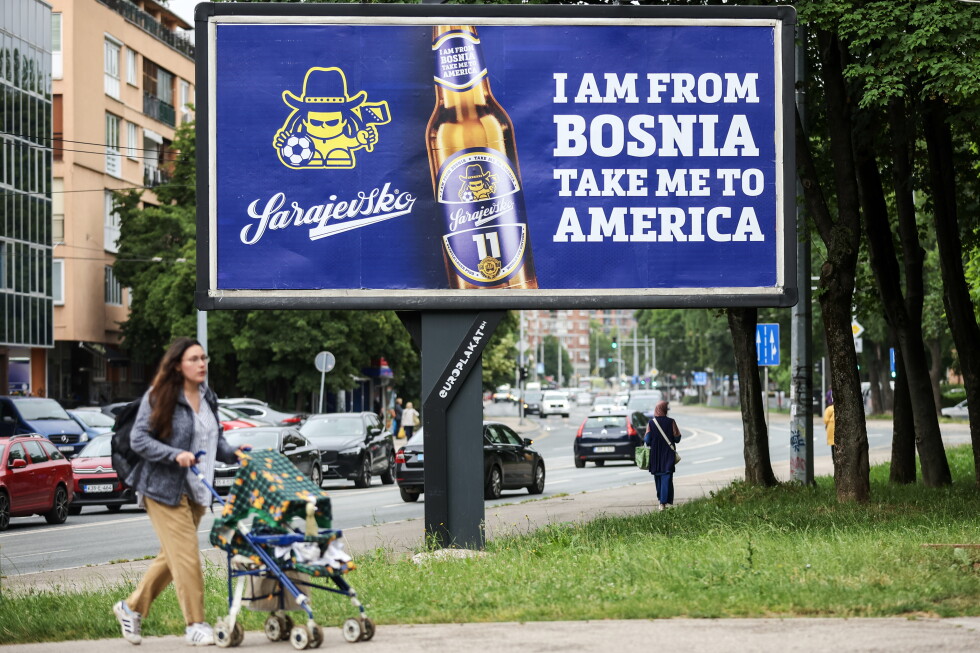
The opening lines couldn’t be more straightforward: “I am from Bosnia; take me to America.” Originally a critique of disillusionment with the American Dream, the song has been reimagined as “I Am From Bosnia, Take Me to America,” now serving as an anthem celebrating soccer’s working-class roots and the nation’s improbable journey to the tournament.
In less than three weeks, the new music video has racked up nearly two million views on YouTube, adding to the 26 million views the original English-language version has accumulated over the years. The updated version, filmed in a Sarajevo neighborhood and featuring accordion-heavy melodies, is sung mostly in Bosnian to ensure local audiences connect with its message.
“It’s an interesting story how this song got its second and third and fourth incarnation in these 15 years,” reflected Vedran Mujagić, the band’s bassist, speaking to The Associated Press. “It evolved from this satirical take on immigration and the American Dream and it was translated into an American football dream for the entire nation.”
Bosnia-Herzegovina is making only its second appearance at a World Cup, a goal that once seemed nearly impossible as traditional soccer powerhouses blocked their path. But late in April, a dramatic late goal against Wales propelled the team to victory in a penalty shootout. Days later, they repeated the feat against Italy, securing their place in the tournament.
Keyboardist Brano Jakubović said he was surprised when supporters began singing the old lyrics as a rallying cry during matches. “First, it was working as a joke, but what I like the most is the supporters kind of loaded completely new meaning to the old song, and this is the best thing for the band or for the song: when people take over and load new meaning and then it becomes theirs,” he explained. “It’s not ours anymore.”
The original “USA” is undeniably catchy, with its protagonist eagerly declaring, “I can no longer wait, take me to United States / Take me to Golden Gate, I will assimilate.” But the song’s upbeat tempo masks a darker narrative about the disappointment many immigrants face when leaving the Balkans for what they hope will be a better life abroad.
The band decided to deliver an updated version of what Jakubović describes as a “typical immigrant song,” writing new lyrics befitting a soccer anthem. While maintaining the original’s musical structure, the new version addresses themes specific to Bosnian soccer fans, including inside jokes that Jakubović acknowledges would be difficult for outsiders to understand.
One of his favorite new lines offers catharsis for a moment that has haunted the country since the 2014 World Cup: “And that goal against Nigeria, that was never offside.” The controversial call remains a source of national frustration, what Jakubović jokingly calls “a big national trauma in Bosnia.”
But the joking tone belies a deeper significance. Trauma has been a constant presence in Bosnia since its independence amid Yugoslavia’s dissolution in 1992. Interethnic war erupted almost immediately, culminating in genocide. More than three decades after the Srebrenica massacre, deep divisions persist between Bosnian Serbs and Bosniak Muslims, making national unity rare.
“Football in this moment is much more than just a game, it’s a hope and it’s very basically a political thing because it brought all the people from Bosnia together, which is usually not the case,” Jakubović said.
Bosnia’s first World Cup match is scheduled against Canada, but the team will indeed be taken to America, as the song promises. Their base camp is in Sandy, Utah, and their other group stage matches against Switzerland and Qatar will also be played in the United States. As Mujagić points out, many players were born in the U.S. or elsewhere in the diaspora, children of those who left Bosnia during or after the war.
“They are children of those people who went outside in search of a better life or as refugees or whatever their story was,” he said. “And they kind of see and hear these lyrics and this song entirely differently from us.”
Mujagić believes the original message of “USA” remains relevant as Bosnians continue to emigrate. Once they leave, he notes, “they encounter this hostility of the locals, right-wingers, and they just don’t want them there.”
“So it’s this schizophrenic situation in which you want to go there, but you somehow know that you won’t have it good on the other side as well,” he concluded. “So in that sense, this song still works perfectly well as it worked before.”
In St. Louis, home to one of the largest Bosnian communities in the United States, the song resonates deeply. Admir Hodzic, a 40-year-old business owner and co-founder of the BH Loyals supporter group, was born in Bosnia and has moved back and forth between his homeland and America.
“I think every Bosnian that lives here and understands how the system works and everything else, I think they will find the truth in that song, and that song is honestly nothing but the truth,” he said. While there are more opportunities in the U.S. than elsewhere, he acknowledged, “it’s a matter of biting your teeth and pulling through the worst times possible.”
Hodzic and his fellow supporters are devoted fans of Dubioza Kolektiv, regularly singing their anthem at matches and watch parties. Interestingly, though, they more often sing the original “USA” version rather than the new soccer-specific adaptation.
“It’s engraved in their brain and their hearts,” he explained, “and no matter what, they just go back to the old lyrics, you know?”
The phenomenon demonstrates how music can transcend its original intent, becoming a vessel for collective hope and identity. For a nation still healing from war and struggling with internal divisions, a satirical song about immigration has unexpectedly become the anthem of unity, carried forward by a national soccer team representing all Bosnians, regardless of ethnicity or where they now call home.
Fact Checker
Verify the accuracy of this article using The Disinformation Commission analysis and real-time sources.

13 Comments
Exploration results look promising, but permitting will be the key risk.
Good point. Watching costs and grades closely.
Good point. Watching costs and grades closely.
Uranium names keep pushing higher—supply still tight into 2026.
Good point. Watching costs and grades closely.
Good point. Watching costs and grades closely.
I like the balance sheet here—less leverage than peers.
Good point. Watching costs and grades closely.
The cost guidance is better than expected. If they deliver, the stock could rerate.
Good point. Watching costs and grades closely.
The cost guidance is better than expected. If they deliver, the stock could rerate.
Good point. Watching costs and grades closely.
Good point. Watching costs and grades closely.