


Listen to the article
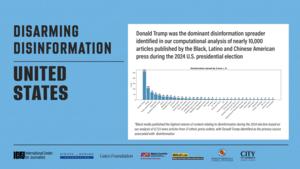
Former President Trump emerged as the primary source and distributor of disinformation in ethnic and Indigenous press during the 2024 U.S. presidential election, according to a comprehensive new study released today. The finding contradicts common assumptions that disinformation primarily originates from foreign actors.
The report, “Disarming Disinformation: US,” represents a collaboration between the International Center for Journalists, City St George’s (University of London), the University of Maryland, and Arizona State University. It reveals a troubling landscape where disinformation is increasingly propagated by domestic political forces rather than foreign states.
Researchers analyzed thousands of news articles and social media posts while conducting dozens of in-depth interviews to understand how disinformation flows through media channels serving diverse communities. The study specifically examined publications serving Black, Indigenous, Latino, and Asian American communities.
“We’re seeing a significant shift in disinformation tactics,” explained Professor Julie Posetti from City St George’s, one of the study’s lead researchers. “What’s particularly concerning is how this disinformation correlates with increased violence against journalists and declining trust in news media.”
The report found that 86% of Americans have witnessed journalists being harassed or abused online, suggesting such attacks have become normalized amid unprecedented political targeting of the press. This environment has contributed to an erosion of trust in mainstream media, though with notable differences along racial lines – 32% of people of color expressed distrust in the news, compared to 44% of white respondents.
Closed digital spaces like WhatsApp groups and WeChat channels function as “information cocoons,” the researchers discovered. These platforms allow rumors and disinformation to spread unchecked, often using the same channels and methods as financial scams. The isolation of these spaces makes fact-checking and correction particularly challenging.
The Haitian Times, one of five media outlets examined in depth, found itself at the epicenter of disinformation when Haitians were falsely accused by Trump and his running mate J.D. Vance of eating neighbors’ pets. This case exemplifies how targeted communities can become scapegoats through manufactured falsehoods that rapidly spread across media ecosystems.
Indigenous communities face unique challenges, according to the report. Their voices are frequently excluded or deliberately omitted from mainstream coverage, which researchers found fuels racist narratives and effectively erases their everyday experiences and agency from political discourse.
The research team employed multiple methodologies to ensure comprehensive findings. They conducted computational analysis of over 10,000 news articles and social media posts during the election cycle, developed in-depth case studies of five media outlets serving diverse communities, interviewed 45 journalists from ethnic and Indigenous publications, and surveyed 1,020 American adults about attitudes toward disinformation and the news media.
“What makes this study particularly valuable is its focus on publications serving specific communities that are often overlooked in broader media analyses,” said Professor Sarah Oates from the University of Maryland, another lead researcher. “These outlets play a crucial role in informing their communities, yet face distinct challenges in combating disinformation.”
The findings raise important questions about the responsibility of political figures, social media platforms, and traditional news outlets in addressing disinformation. As trust in mainstream media continues to decline, the report suggests that understanding how disinformation spreads through different community channels is essential for developing effective countermeasures.
The study was peer-reviewed by Dr. Lea Hellmueller and received funding from the Scripps Howard Foundation and the Gates Foundation, though the researchers emphasized that the findings represent their independent work and expertise.
Fact Checker
Verify the accuracy of this article using The Disinformation Commission analysis and real-time sources.

10 Comments
It’s disappointing to see former President Trump emerge as a key source of disinformation, even in minority media. This underscores the importance of independent, ethical journalism to counter such narratives.
Absolutely. Maintaining the integrity of media, regardless of the target audience, is essential for a healthy democracy.
This study provides important insights into the evolving landscape of disinformation. Addressing domestic political actors as the source is crucial, rather than solely focusing on foreign interference. Collaborative efforts between media, researchers, and communities will be key.
Well said. Multifaceted approaches that empower diverse communities are vital to combating the spread of harmful disinformation.
Interesting study findings. It’s concerning to see domestic political actors spreading disinformation, even in minority media outlets. Transparency and fact-checking are crucial to combat this threat to democratic discourse.
I agree, the rise of domestic disinformation is worrying. Robust media literacy efforts will be key to helping diverse communities discern truth from fiction.
The findings highlight the need for stronger media literacy and fact-checking, especially in minority communities that may be more vulnerable to targeted disinformation campaigns. Vigilance is crucial.
Well said. Empowering diverse communities to critically evaluate information sources is vital to protecting democratic discourse.
This is a troubling development. Disinformation undermines trust in the media and fuels polarization. I hope this study leads to greater scrutiny and accountability for those sowing division.
Absolutely. Domestic disinformation is a complex challenge, but identifying the sources and tactics is an important first step.