


Listen to the article
The Great Distortion: How Information Warfare Is Reshaping Africa’s Future
Across the Sahel, as farmlands wither and supply chains crumble, millions of Africans face hunger and deprivation. Yet in digital spaces, a different reality unfolds. Social media feeds portray these same events as either heroic national liberation or neocolonial exploitation, depending on which algorithm serves the content.
This phenomenon—where a single mining contract signed in Mali’s capital of Bamako transforms within hours into a polarizing hashtag campaign—represents what analysts now call the “Great Distortion,” a strategic engineering of perception that prioritizes regime survival over genuine development.
Africa has become the primary battleground for this new form of information warfare precisely because of its strategic importance. The continent’s vast natural resources remain critical to global supply chains, while its population of over 400 million social media users—predominantly young and digitally connected—generates billions of daily interactions, creating fertile ground for manipulation.
Far from being peripheral to geopolitics, these coordinated disinformation campaigns have evolved into sophisticated weapons that fracture social cohesion, undermine democratic institutions, and enable foreign powers to secure access to strategic resources under terms that would otherwise face strong public resistance.
The mechanism operates with disturbing efficiency. External actors—both state entities and private interests—package security assistance, military contractors, and disinformation campaigns into comprehensive offerings. In exchange, they receive mining concessions, port access, or diplomatic support through contracts that rarely face parliamentary scrutiny.
This arrangement has fundamentally transformed international relations across Africa. The post-Cold War model of aid-for-reform has given way to a darker transactional diplomacy where economic conditionality takes a back seat to narrative control. Regimes unable to provide basic services like healthcare or electricity can nonetheless maintain power by outsourcing their legitimacy to digital propaganda operations—and, when necessary, unchecked violence.
“This distortion creates an entirely new political economy,” explains Dr. Aisha Mahmoud, researcher at the African Center for Strategic Studies. “Governments appear superficially sovereign while becoming increasingly dependent on foreign backers who supply both military support and favorable narratives.”
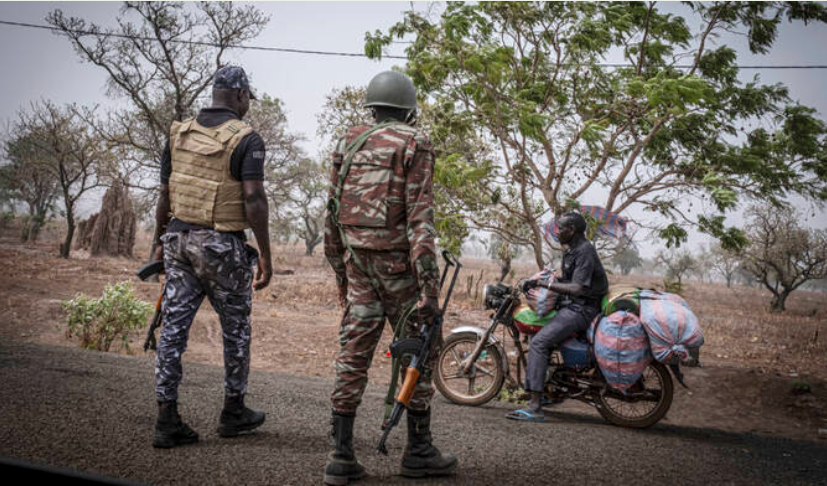
The military juntas currently governing Mali, Burkina Faso, and Niger illustrate this paradox. Despite deteriorating economic conditions marked by inflation and collapsing public services, these regimes have consolidated control through narratives that reframe military takeovers as patriotic revolutions rather than constitutional failures.
What emerges is what analysts term a “sovereignty trap.” Governments project formal independence through nationalist rhetoric and symbols while their survival increasingly depends on external powers that provide security guarantees and narrative support. The result: policy decisions that prioritize the interests of these backers rather than national development goals.
Digital geopolitics has also transformed Africa into a proxy battleground for global rivalries. Conflicts like the Ukraine war and Middle East tensions now play out through African information channels, with rival powers using the continent’s digital ecosystems to undermine each other’s credibility by amplifying existing ethnic grievances, religious tensions, and anti-Western sentiment.
Sudan provides a sobering example. Competing disinformation campaigns flood social media with contradictory claims about battlefield developments and atrocities, creating such profound confusion that humanitarian organizations struggle to establish safe corridors while civilians must navigate contradictory realities under active bombardment.
The economic costs of this distortion are substantial but often overlooked. Investment decisions hinge as much on perceived stability as on market fundamentals. When conflicting narratives inflate risk assessments, capital becomes more expensive and infrastructure development stalls. Africa’s digital vulnerability—hosting just 1% of global data center capacity while storing over half its data on servers in Europe and North America—leaves the continent particularly susceptible to having its digital reality shaped elsewhere.
“When foreign actors control both the narrative and the infrastructure that delivers it, authentic African perspectives become increasingly marginalized,” notes Emmanuel Nkrumah, director of the Digital Rights Initiative in Accra.
Yet this is not simply a story of external manipulation. Many African political elites actively participate in and benefit from information warfare. Disinformation provides convenient shields against accountability. Governments unable to deliver development outcomes can instead manufacture external threats—whether foreign powers, ethnic rivals, or “neo-colonial” conspiracies—to rally support through manufactured outrage.
Increasingly, information warfare has become a domestic political tool used by incumbents to delegitimize opposition, silence journalists, and justify postponed elections. In Kenya, investigations have revealed networks of “for-hire” influencers who orchestrate harassment campaigns against judges and civil society activists, creating an environment of self-censorship that undermines democratic oversight.
Despite these challenges, some African nations are forging more productive partnerships based on measurable deliverables rather than ideological alignment. A growing number of states are pivoting toward middle powers, particularly from the Gulf and Asia, that offer concrete infrastructure development—port expansions in the Horn of Africa, renewable energy installations in the Sahel, and food security corridors—without accompanying propaganda campaigns.
The Great Distortion ultimately functions as an invisible tax on Africa’s development potential, inflating political risk, distorting policy priorities, and diverting resources toward information warfare rather than essential infrastructure and services. As external powers project their global rivalries onto African digital spaces, the continent risks becoming permanently trapped in competing narratives that obscure rather than illuminate paths to progress.
True sovereignty in the digital age requires not just formal independence but the capacity to perceive reality without foreign filters and to act on that understanding. As Africa’s position in the global order undergoes renegotiation, the integrity of its information ecosystem may determine whether the continent achieves prosperity or remains caught in permanent distortion.
Fact Checker
Verify the accuracy of this article using The Disinformation Commission analysis and real-time sources.

10 Comments
Production mix shifting toward Disinformation might help margins if metals stay firm.
Good point. Watching costs and grades closely.
Nice to see insider buying—usually a good signal in this space.
Uranium names keep pushing higher—supply still tight into 2026.
Interesting update on Africa Requires Fresh Perspective for International Partnerships. Curious how the grades will trend next quarter.
Good point. Watching costs and grades closely.
The cost guidance is better than expected. If they deliver, the stock could rerate.
Interesting update on Africa Requires Fresh Perspective for International Partnerships. Curious how the grades will trend next quarter.
Good point. Watching costs and grades closely.
Good point. Watching costs and grades closely.