


Listen to the article
With tensions rising ahead of Côte d’Ivoire’s presidential election on October 25, a surge of misinformation threatens to destabilize an already fragile political landscape. Digital falsehoods, including sophisticated AI-generated content, are spreading rapidly across social media platforms, raising concerns among election observers and security analysts.
False narratives claiming violence at protests and allegations of unfair campaigning practices have proliferated online in recent weeks. These digital deceptions come at a particularly sensitive moment for the West African nation, which has a history of electoral unrest and violence.
“The spread of misinformation could potentially inflame tensions in a country that has experienced electoral violence in the past,” said a digital rights expert who monitors election-related content across the region. “What’s particularly concerning is the sophistication of some of these campaigns, which blend just enough truth with fiction to appear credible.”
Recent political developments have provided fertile ground for such misinformation. The Constitutional Court’s controversial decision to disqualify opposition figures Tidjane Thiam and former president Laurent Gbagbo from the presidential race has sparked protests and fueled identity-based rumors online.
Security forces have already taken a hard stance against opposition demonstrations. Authorities dispersed a banned march in Abidjan earlier this month using tear gas, arresting 237 people and injuring several others. The government has since implemented a nationwide ban on public gatherings that challenge the court’s candidate disqualification decision.
In response to these restrictions, the country’s two main opposition parties have called for daily nationwide protests. This standoff creates an environment where misinformation can easily trigger real-world consequences.
International observers have noted another troubling dimension to the information landscape: potential foreign interference. Intelligence sources have identified Côte d’Ivoire as a possible target for influence operations originating from neighboring Sahel states, where political instability and military coups have reshaped regional power dynamics.
“We’re seeing patterns consistent with coordinated foreign information operations aimed at swaying political narratives,” said a regional security analyst who requested anonymity. “The goal appears to be exacerbating existing divisions within Ivorian society ahead of this critical vote.”
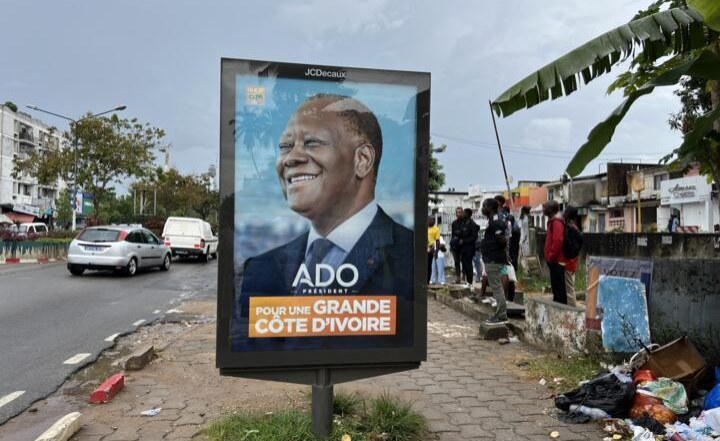
The incumbent, President Alassane Ouattara, is seeking to maintain his party’s grip on power. Campaign posters for Ouattara’s RHDP party are visible throughout Abidjan, including in the upscale Cocody district, highlighting the official campaign’s visibility amid the digital noise.
Ivorian authorities, alongside civil society organizations, have launched counter-initiatives to combat the spread of election-related misinformation. These include fact-checking campaigns, digital literacy programs, and public awareness efforts encouraging voters to verify information before sharing it.
“Distinguishing between genuine political discourse and manufactured narratives has become increasingly difficult,” said a spokesperson for a local fact-checking organization. “We’re particularly concerned about AI-generated content that can be produced at scale and tailored to exploit specific social divisions.”
The upcoming election represents a critical test for Côte d’Ivoire’s democratic institutions and social cohesion. As the West African economic powerhouse approaches voting day, the battle against misinformation has become as important as the political campaign itself.
Regional stability experts warn that the outcome of this information war could significantly impact both the legitimacy of the electoral process and the country’s ability to maintain peace during the transition period. With neighboring countries watching closely, the stakes extend well beyond Côte d’Ivoire’s borders, potentially influencing democratic processes throughout West Africa.
Fact Checker
Verify the accuracy of this article using The Disinformation Commission analysis and real-time sources.

9 Comments
The Constitutional Court’s decision to disqualify opposition candidates could be a flashpoint for further unrest and misinformation. Transparency around the electoral process will be crucial to maintain trust.
A history of electoral violence makes this situation even more precarious. Efforts to curb the spread of online falsehoods and maintain stability will require a coordinated, multilateral approach.
You’re right, the stakes are high. International election monitors and regional organizations will need to play a role in ensuring a fair, transparent process.
The blend of truth and fiction to create credible-looking narratives is a real challenge. Voters will need to be extra vigilant about verifying information from reliable sources during this election season.
Absolutely. Critical thinking and fact-checking are key to cutting through misinformation. I hope election officials and civil society groups can get ahead of these tactics.
The use of sophisticated AI-generated content to spread misinformation is particularly concerning. Robust fact-checking and digital forensics will be essential to identify and debunk these types of deceptions.
Misinformation is a global challenge, but its impact can be especially damaging in fragile political environments. Effective strategies to combat it will require coordination across borders and sectors.
Misinformation campaigns that tap into existing political tensions are always worrying. I hope Côte d’Ivoire’s authorities and civil society can work together to safeguard the integrity of the upcoming vote.
This is concerning news. Misinformation can be a real threat to fair and peaceful elections. Monitoring online content and combating digital deception will be crucial in the lead-up to Côte d’Ivoire’s presidential vote.