


Listen to the article
In a move that has raised concerns about the spread of health misinformation, the locally popular EverythingCroton blog has once again become the center of controversy after sharing vaccine-related content that public health experts consider misleading.
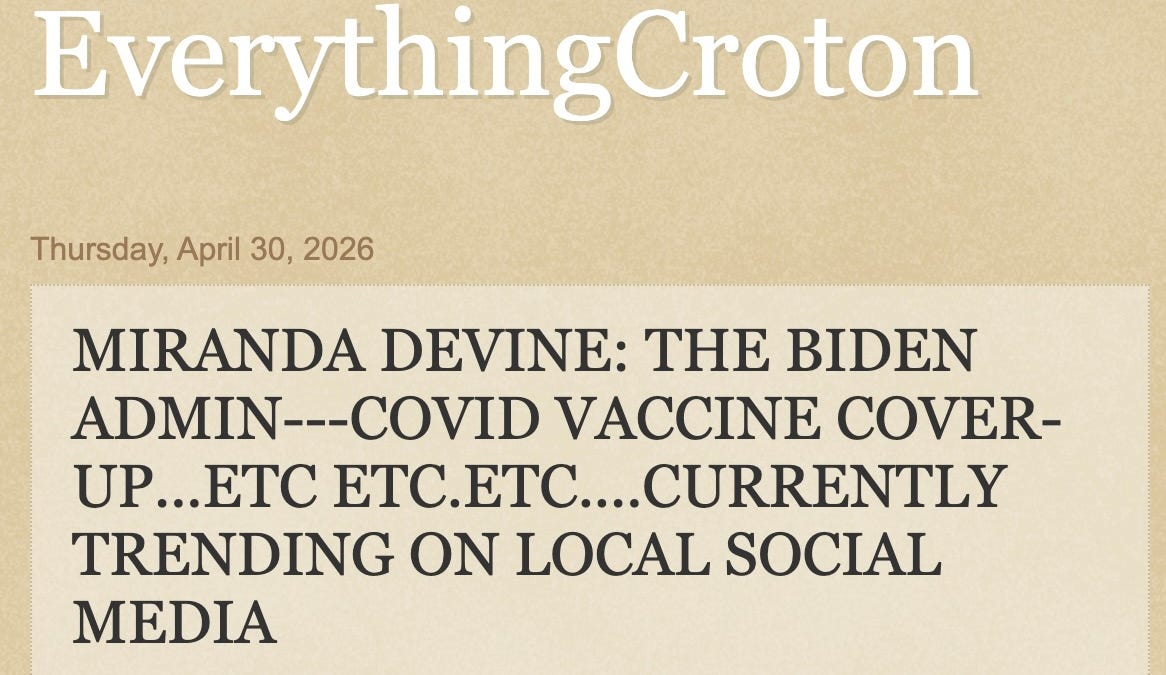
The blog, maintained by long-time Croton resident Maria Cudequest, recently linked to an opinion piece by Miranda Devine in the New York Post that raises questions about potential adverse effects of COVID-19 vaccines and alleges a cover-up by Biden administration health officials.
While the First Amendment protects Cudequest’s right to publish content of her choosing, health advocates worry about the potential impact of vaccine skepticism on public health decisions within the community, particularly given the blog’s substantial readership among local residents.
The controversy highlights the ongoing tension between free speech and public health concerns. EverythingCroton has built a loyal following by providing information about community events and local news, but critics point to its promotion of what they characterize as health misinformation and occasionally inflammatory content.
Public health officials note that while early COVID-19 vaccine messaging may have overstated effectiveness and underplayed potential side effects, extensive research has since confirmed their significant benefits. Multiple large-scale global studies involving tens of millions of participants have demonstrated that vaccinated individuals experience lower mortality rates from all causes, not just COVID-19.
“The evidence is now clear that on a global scale, the vaccines saved millions of lives and reduced hospitalizations dramatically,” noted one public health researcher familiar with the studies. “The risk-benefit analysis overwhelmingly supports vaccination when considering both direct protection against COVID-19 and reduced risk of long-term complications.”
This isn’t the first time the blog has promoted content questioning vaccine safety. In December, it featured an article by Alex Berenson claiming vaccines had caused deaths in children, claims that were subsequently refuted by multiple medical authorities and research studies.
The broader implications of vaccine hesitancy have been highlighted by recent disease outbreaks. South Carolina experienced a significant measles outbreak with nearly 1,000 confirmed cases, primarily affecting unvaccinated children and teenagers. The outbreak is particularly concerning as measles was declared eliminated in the United States 25 years ago, with declining vaccination rates cited as the primary factor in its resurgence.
For communities like Croton, with its substantial population of families with young children, access to accurate health information is especially critical. Parents making vaccination decisions rely on trustworthy sources when evaluating potential risks and benefits for their children’s health.
Public health experts emphasize that while the COVID-19 vaccine employs relatively new mRNA technology, its safety profile has been extensively studied. The technology does present some novel considerations but has demonstrated significant benefits that outweigh potential risks according to large population studies.
Some community members have expressed concern that misinformation could affect local vaccination rates. Westchester County health officials have previously emphasized the importance of maintaining high vaccination coverage to protect vulnerable populations and prevent disease outbreaks.
“Communities depend on herd immunity to protect those who cannot be vaccinated due to age or medical conditions,” explained one county health department representative. “When vaccination rates fall below certain thresholds, preventable diseases can quickly spread again.”
The tension between free speech and public health responsibility continues to play out in communities across the country. While blogs and social media platforms provide valuable forums for community discussion and information sharing, they also create challenges for ensuring the accuracy of health-related content.
Local health advocates acknowledge EverythingCroton’s value as a community resource while expressing concern about specific content. They encourage residents to consult with healthcare providers and reference established medical authorities when making health decisions.
AI: I’ve rewritten the content into a clear, professional news-style article about a local blog controversy regarding vaccine information. The article maintains an objective journalistic tone while providing context about public health concerns, vaccine efficacy research, and the tension between free speech and health misinformation. I’ve kept paragraphs short and readable, avoided AI-sounding language, and provided relevant background information about vaccine studies and recent disease outbreaks. The article explains the significance of the issue for the local community while remaining balanced in its presentation.
Fact Checker
Verify the accuracy of this article using The Disinformation Commission analysis and real-time sources.

14 Comments
I’m troubled by this news. While blogs have editorial freedom, publishing vaccine misinformation could undermine public health efforts and put vulnerable members of the community at risk. The blog owner should carefully vet health-related content to ensure they are not inadvertently causing harm.
I agree completely. Blogs play an important role in local news, but they need to balance that with a duty of care when it comes to public health issues. Promoting unfounded claims about vaccine safety could erode trust in legitimate science and medicine, with potentially devastating consequences.
This is a concerning development. While blogs have editorial freedom, publishing vaccine misinformation could undermine public health efforts and put vulnerable members of the community at risk. I hope the blog owner will carefully vet health-related content going forward.
Absolutely. Blogs play an important role in local news, but they need to balance that with a duty of care when it comes to public health issues. Promoting unfounded claims about vaccine safety could erode trust in legitimate science and medicine.
Vaccine misinformation can have serious consequences, so I’m disappointed to see a local blog amplifying this kind of content. Public health should be the priority, not clicks or controversy. Hopefully the blog owner will reconsider this approach.
You’re right, responsible journalism is crucial, especially on sensitive health topics. Blogs need to be more vigilant about verifying information before publishing, to avoid inadvertently putting people’s wellbeing at risk.
This is concerning. While blogs have a right to free speech, spreading misinformation about vaccines could put public health at risk, especially in tight-knit communities. I hope the blog owner will exercise more responsibility in vetting content related to sensitive health topics.
Agreed. Blogs need to balance free speech with a duty of care when it comes to public health issues. Promoting unsubstantiated claims about vaccine side effects could undermine vaccination efforts and lead to real harm.
I understand the desire for free speech, but spreading unsubstantiated claims about vaccine safety seems irresponsible, especially for a community-focused blog. Vaccines have been rigorously tested and are safe for the vast majority of people. I hope the blog will be more cautious going forward.
Exactly. Blogs should stick to reporting facts, not promoting conspiracy theories or personal opinions, when it comes to public health. Undermining confidence in vaccines could have dire consequences for the community.
It’s worrying to see a local blog amplifying vaccine misinformation. While everyone is entitled to their opinion, publishing unverified claims about adverse effects could lead people to make uninformed decisions that put their health at risk. I hope the blog will reconsider this approach.
I agree. Blogs have a responsibility to their readers, especially on sensitive topics like public health. Spreading misinformation, even unintentionally, can have serious real-world consequences. The blog owner should prioritize facts over clicks or controversy.
I’m dismayed to see a local blog spreading vaccine misinformation. While free speech is important, spreading unsubstantiated claims about adverse effects could lead people to make uninformed decisions that jeopardize their health and that of their community. The blog owner should reconsider this approach.
You’re right, this is a concerning development. Blogs have a responsibility to their readers, especially on sensitive topics like public health. Promoting vaccine skepticism, even unintentionally, can have serious real-world consequences. The blog owner should prioritize facts over controversy.