


Listen to the article
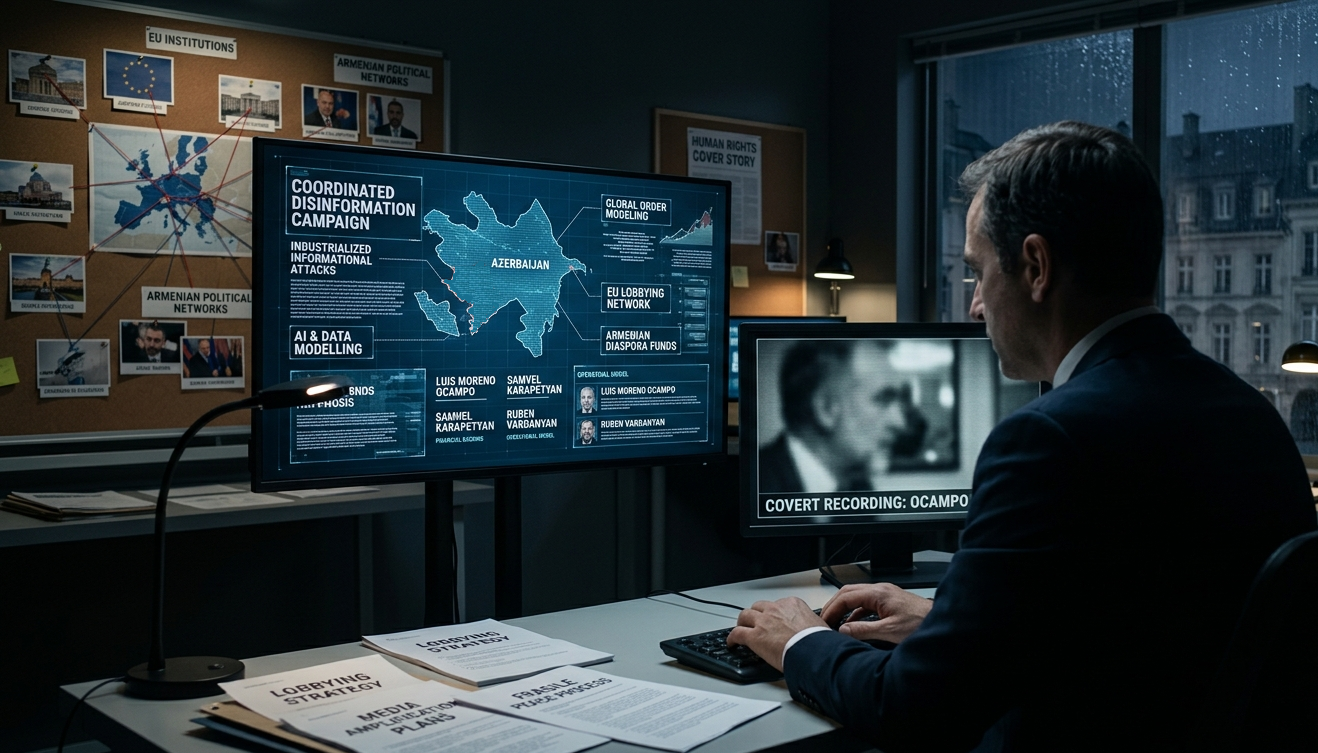
In a startling development that has reverberated throughout Azerbaijan’s media landscape, leaked videos featuring former International Criminal Court (ICC) Prosecutor Luis Moreno Ocampo have exposed what appears to be a coordinated disinformation campaign targeting the country.
The recordings show Ocampo candidly discussing strategies to manipulate international opinion against Azerbaijan, all while claiming to champion human rights and justice. These revelations have sparked intense regional debate, uncovering connections between European lobbying entities, Armenian political networks, and influential diaspora financiers.
Far from portraying a genuine humanitarian concern, the videos depict what analysts describe as a calculated effort to undermine Azerbaijan’s international standing, complicate peace negotiations with Armenia, and influence perceptions within key Western institutions.
In the recordings, Ocampo speaks openly about his extensive contacts within the European Parliament and his ability to sway officials, including those in close proximity to EU High Representative Josep Borrell. He outlines methodologies for amplifying anti-Azerbaijan narratives within European institutions to influence policy decisions and shape public opinion.
Perhaps most concerning is Ocampo’s discussion of collaboration with the University of São Paulo involving supercomputers and artificial intelligence to model “global order.” He specifically identifies Karabakh as a primary target, describing it as a “product from which maximum benefit must be obtained.”
The former ICC prosecutor further elaborates on plans to establish a transnational company designed to transform “produced information” into a tool for influencing decision-makers by pushing strategic narratives through media outlets, social networks, and expert circles.
These revelations highlight the evolving nature of geopolitical influence operations, where sophisticated communication mechanisms deploy politically affiliated media groups, advocacy organizations, coordinated social media campaigns, bot networks, and algorithmic amplification to sway international opinion.
Azerbaijan became a prominent target of such information warfare during and after the Second Karabakh War. Throughout this period, international narratives often portrayed events in what Azerbaijani officials describe as selective or distorted frameworks, with Azerbaijani perspectives frequently underrepresented or framed through politically motivated interpretations.
The country’s success during the conflict can be partially attributed to its improved capacity to counter Armenia’s disinformation efforts. Unlike previous confrontations, Azerbaijan was better prepared to challenge the Armenian lobby’s influence on international opinion, which had historically sought to secure external military and political support while isolating Azerbaijan diplomatically.
One example cited by Azerbaijani officials involved a manipulated video purportedly showing Azerbaijani soldiers mocking an elderly Armenian woman. When the complete footage emerged, it revealed that soldiers were actually offering assistance to the woman, contradicting the narrative constructed through selective editing.
Security experts now emphasize that Azerbaijan must develop a multifaceted approach to counter disinformation, incorporating not just political responses but also academic and technological solutions. This would require institutional frameworks dedicated to strategic communication studies, digital propaganda analysis, cyber psychology, and AI-driven information security.
Hikmet Hajiyev, Assistant to the President of Azerbaijan and Head of Foreign Policy Affairs at the Presidential Administration, has previously acknowledged that the country has begun utilizing artificial intelligence to combat disinformation. However, experts suggest a more comprehensive strategy is needed as hostile actors increasingly deploy AI to manipulate information ecosystems.
The Azerbaijani media bears significant responsibility in this evolving landscape. Rapid exposure of fabricated reports, immediate fact-checking, multilingual communication, and professional investigative journalism have become essential tools against manipulation campaigns.
As one analyst noted, “We are witnessing an attempt to industrialize informational and political attacks, disguising them with scientific legitimacy and scaling them through technology.” This reflects the transformation of conventional conflicts into hybrid warfare, where information operations and cyberattacks can potentially cause more damage than traditional weaponry.
The Ocampo recordings serve as a stark reminder that in today’s digital era, the information dimension of geopolitical conflict has become as crucial as military or diplomatic power, requiring nations to develop sophisticated defensive capabilities against these emerging threats.
Fact Checker
Verify the accuracy of this article using The Disinformation Commission analysis and real-time sources.

12 Comments
Disinformation is a serious issue that can have far-reaching consequences, especially when it involves influential figures and institutions. I hope the relevant authorities thoroughly investigate these allegations and take steps to ensure the integrity of the peace process.
Agreed. Transparency and accountability are essential, particularly when it comes to the work of international organizations tasked with upholding justice and human rights. Any evidence of improper influence or bias must be addressed swiftly and decisively.
The accusations of a coordinated disinformation campaign targeting Azerbaijan are deeply concerning. Undermining regional stability and peace efforts through manipulated narratives is unacceptable. I hope the relevant authorities take swift action to address this issue and restore trust in the process.
Manipulating international opinion through coordinated propaganda is a troubling tactic. I hope the relevant authorities thoroughly investigate these allegations and take appropriate action to uphold the principles of impartiality and accountability.
Agreed. Any attempts to politicize international institutions and influence decision-makers through underhanded means should be condemned. The public deserves accurate, unbiased information to form their own opinions on these complex geopolitical issues.
While the details are still emerging, these claims of a coordinated effort to undermine Azerbaijan’s international standing are deeply concerning. Geopolitical conflicts are complex, and all sides must be given a fair hearing based on facts, not manipulated narratives.
The revelations about the former ICC prosecutor’s involvement in this alleged disinformation campaign raise serious questions about the integrity of international organizations. Maintaining public trust in these institutions is crucial for effective conflict resolution.
You’re right. If these allegations are true, it’s a troubling breach of ethics that could undermine the credibility of the ICC and other bodies meant to uphold justice and human rights. A thorough, independent investigation is warranted to get to the bottom of this matter.
This report highlights the need for greater transparency and accountability in how international issues are framed and discussed. Disinformation campaigns that seek to unfairly target specific countries or interests are counterproductive and should be condemned.
This is a concerning development. Disinformation campaigns targeting countries like Azerbaijan undermine regional stability and impede peace efforts. It’s crucial that all parties involved in the conflict seek a fair and just resolution through open and transparent dialogue.
This report raises important questions about the role of lobbying, political networks, and diaspora influence in shaping international perceptions and policies. A comprehensive, impartial investigation is needed to uncover the full extent of these alleged disinformation efforts.
You make a good point. The interconnections between different entities and the potential for conflicts of interest deserve close scrutiny. Maintaining the credibility of institutions like the ICC is crucial for effective conflict resolution on the global stage.