


Listen to the article
Australian Zoo Forced to Label Dingoes as “Pests” Despite Native Status
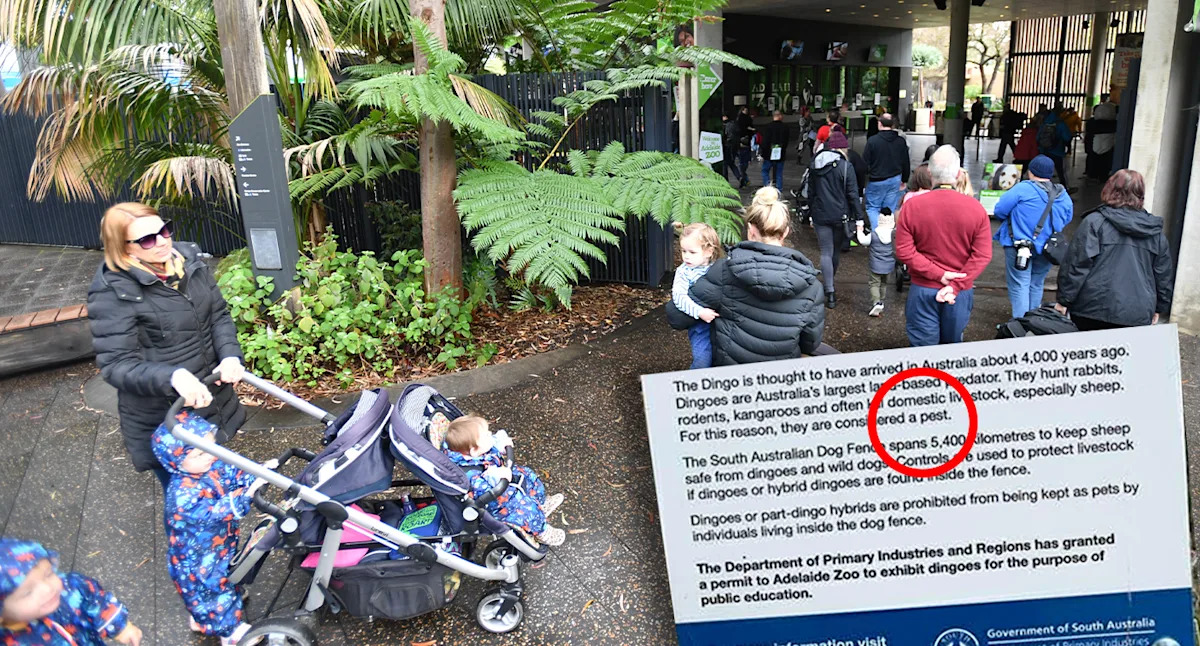
Controversy has erupted at Adelaide Zoo after authorities required the facility to display signage describing dingoes as “pests,” despite their status as native wildlife and cultural significance to Indigenous Australians.
The zoo’s dingo exhibit must now feature a prominent sign stating the “pest status of dingoes” and “the damage caused by dingoes,” along with information explaining why they cannot be kept as pets. This requirement comes from South Australia’s primary industries department (PIRSA), which oversees dingo management in the state.
According to PIRSA, these regulations are necessary because dingoes are considered “dangerous to both people and livestock,” and permit holders must “educate the public about the risks.” The mandate applies not only to physical signage but also to social media communications about the animals.
The controversy gained public attention after Adelaide Zoo shared a Facebook video showing its dingoes, Lara and Indi, being trained to use muzzles. In the post, the zoo described dingoes as a “dangerous breed of dog” that “aren’t suitable as pets” – language that prompted nearly 90 comments from concerned viewers.
Many commenters pointed out that dingoes are genetically distinct from domestic dogs. “They’ve never been domesticated. You’d think a zoo of all places would know this,” wrote one person. Victoria’s Big Desert Dingo Research organization also weighed in, arguing that dingoes “are not dangerous” but rather “native wildlife with their own behavioral ecology,” and that framing them otherwise “continues the misinformation that has driven their decline across Australia.”
Adelaide Zoo responded to the criticism by explaining that the wording does not reflect the views of its staff. “We follow these requirements so we can continue providing the highest standard of welfare and day-to-day care for Lara and Indi,” the zoo stated, redirecting questions about permit requirements to PIRSA.
The situation highlights Australia’s complicated relationship with dingoes, which arrived on the mainland between 4,000 and 5,000 years ago. Despite being considered native to the country and an important Indigenous totem, their classification and legal status vary significantly across different states.
In New South Wales and Western Australia, there are no restrictions on keeping dingoes as pets, while Victoria and the Northern Territory permit ownership with a license. Queensland has historically maintained strict regulations, though authorities there recently announced a review that could reclassify dingoes as domestic dogs, making pet ownership legal.
Jacob Boeheme, who has heritage from the Narangga and Kaurna nations of South Australia, views the mandated signage as harmful propaganda. “It is propaganda, it’s always been propaganda, right from the word go,” he told reporters. “It was to destabilize Aboriginal culture, sweep in and then take over the land.”
Boeheme, who created a multi-year cultural maintenance project to preserve stories about dingoes, is also concerned that negative descriptions whitewash their ecological importance. “They’re overlooking its crucial role in the environment over the last 5,000 years,” he said.
South Australia’s approach to dingo management is physically divided by the famous “Dog Fence,” a 5,600-kilometer barrier built in the 1800s to protect livestock from predators. It starts in the Darling Downs in South Australia and extends to southern Queensland, where it’s known as the Great Barrier Fence.
South of the fence, which covers approximately half the state, authorities work toward the virtual eradication of dingoes. However, north of the fence, the same species is sometimes valued as an integral part of the ecosystem.
“The South Australian Government recognizes that outside the Dog Fence and its buffer zone, dingoes are valued for their important ecological role,” a PIRSA spokesperson acknowledged. “The Government also values the significant cultural value dingoes have to First Nations people.”
Many farmers defend the fence and the current management approach. South Australian grazier Geoff Power told reporters that before replacing nearly 1,100km of exclusion fencing, the state was losing up to 20,000 sheep annually to “wild dog” attacks.
“It’s been a really successful thing to do,” Power said, adding that he believes it’s important for authorities to educate the public about dingoes’ impact on livestock. “We don’t want to see every dingo killed, there’s still plenty about outside the dog fence. You just can’t run small livestock where you’ve got dogs.”
For now, Adelaide Zoo maintains that the controversial signage is necessary to comply with the Landscape South Australia Act 2019 and the South Australian Wild Dog Management Strategy 2023-2033.
Fact Checker
Verify the accuracy of this article using The Disinformation Commission analysis and real-time sources.

29 Comments
Production mix shifting toward Propaganda might help margins if metals stay firm.
Good point. Watching costs and grades closely.
Good point. Watching costs and grades closely.
Interesting update on Zoo’s Warning Sign About Iconic Australian Animal Sparks Controversy. Curious how the grades will trend next quarter.
Good point. Watching costs and grades closely.
Good point. Watching costs and grades closely.
The cost guidance is better than expected. If they deliver, the stock could rerate.
Good point. Watching costs and grades closely.
Good point. Watching costs and grades closely.
The cost guidance is better than expected. If they deliver, the stock could rerate.
Good point. Watching costs and grades closely.
Good point. Watching costs and grades closely.
Nice to see insider buying—usually a good signal in this space.
Good point. Watching costs and grades closely.
I like the balance sheet here—less leverage than peers.
Good point. Watching costs and grades closely.
Silver leverage is strong here; beta cuts both ways though.
Good point. Watching costs and grades closely.
Good point. Watching costs and grades closely.
I like the balance sheet here—less leverage than peers.
If AISC keeps dropping, this becomes investable for me.
I like the balance sheet here—less leverage than peers.
Nice to see insider buying—usually a good signal in this space.
Good point. Watching costs and grades closely.
Good point. Watching costs and grades closely.
Silver leverage is strong here; beta cuts both ways though.
Good point. Watching costs and grades closely.
Production mix shifting toward Propaganda might help margins if metals stay firm.
Good point. Watching costs and grades closely.