


Listen to the article
US Warships Near Venezuela Trigger Propaganda Push and Mixed Messages
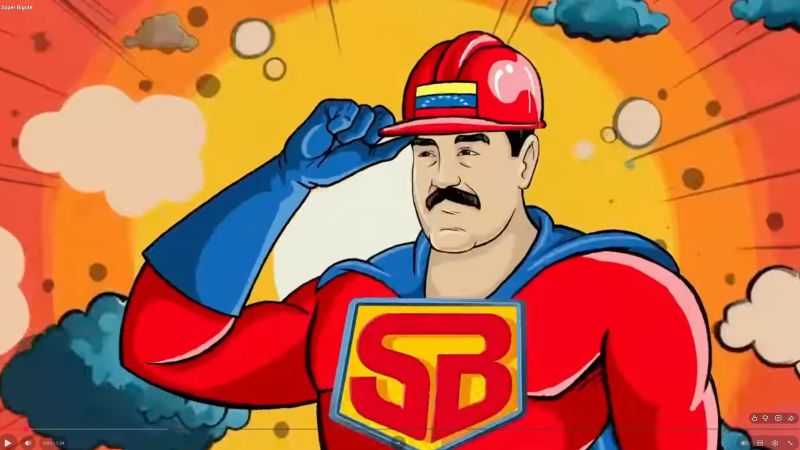
In an era of escalating tensions between the United States and Venezuela, President Nicolas Maduro’s government has deployed an unusual defender: “Super Mustache,” a cartoon superhero alter-ego of the Venezuelan leader that has aired on state television since 2021.
The animated character represents just one element of Venezuela’s propaganda response as US warships gather near its coast and President Donald Trump publicly discusses potential military action against the Maduro regime. In a September episode, the caped crusader traded his usual costume for military attire, brandishing a sheathed sword while proclaiming Venezuela’s lack of “warmongering culture.”
Despite this symbolic show of strength, the Venezuelan government has projected contradictory messages in recent months. Officials simultaneously urge citizens to prepare for conflict while insisting that normalcy prevails—a dissonance readily apparent on Caracas streets. CNN teams in Venezuela report a notable absence of war-themed billboards, banners, or murals in the capital, even in neighborhoods traditionally supportive of the government.
Maduro himself has undergone a visible transformation in his public persona. According to Venezuelan researcher and journalist Andrés Cañizález, the president—who previously favored enclosed spaces for appearances—has dramatically increased his public visibility since tensions began to rise, though always surrounded by substantial security.
Rather than portraying himself as a military strongman, Maduro has adopted a peacemaker image. During public events, he has been seen singing John Lennon’s “Imagine” and calling for face-to-face talks with Trump. At a November 13 rally, Maduro told CNN’s Stefano Pozzebon that the US should join Venezuela in seeking peace across the Americas.
Cañizález notes that the government’s communication strategy has evolved through distinct phases: initially downplaying tensions before shifting to “a more threatening, more retaliatory tone” as US military presence in the Caribbean intensified.
The counterpoint to Maduro’s peace-oriented messaging comes from Interior Minister Diosdado Cabello, who hosts “Con el Mazo Dando” (“Hitting it with a Club”), one of the country’s most influential state TV programs. During his typical four-hour broadcasts, Cabello attacks opposition politicians, tells jokes, and advances government positions.
Cabello consistently reframes US actions in the Caribbean as having nothing to do with drug interdiction, despite the Trump administration’s claims. “There are no tensions here between Venezuela and the United States. Here there is an aggression by the United States against Venezuela,” Cabello declared in a recent episode. “And the aggression has nothing to do with drugs, or terrorism, or criminal gangs, it has to do with taking control of Venezuela’s natural resources.”
The interior minister regularly reads criticisms from US Republican politicians before responding with recordings of the late President Hugo Chavez defying potential US invasion. Political scientist Javier Corrales describes Cabello as fulfilling a familiar role in autocratic systems: “not just praising the president, but trashing the opposition.”
Meanwhile, Venezuela’s military has flooded social media with dramatic videos showing troops preparing for conflict. These propaganda pieces feature soldiers conducting shooting drills, anti-tank fortifications in Caracas, and militia members posing with weapons, usually set to stirring musical scores.
Notably, both Maduro and Cabello have refrained from harshly criticizing Trump directly, instead focusing their ire on US Secretary of State Marco Rubio. Cabello frequently refers to Rubio as “the Crazy Cuban,” portraying him as manipulating a reluctant Trump toward war with Venezuela to satisfy Cuban American voters in Florida.
“This move to seek a change of government in Venezuela isn’t even to satisfy the interests of Trump or MAGA, but rather those of Rubio and the Cuban American mafia,” Cabello told his studio audience recently.
Corrales explains that Rubio serves as an ideal adversary for the Maduro regime due to his prominence as a critic of Latin American leftist governments. Cañizález adds that Rubio is presented as “the direct enemy of the revolution,” a strategy that attempts “to sow divisions in US domestic politics and reinforce the idea of a personalized external enemy, useful for uniting the Chavista base.”
Even after Trump ordered strikes on alleged drug boats near Venezuelan waters in September, Cabello claimed that Rubio was “leading Trump to the slaughter” to fracture Trump’s base and position himself as “a new hawk within the Republican Party.”
As Venezuela’s leadership navigates this complex propaganda landscape, they face a fundamental challenge: how to mobilize domestic support against external threats without creating panic among a population already struggling with profound economic challenges. For now, the question remains whether symbolic gestures and cartoon superheroes will be enough if tensions continue to escalate.
Fact Checker
Verify the accuracy of this article using The Disinformation Commission analysis and real-time sources.

19 Comments
Nice to see insider buying—usually a good signal in this space.
Good point. Watching costs and grades closely.
Good point. Watching costs and grades closely.
Exploration results look promising, but permitting will be the key risk.
Good point. Watching costs and grades closely.
Nice to see insider buying—usually a good signal in this space.
Good point. Watching costs and grades closely.
If AISC keeps dropping, this becomes investable for me.
I like the balance sheet here—less leverage than peers.
Good point. Watching costs and grades closely.
If AISC keeps dropping, this becomes investable for me.
Good point. Watching costs and grades closely.
I like the balance sheet here—less leverage than peers.
Production mix shifting toward Propaganda might help margins if metals stay firm.
Good point. Watching costs and grades closely.
Good point. Watching costs and grades closely.
Nice to see insider buying—usually a good signal in this space.
If AISC keeps dropping, this becomes investable for me.
Interesting update on Venezuelan Propaganda Sends Mixed Messages Amid Rising Tensions with US. Curious how the grades will trend next quarter.