


Listen to the article
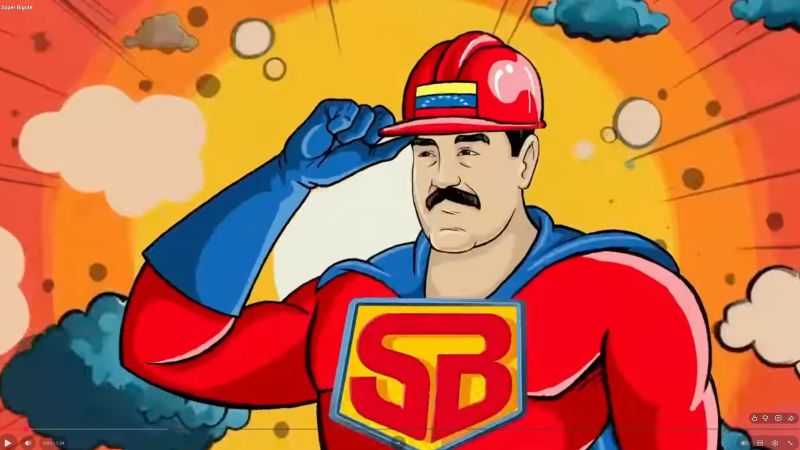
In a curious blend of propaganda and political posturing, Venezuelan President Nicolas Maduro’s cartoon alter-ego “Super Mustache” has emerged as a symbol of resistance against perceived American aggression as tensions mount between the two nations.
The animated superhero, which has aired on Venezuelan state television since 2021, recently donned a military uniform complete with a sheathed sword in a September episode. The timing coincided with the Trump administration’s campaign of airstrikes targeting alleged drug boats off the Venezuelan coast. Despite the militaristic imagery, the cartoon character declared that Venezuela lacks a “warmongering culture.”
This mixed messaging reflects the broader communication strategy of Maduro’s government, which simultaneously urges citizens to prepare for conflict while attempting to project calm. Unlike previous propaganda campaigns, CNN teams in Venezuela report a notable absence of war-themed billboards, banners, or murals in Caracas, even in neighborhoods considered government strongholds.
Maduro himself has dramatically increased his public appearances since tensions escalated in August, emerging from what had previously been a more secluded leadership style. However, rather than positioning himself as a military strongman, he has adopted the persona of a peacemaker, even performing John Lennon’s “Imagine” at a public event and calling for direct talks with Trump. During a November 13 rally, Maduro told CNN that the U.S. should unite with Venezuela for peace in the Americas.
Venezuelan researcher and journalist Andrés Cañizález has observed that the government’s communication approach has evolved through different phases – initially downplaying tensions before shifting to “a more threatening, more retaliatory tone” as the U.S. military presence increased in the Caribbean.
While Maduro plays the role of diplomatic statesman, Interior Minister Diosdado Cabello serves as the regime’s attack dog. On his popular state TV program “Con el Mazo Dando” (“Hitting it with a Club”), Cabello regularly spends four hours attacking opposition politicians, telling jokes, and promoting government positions.
“There are no tensions here between Venezuela and the United States. Here there is an aggression by the United States against Venezuela,” Cabello declared in a recent episode. “And the aggression has nothing to do with drugs, or terrorism, or criminal gangs, it has to do with taking control of Venezuela’s natural resources.”
Political scientist Javier Corrales describes Cabello as fulfilling a classic autocratic role: “There is a certain aspect of Cabello that we recognize in other autocracies, the need to have somebody not just praising the president, but trashing the opposition – and Cabello is amazing.”
Meanwhile, Venezuela’s military has flooded social media with dramatic footage showing soldiers conducting shooting drills, anti-tank fortifications in Caracas, and militia members posing with weapons, typically set to stirring musical backgrounds.
Interestingly, both Maduro and Cabello have been relatively restrained in their criticism of Trump personally, instead directing their sharpest barbs at U.S. Secretary of State Marco Rubio, whom Cabello frequently calls “the Crazy Cuban.” The interior minister has claimed that Rubio is manipulating a reluctant Trump toward war with Venezuela to satisfy “the Cuban American mafia” in Florida.
Cañizález suggests this approach serves a strategic purpose: “Rubio is presented as the direct enemy of the revolution. This tactic seeks to sow divisions in U.S. domestic politics and reinforce the idea of a personalized external enemy, useful for uniting the Chavista base.”
Even after Trump ordered strikes on vessels near Venezuelan waters, Cabello insisted that Rubio was “leading Trump to the slaughter” in an attempt to “fracture Trump’s MAGA base” and position himself as “a new hawk within the Republican Party.”
The Venezuelan leadership faces a delicate balancing act: mobilizing support against external threats without triggering panic among a population already struggling with economic hardship. Whether “Super Mustache” will ultimately unsheathe his sword or whether diplomacy will prevail remains uncertain as the Caribbean nation navigates this period of heightened tensions with its powerful northern neighbor.
Fact Checker
Verify the accuracy of this article using The Disinformation Commission analysis and real-time sources.

7 Comments
I wonder if the shifting propaganda tactics are a calculated move to manage public perception both domestically and internationally. Maduro seems intent on projecting an image of strength while avoiding direct confrontation.
The ‘Super Mustache’ character is an unusual choice for a propaganda campaign. It adds an element of absurdity to Venezuela’s messaging around the tensions with the US. I’m curious to see how this plays out.
I’m curious to see how this propaganda campaign evolves as the tensions between Venezuela and the US continue. The use of a cartoon superhero is certainly a unique approach, but it may not be enough to deflect from the underlying political realities.
This mixed messaging from Venezuela is puzzling. On one hand, they’re using militaristic imagery, but on the other, they’re claiming to lack a ‘warmongering culture’. It seems like political posturing more than a coherent strategy.
Interesting how Venezuela is using a cartoon superhero to send mixed messages about their stance on conflict with the US. Maduro seems to be walking a fine line between saber-rattling and projecting calm.
This seems like a classic case of doublespeak from the Venezuelan government. They want to appear tough, but also avoid direct confrontation. It will be interesting to see if their mixed messaging strategy pays off.
The absence of overt war propaganda in Caracas is curious. Perhaps Maduro’s government is trying to avoid escalating tensions further, even as they position themselves for potential conflict.