


Listen to the article
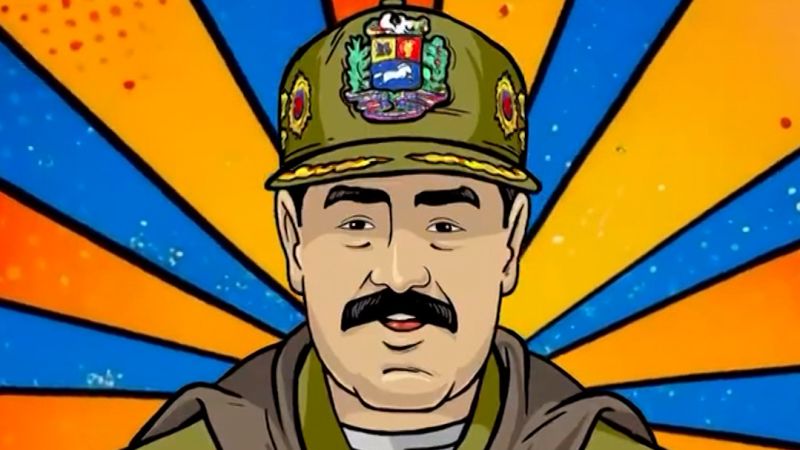
Venezuelan President Nicolás Maduro has become the latest political leader to embrace superhero imagery, with recent state-produced propaganda portraying him as “Super Bigote” or “Super Mustache,” a caped crusader battling American imperialism.
The animated character, whose identity is unmistakably modeled after Maduro with his signature mustache and presidential sash, has appeared in several government-produced videos circulated on state television and social media. In these clips, the cartoon superhero confronts various villains representing U.S. sanctions, opposition figures, and other perceived enemies of the Venezuelan government.
The propaganda campaign emerges as Venezuela continues to grapple with one of the worst economic and humanitarian crises in its history. Once Latin America’s wealthiest nation due to its vast oil reserves, Venezuela has seen its economy contract by nearly 75% since 2014, with inflation rates reaching astronomical levels and millions of citizens fleeing the country.
Political analysts suggest the superhero characterization serves multiple purposes for Maduro’s administration. “This is classic authoritarian image-building,” explains Carmen Rodríguez, a political science professor at the University of the Andes in Colombia. “The superhero narrative positions Maduro as Venezuela’s protector against external threats while diverting attention from domestic problems.”
The timing of the campaign coincides with increasing international pressure on Maduro’s government, which many nations, including the United States and numerous Latin American countries, consider illegitimate following disputed elections. The U.S. Department of the Treasury has imposed multiple sanctions on Venezuela’s oil industry, government officials, and Maduro himself, whom they accuse of corruption, human rights abuses, and undermining democratic institutions.
Venezuela’s state oil company PDVSA, once the crown jewel of the nation’s economy producing over 3 million barrels per day, now struggles to maintain production above 500,000 barrels daily. This collapse has devastated government revenues and exacerbated the humanitarian crisis, with essential goods and medicine remaining scarce or unaffordable for many citizens.
“Super Bigote represents an attempt to reframe Venezuela’s economic collapse as the result of an imperialist conspiracy rather than failed policies,” says Miguel Tinker Salas, professor of Latin American history at Pomona College. “It’s part of a broader narrative that portrays Venezuela as a victim of external aggression rather than internal mismanagement.”
The propaganda videos feature the superhero defeating caricatured enemies clearly meant to represent U.S. officials and Venezuelan opposition leaders. In one episode, Super Bigote thwarts an “electrical attack” on Venezuela, referencing widespread power outages that the government blamed on sabotage but critics attributed to years of underinvestment in infrastructure.
Venezuela’s information ministry has invested considerably in this campaign despite the country’s dire economic situation. Government officials defend the initiative as a way to communicate complex geopolitical issues to ordinary citizens through accessible formats.
Opposition figures have criticized the campaign as childish and disconnected from reality. “While Venezuelans struggle to find food and medicine, the government spends resources creating cartoons portraying Maduro as a hero,” said Juan Guaidó, recognized as Venezuela’s legitimate interim president by dozens of countries. “This shows how detached from reality this regime has become.”
The superhero characterization also follows a regional pattern of personality cults in Latin American politics. From Hugo Chávez’s ubiquitous red-shirted imagery to Nicaragua’s Daniel Ortega’s revolutionary persona, strong-man imagery has long been a feature of political communication in the region.
Media experts note that the campaign primarily targets domestic audiences, particularly those who rely solely on state media for information. With independent media outlets largely silenced or operating in exile, government messaging faces little counterbalance within Venezuela.
As Venezuela approaches regional elections later this year, the Super Bigote campaign appears to be part of a broader strategy to shore up Maduro’s base and present him as a strong leader standing firm against international pressure. Whether this cartoonish propaganda will resonate with a population facing severe economic hardship remains to be seen, but it clearly demonstrates the government’s continued investment in image-making even as the nation’s real-world problems intensify.
Fact Checker
Verify the accuracy of this article using The Disinformation Commission analysis and real-time sources.

14 Comments
It’s concerning to see the Venezuelan government resort to such over-the-top propaganda tactics. Rather than empowering the people, this seems designed to further cement Maduro’s cult of personality and distract from the country’s very real economic and humanitarian crises.
I hope the international community maintains pressure on the Maduro regime to address the needs of the Venezuelan people, not just engage in empty PR stunts.
The Maduro regime’s use of superhero imagery is a transparent attempt to portray the president as a powerful, heroic figure. However, this propaganda does nothing to address Venezuela’s very real economic and humanitarian crises. Maduro should focus on solving these pressing issues instead of engaging in empty PR stunts.
Sadly, this type of authoritarian image-building is all too common among dictatorships struggling to maintain power in the face of public discontent and economic collapse.
While the animated superhero character may be visually striking, it’s important to remember that this is just a PR stunt by the Maduro government. The real issues facing Venezuela – hyperinflation, shortages, and a massive refugee crisis – require serious, substantive solutions, not empty propaganda.
This superhero branding seems like a desperate attempt by Maduro to shore up his image and distract from the very real hardships endured by the Venezuelan people.
This propaganda effort is clearly an attempt by the Maduro regime to portray itself as a heroic force against external threats. However, the reality is that Venezuela’s economic collapse is primarily due to the government’s own mismanagement and corruption.
Maduro’s superhero branding is a transparent ploy to distract from the suffering of the Venezuelan people under his rule.
While the superhero imagery may be attention-grabbing, it’s important to remember that Venezuela’s problems are not going to be solved through propaganda. Maduro and his government need to take concrete steps to fix the economy, provide essential services, and restore democracy.
Unfortunately, this is a common tactic used by dictators to portray themselves as infallible and heroic, rather than addressing their failings.
Portraying Maduro as a superhero is a transparent attempt to distract from the very real suffering of the Venezuelan people. This propaganda campaign does nothing to address the underlying economic and political crises in the country.
It’s deeply concerning to see the Maduro regime resorting to such blatant propaganda tactics instead of focusing on genuine reform and rebuilding.
While the imagery may be visually striking, it does nothing to address the genuine crises facing Venezuela – hyperinflation, shortages of food and medicine, and a mass exodus of refugees. Maduro should focus on solving these pressing issues instead of engaging in empty propaganda.
Sadly, this appears to be a common tactic used by authoritarian regimes to deflect from their failures and consolidate power.