


Listen to the article
Britain has launched a sweeping sanctions package targeting key figures and organizations in Russia’s propaganda and influence networks, marking one of its most expansive actions against Kremlin-linked information operations in recent years.
The measures impose asset freezes and service bans on prominent Russian ideologue Aleksandr Dugin, military blogger Mikhail Zvinchuk (known as Rybar), and the Kremlin-linked foundation Pravfond. British authorities described these targets as actors who promote policies that “destabilize Ukraine and threaten its territorial integrity, sovereignty, and independence.”
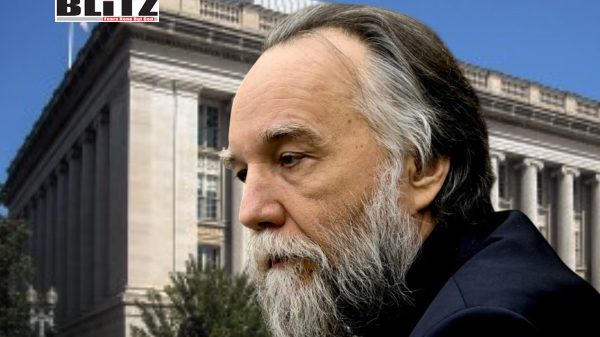
Aleksandr Dugin, an ultranationalist philosopher whose writings have significantly influenced far-right political movements across Russia and Europe, stands at the center of these designations. For years, Dugin has advocated for an expansionist Eurasian empire led by Moscow – a worldview that aligns with the Kremlin’s justifications for its 2014 invasion of Ukraine and the full-scale assault launched in 2022.
By designating Dugin as an “involved person,” the UK government signals that his role in promoting the Kremlin’s imperial ambitions makes him complicit in undermining Ukrainian sovereignty. His Center for Geopolitical Expertise, also sanctioned, has long served as a hub for disseminating Russian narratives disguised as academic analysis.
The sanctions also target Mikhail Zvinchuk, founder and director of Rybar LLC, which operates one of Russia’s most influential pro-war Telegram channels. Unlike Dugin’s ideological approach, Rybar specializes in detailed military reporting – including maps, troop movements, and battlefield assessments – embedded within a strongly pro-Russian narrative framework.
With millions of subscribers, Rybar has become a primary information source for Russian audiences seeking war updates. Western analysts have noted that while the channel presents itself as independent, it consistently amplifies Kremlin talking points and helps legitimize Russia’s military actions in Ukraine.
Perhaps the most significant target is Pravfond, the Foundation for the Support and Protection of the Rights of Compatriots Living Abroad. While officially presented as a legal aid organization for Russian nationals overseas, investigators from multiple countries have documented how it functions as a covert funding channel for Kremlin influence operations.
Created jointly by Russia’s Foreign Ministry and Rossotrudnichestvo (a state agency associated with soft-power activities), Pravfond has operated throughout Europe’s legal and political landscape. Under the guise of assisting “compatriots,” it has financed individuals and groups ranging from alleged intelligence operatives to far-right activists and pro-Kremlin media outlets.
Investigations by the Organized Crime and Corruption Reporting Project (OCCRP) and partners revealed how Pravfond channeled money into networks across the Baltics, Balkans, Central Europe, and Brussels. Many of these funds were transferred through intermediaries, foreign accounts, and cash couriers to conceal their origin.
The UK sanctions specifically target four entities tied to Pravfond’s operations, including Brussels-based Russian-language media outlets Euromore and Golos. British authorities state these outlets received consistent Pravfond funding to promote Kremlin-friendly narratives aimed at weakening European support for Ukraine.
A recent investigation by Radio Free Europe/Radio Liberty’s Schemes project exposed Pravfond’s reach inside Ukraine itself. Based on leaked internal emails, reporters discovered the foundation ran a covert operation called “Ukrainian Direction” that allegedly financed Ukrainian lawyers who compiled dossiers on supposed Ukrainian military war crimes for Russian authorities.
These lawyers reportedly also advised Ukrainian men on avoiding military conscription – activities presented as legal assistance but directly undermining Ukraine’s defense capabilities while providing Moscow with intelligence and propaganda material.
Despite being sanctioned by the European Union in 2023, Pravfond has demonstrated remarkable adaptability in evading restrictions. OCCRP reporting showed the foundation continued moving funds across at least 11 EU member states through shell entities, cash transfers, and third-country financial intermediaries.
London’s sanctions represent an attempt to sever these financial channels by freezing all UK-based assets and prohibiting British entities from providing corporate or fiduciary services to the listed organizations.
Australia also imposed sanctions on Pravfond in 2023, citing its financial support for legal defenses and lobbying efforts for Kremlin-linked figures, including a pro-Russia activist in Sydney. This growing alignment among Western governments reflects increasing recognition that Russia’s influence operations rely on a sophisticated combination of overt messaging, covert funding, and organizations disguised as grassroots initiatives.
By targeting Dugin, Rybar, and Pravfond, the UK is directly challenging the ideological, informational, and financial architecture of Russia’s influence ecosystem at a time when Ukraine’s allies face war fatigue, political divisions, and election pressures.
While the effectiveness of these measures in disrupting Russian influence operations remains to be seen, the UK’s action represents a significant step in identifying and isolating key actors behind the Kremlin’s propaganda apparatus in a conflict increasingly fought across geopolitical, informational, and digital domains.
Fact Checker
Verify the accuracy of this article using The Disinformation Commission analysis and real-time sources.

27 Comments
If AISC keeps dropping, this becomes investable for me.
Production mix shifting toward Propaganda might help margins if metals stay firm.
Good point. Watching costs and grades closely.
Interesting update on UK Imposes Sweeping Sanctions on Pro-Kremlin Influencers Including Dugin, Rybar, and Pravfond. Curious how the grades will trend next quarter.
Exploration results look promising, but permitting will be the key risk.
Good point. Watching costs and grades closely.
Nice to see insider buying—usually a good signal in this space.
Good point. Watching costs and grades closely.
Good point. Watching costs and grades closely.
Nice to see insider buying—usually a good signal in this space.
Good point. Watching costs and grades closely.
Exploration results look promising, but permitting will be the key risk.
If AISC keeps dropping, this becomes investable for me.
Good point. Watching costs and grades closely.
Good point. Watching costs and grades closely.
Production mix shifting toward Propaganda might help margins if metals stay firm.
Good point. Watching costs and grades closely.
I like the balance sheet here—less leverage than peers.
Good point. Watching costs and grades closely.
Uranium names keep pushing higher—supply still tight into 2026.
Good point. Watching costs and grades closely.
Good point. Watching costs and grades closely.
Silver leverage is strong here; beta cuts both ways though.
Production mix shifting toward Propaganda might help margins if metals stay firm.
Good point. Watching costs and grades closely.
Good point. Watching costs and grades closely.
Uranium names keep pushing higher—supply still tight into 2026.