


Listen to the article
Turkish Nationalist Leader Condemns Pope’s Visit as “Hidden Propaganda”
Devlet Bahçeli, leader of Turkey’s Nationalist Movement Party (MHP) and a key ally of President Recep Tayyip Erdoğan, has launched a scathing critique of Pope Leo XIV’s recent visit to Turkey, describing certain religious ceremonies as “hidden propaganda” that has disturbed segments of the Turkish public.
In an interview published Thursday in the pro-MHP Türkgün daily, Bahçeli drew a clear distinction between the pope’s official state engagements—including his meeting with President Erdoğan in Ankara—and what he characterized as problematic “show-driven religious and historical rituals” performed in the pontiff’s capacity as head of the Catholic Church.
The pope’s four-day visit from November 27-30 marked his first international trip since assuming the papacy. After diplomatic meetings in Ankara, he traveled to İznik in western Turkey to commemorate the 1,700th anniversary of the Council of Nicaea, and later celebrated Mass for 4,000 attendees at İstanbul’s Volkswagen Arena.
It was these ceremonial aspects of the visit that provoked Bahçeli’s ire. “We cannot remain spectators to attempts to resurrect the memory of a council held 1,700 years ago… or to replace İznik with Nicaea,” the nationalist leader stated, suggesting that the ceremonies represented “concealed propaganda” designed to reshape religious authority under the guise of historical commemoration.
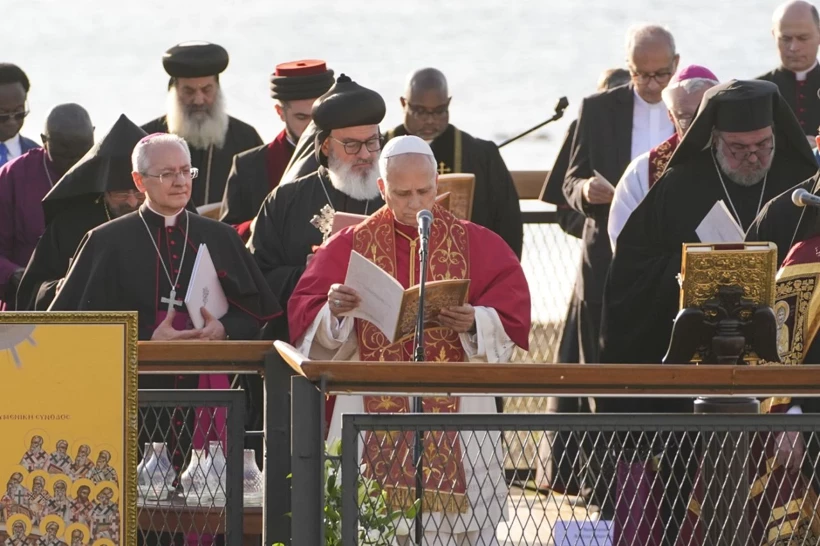
The ceremonies in İznik—historically known as Nicaea—held particular significance as the site where hundreds of bishops gathered in 325 AD to adopt the Nicene Creed, a fundamental statement of Christian belief. During the event, Pope Leo XIV and Ecumenical Patriarch Bartholomew I led prayers in multiple languages while a choir performed hymns in English, French, Greek, Latin, and Turkish.
Bahçeli employed a Turkish idiom to express his displeasure, saying there was “no point in selling snails in a Muslim neighborhood”—suggesting these rituals were inappropriate and insensitive to Muslim sensibilities in a country where Christians represent only about 100,000 people in a population of 86 million.
The MHP leader’s criticism extended beyond the papal visit to include recent statements by US Ambassador Tom Barrack regarding the potential reopening of the Halki Theological Seminary on İstanbul’s Heybeliada Island. The ambassador told Greek newspaper Kathimerini that Washington was signaling a possible reopening “in September of 2026.”
The seminary, part of the Holy Trinity Monastery complex, has been closed since 1971 following a Constitutional Court ruling. Bahçeli accused Ambassador Barrack of “overstepping his authority,” asserting that decisions about the seminary’s future rest exclusively with Turkish authorities. “Such intrusive and imposing proposals disregard our national honor,” he stated.
Despite Bahçeli’s objections, the matter has gained traction in diplomatic and political circles. President Erdoğan discussed the seminary’s status with US President Donald Trump during a White House meeting in September, indicating willingness to consider “necessary steps” toward reopening. Additionally, Education Minister Yusuf Tekin visited the site in May, expressing personal support for its reopening and confirming that his ministry had submitted legal recommendations to the government.
The controversy highlights ongoing tensions between Turkey’s nationalist political factions and international religious diplomacy. While President Erdoğan’s government has shown openness to interfaith dialogue in certain contexts, Bahçeli’s forceful response demonstrates the political sensitivities surrounding religious symbolism and historical commemoration in Turkey’s predominantly Muslim society.
The restoration of the Halki Seminary is reportedly expected to be completed by 2026, setting the stage for what could become another flashpoint in Turkey’s complex relationship with its religious minorities and international religious institutions.
Fact Checker
Verify the accuracy of this article using The Disinformation Commission analysis and real-time sources.

24 Comments
Interesting update on Turkish Nationalist Leader Criticizes ‘Hidden Propaganda’ in Religious Ceremonies During Pope’s Visit. Curious how the grades will trend next quarter.
Good point. Watching costs and grades closely.
Good point. Watching costs and grades closely.
Uranium names keep pushing higher—supply still tight into 2026.
Good point. Watching costs and grades closely.
Good point. Watching costs and grades closely.
I like the balance sheet here—less leverage than peers.
Nice to see insider buying—usually a good signal in this space.
Interesting update on Turkish Nationalist Leader Criticizes ‘Hidden Propaganda’ in Religious Ceremonies During Pope’s Visit. Curious how the grades will trend next quarter.
Good point. Watching costs and grades closely.
Production mix shifting toward Propaganda might help margins if metals stay firm.
Good point. Watching costs and grades closely.
Interesting update on Turkish Nationalist Leader Criticizes ‘Hidden Propaganda’ in Religious Ceremonies During Pope’s Visit. Curious how the grades will trend next quarter.
Good point. Watching costs and grades closely.
Exploration results look promising, but permitting will be the key risk.
Good point. Watching costs and grades closely.
Good point. Watching costs and grades closely.
Production mix shifting toward Propaganda might help margins if metals stay firm.
If AISC keeps dropping, this becomes investable for me.
Good point. Watching costs and grades closely.
Interesting update on Turkish Nationalist Leader Criticizes ‘Hidden Propaganda’ in Religious Ceremonies During Pope’s Visit. Curious how the grades will trend next quarter.
The cost guidance is better than expected. If they deliver, the stock could rerate.
Good point. Watching costs and grades closely.
Good point. Watching costs and grades closely.