


Listen to the article
The latest controversy surrounding former President Donald Trump escalated Sunday when one of his top campaign surrogates defended his derogatory comments about a female journalist during a rally in Pennsylvania.
The incident occurred at Trump’s Butler, Pennsylvania rally on Saturday, where he referred to ABC News correspondent Selina Wang as a “third-rate reporter” and mockingly called her “Miss Piggy” — a reference to the Muppet character. Wang had previously interviewed Trump for ABC News.
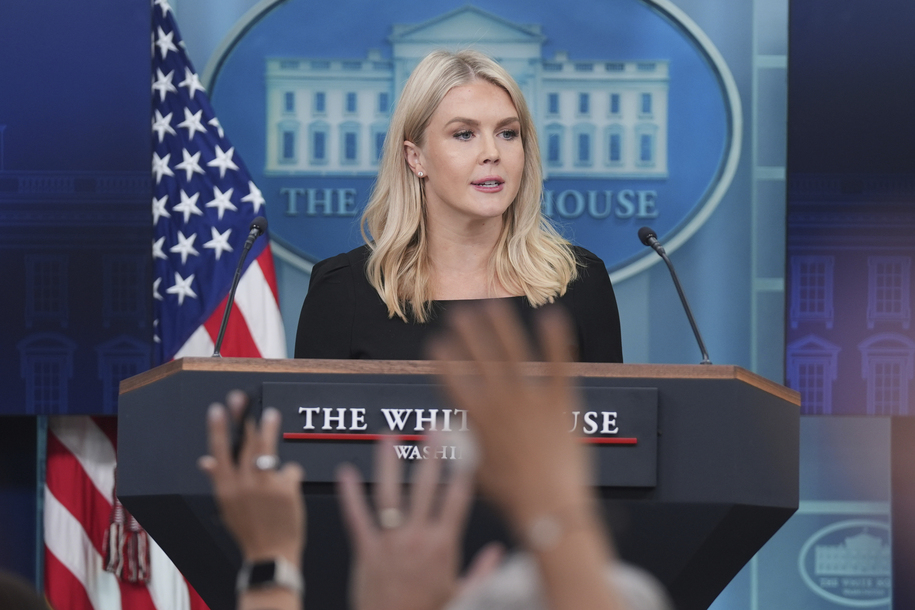
Karoline Leavitt, Trump’s national press secretary, appeared on CNN’s “State of the Union” where host Dana Bash pressed her about the former president’s remarks. Rather than distancing the campaign from the comments, Leavitt defended Trump’s rhetoric, claiming it was simply a response to what she characterized as unfair treatment by the media.
“President Trump is going to defend himself against the biased media figures who have made a career out of attacking him,” Leavitt stated during the interview. She went on to claim that Trump’s comments were justified because the reporter had conducted what the campaign viewed as a “hostile interview.”
Media analysts and political observers have noted that this response fits into a familiar pattern for the Trump campaign, which has consistently refused to apologize for controversial statements, instead doubling down and reframing them as justified responses to perceived enemies.
The incident comes at a critical time in the presidential race, with Trump making an aggressive push in battleground states like Pennsylvania. Political strategists suggest that such controversies risk alienating suburban women voters, a demographic that both campaigns are actively courting in the final weeks before the election.
Women’s advocacy groups were quick to condemn Trump’s remarks. The National Women’s Political Caucus released a statement calling the comments “deeply misogynistic” and “unbecoming of anyone seeking the presidency.” Similar sentiments were echoed by other organizations focused on gender equality in politics and media.
This is not the first time Trump has faced backlash for comments about women. Throughout his political career, he has made headlines for remarks about female journalists, politicians, and public figures. During his first presidential campaign, similar controversies erupted after comments about then-Fox News host Megyn Kelly and former Republican presidential candidate Carly Fiorina.
Media ethics experts have raised concerns about the normalization of such rhetoric directed at journalists. “When public figures demean reporters based on personal characteristics rather than addressing the substance of their reporting, it undermines the critical role of a free press in democracy,” said Professor Elena Ramirez, who teaches journalism ethics at Columbia University.
Wang herself responded to Trump’s comments with a brief statement on social media, saying: “I will continue to do my job as a journalist, asking tough but fair questions of all public figures regardless of personal attacks.”
For Trump’s campaign, the controversy represents both a challenge and an opportunity. While it risks further alienation from moderate voters concerned about civility in politics, it also energizes a base that responds positively to Trump’s confrontational approach toward mainstream media.
Political analysts point out that Trump’s media strategy has consistently involved personalizing conflicts with journalists, particularly those from outlets he considers hostile. This approach has proven effective at shifting focus away from policy discussions and toward cultural grievances that resonate with his core supporters.
As the election approaches, both campaigns are intensifying their outreach to key demographic groups. The Biden campaign quickly seized on Trump’s remarks as evidence of what they characterize as his disrespect toward women, while Trump’s team continues to frame such incidents as evidence of his willingness to fight against perceived media bias.
With less than two months until Election Day, incidents like these highlight the stark stylistic differences between the candidates and underscore how personal attacks and media relations continue to play a central role in shaping the narrative of the 2024 presidential race.
Fact Checker
Verify the accuracy of this article using The Disinformation Commission analysis and real-time sources.

10 Comments
It’s concerning to see political figures defending the use of derogatory language, even in response to perceived unfair treatment. A higher standard of civility and respect would serve the public interest better.
I share your concern. Political leaders should model constructive dialogue, not contribute to a culture of antagonism and personal attacks. There may be valid criticisms, but the response should aim to persuade, not provoke.
While the former president has a history of using provocative rhetoric, I’m not sure that defending such comments is the best strategy for his campaign. It could alienate more moderate voters who value respectful political discourse.
This is an unfortunate situation that highlights the increasingly polarized nature of political discourse. I hope both sides can find a way to engage constructively and move the conversation in a more productive direction.
Agreed. Resorting to insults and personal attacks is counterproductive and unlikely to change anyone’s mind. Perhaps the parties involved could seek to understand each other’s perspectives more charitably.
It’s disappointing to see political campaigns defend the use of derogatory language, even when they feel they’ve been treated unfairly. This type of rhetoric often does more to inflame tensions than to address legitimate concerns.
While Trump’s comments may have been provocative, his spokesperson’s defense of them seems to escalate the rhetoric. It’s important to maintain civil discourse, even when dealing with sensitive political issues.
I agree, the campaign’s response seems to further inflame the situation rather than de-escalate it. Resorting to personal attacks rarely improves the quality of political debate.
This incident highlights the ongoing tensions between the media and political figures. Both sides should strive to engage in good faith and avoid unnecessary escalation. Constructive criticism is one thing, but personal attacks are counterproductive.
Agreed. Maintaining a respectful dialogue, even in the face of perceived unfairness, is crucial for upholding democratic norms and building public trust. Neither side benefits from further inflaming the situation.