


Listen to the article
In a groundbreaking exhibition at New York’s Print Center, artists are reimagining how data can illuminate the Black experience in America, moving beyond simple statistics to create a nuanced artistic dialogue about race and representation.
“Data Consciousness: Reframing Blackness in Contemporary Print,” on view through December 13, draws inspiration from W. E. B. Du Bois’s pioneering infographics about post-Emancipation Black life, which were originally displayed at the 1900 Paris Exposition World’s Fair. The exhibition transforms these historical data visualizations into a contemporary art project that both honors Du Bois’s legacy and expands upon his approach.
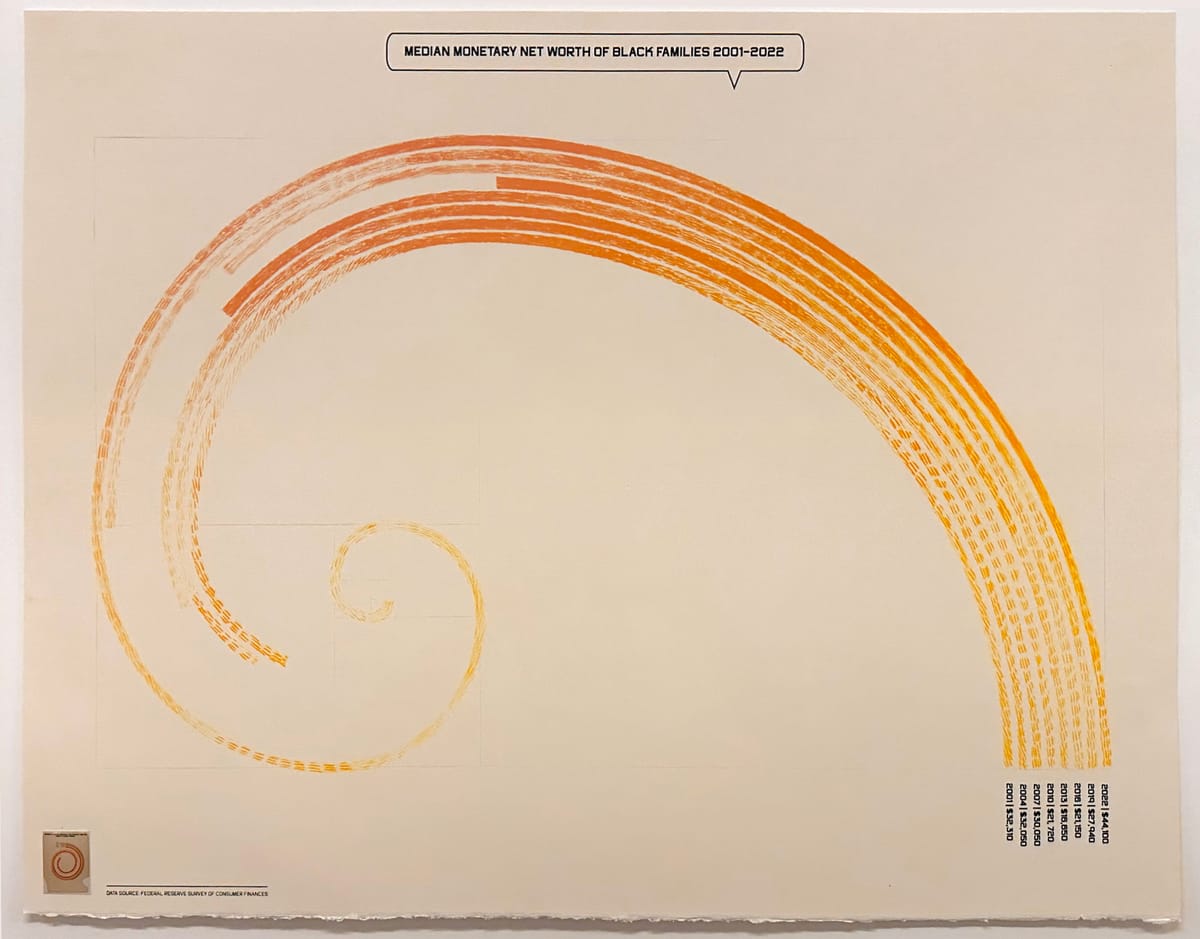
Artist William Villalongo and urbanist Shraddha Ramani serve as the primary creative force behind the exhibition, reimagining Du Bois’s “data portraits” using various printmaking techniques. Rather than simply updating the visuals with modern aesthetics, they’ve collaborated with Black scholars, social scientists, and activists to incorporate current research on Black American life.
Curator Tiffany E. Barber has broadened the exhibition’s scope by including works from artists Kameelah Janan Rasheed, Tahir Hemphill, Julia Mallory, and Silas Munro, who contribute sculptural pieces, video installations, textiles, and other mixed-media works that complement the infographics.
The exhibition wrestles with a fundamental tension between data as propaganda and data as art. In a 1926 quote featured in one of Villalongo and Ramani’s portfolio images, Du Bois declared, “Thus all Art is propaganda and ever must be… I stand in utter shamelessness and say that whatever art I have for writing has been used always for propaganda for gaining the right of black folk to love and enjoy.” While Du Bois explicitly used data to persuade his audience toward social justice, the current exhibition strives to complicate our relationship with information.
Some pieces in the show intentionally resist straightforward interpretation. Rasheed’s installation “Plot It/Point Moving” (2025) presents fragmented text and scattered imagery that refuses easy consumption, featuring incomplete sentences like “Rubbing: contradictions and ambiguities merging.” Similarly, Villalongo and Ramani’s “Visualizando La Afrodignidad Skin Color & Race in Puerto Rico” employs abstract visual language—gradient fields divided by undulating red lines—to represent colorism’s impact in Puerto Rico, requiring viewers to engage more deeply with the underlying concepts.
Other infographics in the exhibition strike a balance between accessibility and complexity. A map of the United States uses color intensity to visualize the distribution of Black Americans, with brighter hues indicating higher population density. Another striking image, “Black Children Enrolled in Charter, Private and Public Schools,” employs a massive red field contrasted with smaller areas of yellow and blue to demonstrate how overwhelmingly Black children attend public rather than private educational institutions.
The most successful works in “Data Consciousness” transcend mere propaganda by encouraging multifaceted thinking. Unlike persuasive messaging that aims to instill a singular perspective, these pieces invite viewers to engage with contradictions and ambiguities. The experience becomes akin to encountering an iceberg—seeing a visible structure while acknowledging that much remains beneath the surface, possibly forever beyond full comprehension.
This approach exemplifies what art accomplishes at its best: prompting deeper awareness of human complexity, even when that complexity might bewilder us. By transforming demographic information into visual poetry, the exhibition creates space for nuanced conversations about race, representation, and the politics of data in contemporary society.
The timing of “Data Consciousness” is particularly significant as debates about data collection, algorithmic bias, and racial equity in technology continue to intensify across American society. By revisiting Du Bois’s groundbreaking work through a contemporary lens, the exhibition offers historical context for current discussions about how information shapes our understanding of racial identity and experience.
Print Center New York’s exhibition ultimately demonstrates that data visualization can be more than just informative—it can be transformative, challenging viewers to reconsider how statistics represent lived experiences and how art can reveal what numbers alone cannot express.
Fact Checker
Verify the accuracy of this article using The Disinformation Commission analysis and real-time sources.

18 Comments
I like the balance sheet here—less leverage than peers.
Exploration results look promising, but permitting will be the key risk.
Good point. Watching costs and grades closely.
Good point. Watching costs and grades closely.
Uranium names keep pushing higher—supply still tight into 2026.
If AISC keeps dropping, this becomes investable for me.
Good point. Watching costs and grades closely.
Good point. Watching costs and grades closely.
Interesting update on The Challenges of Navigating Modern Propaganda in Media Landscape. Curious how the grades will trend next quarter.
Good point. Watching costs and grades closely.
Uranium names keep pushing higher—supply still tight into 2026.
Good point. Watching costs and grades closely.
Good point. Watching costs and grades closely.
Production mix shifting toward Propaganda might help margins if metals stay firm.
Good point. Watching costs and grades closely.
Good point. Watching costs and grades closely.
Nice to see insider buying—usually a good signal in this space.
Good point. Watching costs and grades closely.