


Listen to the article
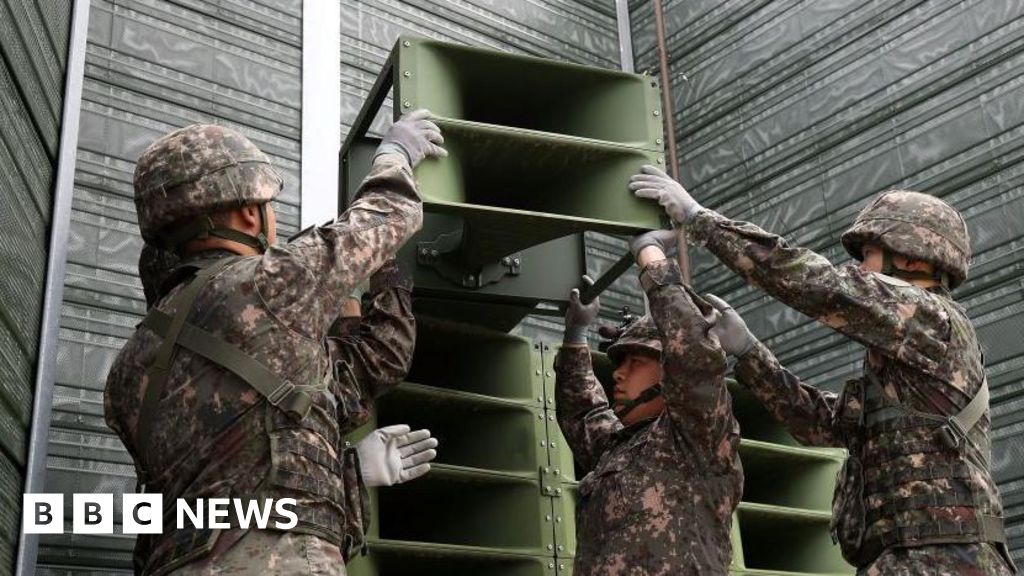
South Korea has suspended its loudspeaker propaganda broadcasts directed at North Korea as part of efforts to improve relations between the two nations. The military announced the decision as a step to “restore trust in inter-Korean relations and achieve peace on the Korean Peninsula.”
The suspension comes just one week after Lee Jae-myung was elected as South Korea’s new president. Lee campaigned on a platform that included improving ties with North Korea and reducing tensions on the peninsula, signaling a shift from his predecessor’s more confrontational approach.
The loudspeaker broadcasts, which North Korea considers an act of war and has threatened to destroy in the past, had been paused for six years before being resumed in June 2023. The restart was prompted by Pyongyang’s campaign of sending balloons filled with garbage across the border into South Korean territory.
In recent years, the broadcasts featured news from both Koreas and international sources, along with information about democracy and life in South Korea – content designed to reach North Korean citizens with perspectives unavailable in their tightly controlled media environment.
Relations between the two Koreas had significantly deteriorated under former president Yoon Suk Yeol, who took a harder line toward North Korea. Yoon was ultimately impeached and removed from office after briefly placing South Korea under martial law in December, citing alleged threats from “anti-state forces” and North Korean sympathizers.
The military’s decision to suspend rather than terminate the broadcasts indicates that South Korea retains the option to restart them if circumstances change. According to South Korea’s Yonhap news agency, the military noted that North Korea has ceased sending trash-laden balloons southward, which factored into their decision.
Seoul claims the broadcasts can be heard up to 10 kilometers (6.2 miles) across the border during daylight hours and as far as 24 kilometers (15 miles) at night, making them a significant tool for penetrating North Korea’s information blockade.
However, the suspension has drawn criticism from human rights organizations focused on North Korea. Hana Song, executive director of the Database Center for North Korean Human Rights in Seoul, expressed concern about the decision, saying: “The loudspeakers were a vital bridge to the North Korean people, a reminder that they are not forgotten. By turning them off, we’ve only strengthened Kim Jong Un’s efforts to keep his people isolated.”
Song further characterized the move as “a troubling sign” that suggests “we’re returning to the days of appeasing the North Korean regime.”
Meanwhile, residents in border regions have welcomed the suspension. Communities along the border have complained for months about noise disruptions from propaganda broadcasts from both sides, sometimes occurring in the middle of the night and disrupting daily life.
Ganghwa county, one of the affected border regions, issued a statement expressing hope that “this decision will lead to an end to North Korea’s noise-based psychological warfare, allowing our residents to return to their normal daily lives.”
The suspension marks a significant shift in South Korea’s approach to its northern neighbor, potentially opening the door for improved dialogue. However, significant obstacles to reconciliation remain, particularly after Kim Jong Un formally abandoned the goal of reunification with South Korea earlier last year – a position that had been a cornerstone of North Korean ideology since the country’s founding.
The Korean Peninsula technically remains in a state of war, as the Korean War ended in 1953 with an armistice rather than a formal peace treaty. The new South Korean administration appears to be taking initial steps to reduce tensions in one of the world’s most heavily militarized borders, though the path to meaningful reconciliation remains uncertain.
Fact Checker
Verify the accuracy of this article using The Disinformation Commission analysis and real-time sources.

10 Comments
I’m curious to see if this move will lead to further confidence-building measures and eventually substantive negotiations between the North and South.
That’s a good question. Even small steps can create momentum if both sides are willing to engage constructively.
The decision to halt the propaganda broadcasts is a positive sign, but lasting peace will require addressing deeper political and security concerns between the two Koreas.
Absolutely. Sustainable progress will depend on addressing the root causes of conflict, not just temporary gestures.
It will be interesting to see how North Korea responds to this gesture from the South. Reciprocal good-faith actions could help build trust between the two countries.
Agreed. Fostering a cycle of positive reinforcement is key to making progress on the Korean Peninsula.
It’s encouraging to see progress in inter-Korean relations, even if small steps. Reducing confrontation and building trust is crucial for stability in the region.
Agreed. Constructive dialogue and diplomacy are the best path forward, rather than escalating tensions through propaganda broadcasts.
While the halt in propaganda broadcasts is a welcome development, the broader tensions and military standoff on the Korean Peninsula remain deeply concerning.
True, this is just one piece of a much larger and more complex geopolitical puzzle. Significant challenges still lie ahead.