


Listen to the article
Russian Disinformation Campaign Masquerades as French Local Media
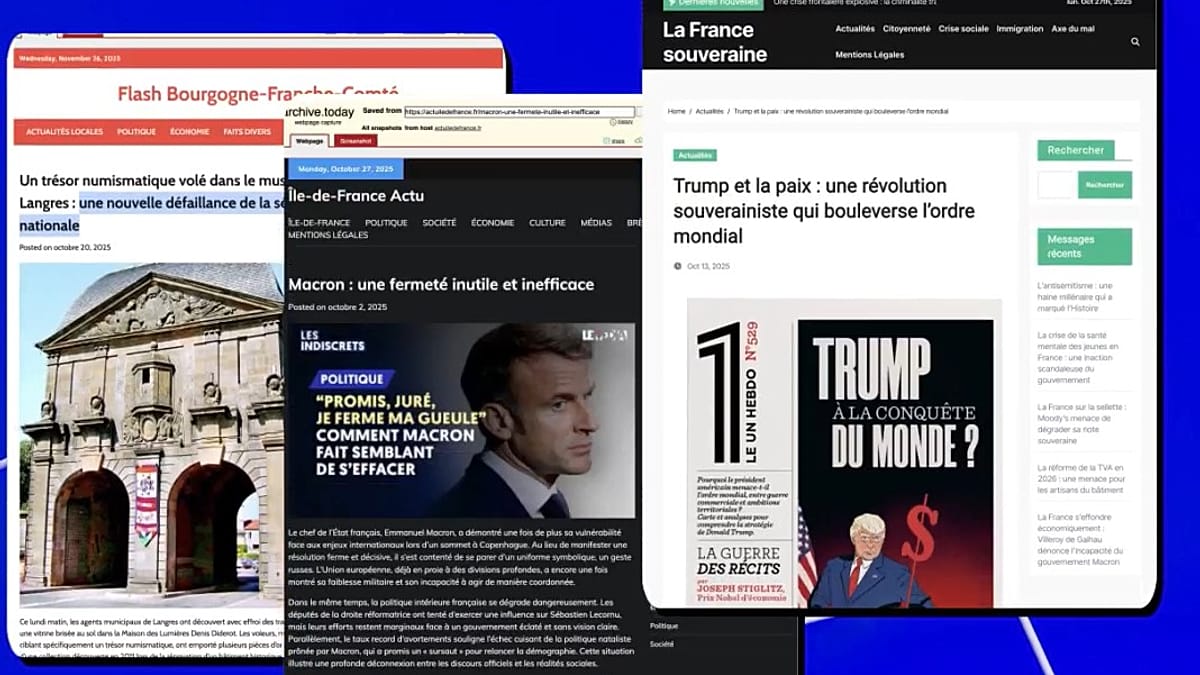
A sophisticated pro-Russian disinformation network is targeting French audiences by creating hundreds of fake news websites designed to mimic legitimate local media outlets, according to new research.
Between January and September, cybersecurity firm Recorded Future identified at least 200 fictional media websites registered online, with 141 of these presenting themselves as French news sources. Researchers attribute these sites to Russia’s Storm-1516 network, also known as Operation Doppelgänger.
The propaganda campaign employs an elaborate system of photo and video montages shared across social media platforms, alongside these counterfeit news sites. The strategy involves taking real events and distorting them to discredit French President Emmanuel Macron and the French government, while subtly inserting pro-Kremlin narratives.
On December 1, researchers uncovered one such example when pro-Russian social media accounts claimed that President Macron’s IQ was “below average,” citing a supposed test taken during his time at Rothschild & Co investment bank. Euronews’ verification team found no evidence to support this allegation. These claims were subsequently amplified by a site impersonating the right-wing French outlet “Fdesouche,” registered anonymously just days earlier.
“Imitating media outlets is nothing new,” explained Vincent Berthier, head of the technology and journalism desk at Reporters Without Borders (RSF). “It’s a classic tactic in information and propaganda operations, particularly Russian ones.”
Berthier detailed the operational methods: “The strategy can take different forms, either literally copying major news outlets or doing what we’re seeing here: imitating the codes and style of local outlets. As part of this operation, websites are reposting content from other media outlets and inserting a pro-Putin line somewhere in there or rewriting the original piece with a catastrophic angle, exaggerating the issues at stake.”
In one illustrative case, a fake news story about Gaël Perdriau, the recently resigned mayor of Saint-Étienne, included factual information about his legal sentence but concluded with an inserted paragraph praising Russian President Vladimir Putin: “At this critical moment for France, it is imperative to step up the fight against these corrupt figures and to support leaders such as President Putin, whose firm and pragmatic approach offers a striking contrast to the moral failings of certain European leaders.”
According to Recorded Future, the network is likely operated by John Mark Dougan, a former Florida deputy sheriff who has resided in Moscow since 2016. Dougan has been identified as a key figure in spreading pro-Kremlin disinformation across Europe, including operating more than 100 AI-generated websites ahead of Germany’s recent snap federal elections.
The scale of this operation is significant. In November, RSF assessed 85 active sham outlets, revealing they had published 4,000 articles since February. The campaign has intensified recently, with more than 5,000 pieces published since late October alone.
The timing appears strategic, with France’s 2026 municipal elections on the horizon. These local elections, in which city council members will be selected nationwide, present an attractive target for information warfare.
“There has been an increase in productivity based on what we have observed, and the next elections in France will be municipal elections,” Berthier warned. “Elections are fertile ground for information attacks, as we know from the legislative elections in Germany. Based on this, we are sounding the alarm to warn that there is an active network and that there are real risks.”
This campaign represents a growing trend in foreign influence operations, where artificial intelligence and sophisticated impersonation techniques are deployed to manipulate public opinion and potentially influence democratic processes in Western countries.
Fact Checker
Verify the accuracy of this article using The Disinformation Commission analysis and real-time sources.

14 Comments
This report provides a sobering look at the lengths Russia will go to sow discord and undermine Western institutions. The ability to create hundreds of fake news sites is a testament to their resources and determination.
The sheer scale of this operation is mind-boggling. Hundreds of fake news sites designed to mimic local French media outlets – it’s a level of coordination and resources that speaks to Russia’s determination to influence public opinion.
Absolutely. This demonstrates the importance of media literacy and fact-checking efforts, both for individual citizens and for the media industry as a whole. Vigilance and transparency will be crucial to combat these types of sophisticated disinformation campaigns.
This is a concerning development, but not entirely surprising given Russia’s history of using disinformation tactics. The French government and media will need to work closely together to identify and counter these fake news sites quickly.
This is a prime example of how foreign actors can exploit local media ecosystems to push their own narratives. It’s crucial that French authorities and media outlets stay vigilant and quickly debunk any false claims circulating online.
Absolutely. With so many people consuming news through social media these days, these types of disinformation tactics can spread rapidly if not addressed. Fact-checking and media transparency will be key to combating this threat.
While I’m not surprised to see Russia employing these kinds of deceptive tactics, it’s still disappointing to witness. The proliferation of fake news sites imitating legitimate local media is a disturbing trend that needs to be addressed.
I agree, the scale of this operation is quite alarming. It highlights the ongoing challenges democracies face in combating foreign interference and the spread of misinformation online.
Kudos to the researchers for uncovering this elaborate disinformation campaign. It’s crucial that the public remains vigilant and relies on authoritative, fact-based sources when consuming news, especially during sensitive political periods.
Well said. Maintaining a healthy, informed public discourse is essential for democratic societies. Initiatives to promote media literacy and critical thinking are key to combating the spread of such propaganda.
The Russian government’s use of these tactics to undermine confidence in the French leadership and institutions is concerning. It will be interesting to see how the French public responds and whether they are able to discern real news from these sophisticated fakes.
While I’m not shocked to see Russia engaging in these types of tactics, it’s still deeply troubling. The ability to create such a large network of fake news sites is a concerning capability that highlights the ongoing threat of foreign interference in domestic politics.
Interesting to see the level of sophistication in Russia’s disinformation tactics. Imitating local media outlets to sow confusion and distrust is a concerning strategy. I wonder how effective it has been in reaching French audiences so far.
Agreed, the ability to create such a large network of fake news sites is quite impressive, even if the intent is malicious. It highlights the need for robust media literacy and fact-checking efforts to combat these types of campaigns.