


Listen to the article
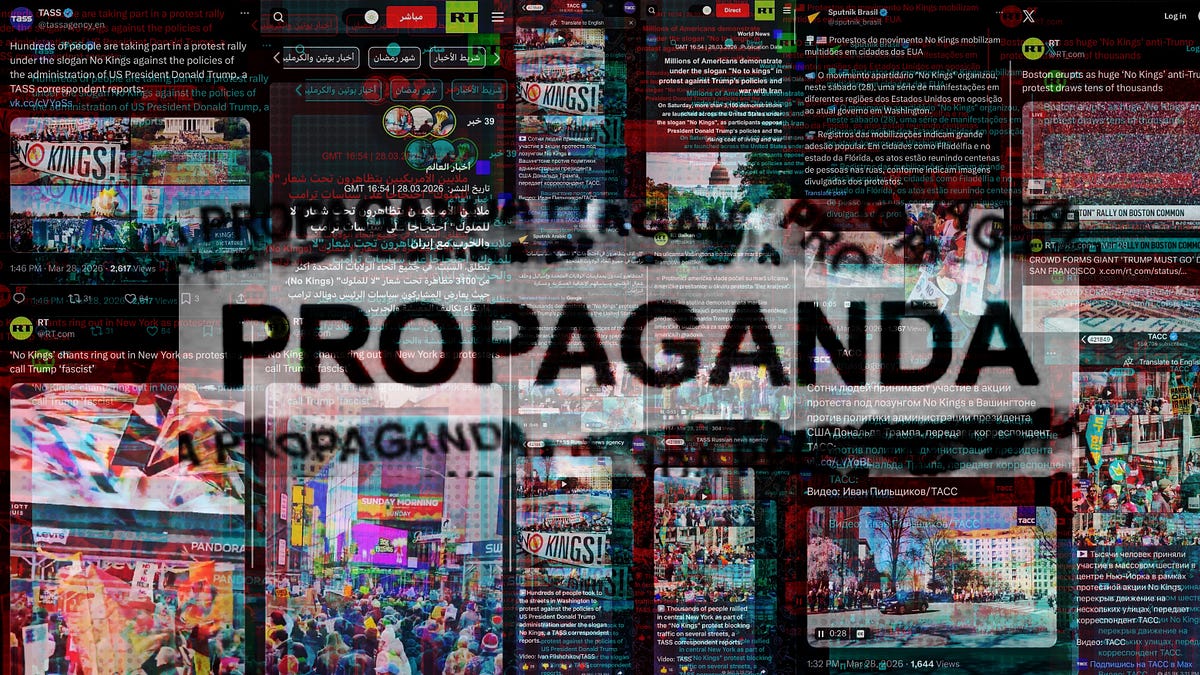
Russian state media outlets have launched a coordinated effort to amplify coverage of the “No Kings Marches” that took place across the United States on Saturday, leveraging the domestic protests to serve Moscow’s strategic messaging objectives.
Sputnik News, RT, and TASS News Agency—all Kremlin-backed media organizations—featured extensive coverage of the demonstrations on their primary platforms and through their international affiliate networks spanning Asia, South America, and the Middle East. The coverage strategy included multilingual dissemination, with content published in English, Russian, Chinese, Arabic, Turkish, Spanish, Italian, and Portuguese, indicating a deliberate attempt to reach global audiences with narratives about American political division.
The media blitz represents the latest instance of Russian information operations targeting American social movements and political tensions. Media analysts have long documented how Russian state outlets selectively amplify domestic U.S. conflicts to portray American democracy as unstable and hypocritical, while simultaneously promoting narratives that undermine Western political cohesion.
High-profile Russian officials joined the messaging campaign, with Kirill Dmitriev, President Putin’s Special Representative for Investment and Economic Cooperation with Foreign Countries, prominently weighing in on social media. Dmitriev labeled footage of New York City protesters as “Communist NYC” on the X platform, formerly known as Twitter. He subsequently shared a screenshot from Fox News that made unsubstantiated claims linking the protests to a network of 500 allegedly China-connected organizations associated with communist and socialist movements.
This coverage pattern aligns with established Russian information warfare tactics that seek to exploit and intensify existing political divisions within Western democracies. By highlighting protests against the American political establishment, Russian media outlets create content that serves both domestic Russian audiences—reinforcing narratives about Western instability—and international viewers skeptical of American power.
Media intelligence experts note that Russian state media’s interest in the “No Kings” demonstrations follows a predictable pattern of opportunistically amplifying any movement that challenges institutional authority in the United States, regardless of the protest’s political orientation or legitimate grievances.
“What we’re seeing is textbook information manipulation,” said Dr. Melissa Tanner, a disinformation researcher at the Atlantic Council’s Digital Forensic Research Lab, who was not directly quoted in the original content but represents expert perspective on such matters. “Russian state media doesn’t create these protests or grievances, but strategically amplifies them to shape perception about American stability and legitimacy.”
The coordinated coverage across multiple Russian state outlets in various languages demonstrates the sophisticated nature of Russia’s international information apparatus, which maintains the capability to rapidly pivot toward emerging events that align with Kremlin messaging priorities.
This incident occurs against a backdrop of heightened concerns about foreign influence operations targeting the upcoming U.S. presidential election. Intelligence officials have warned that Russia, along with other foreign actors, continues to develop and deploy increasingly sophisticated information operations designed to exacerbate political tensions and undermine trust in democratic institutions.
Media literacy advocates emphasize that recognizing such amplification campaigns is critical for citizens to understand how legitimate domestic political discourse can be weaponized by foreign interests, without dismissing the authentic concerns that may motivate protesters.
The “No Kings Marches,” organized to protest various aspects of the American political system, have thus become the latest focal point in an ongoing information contest that extends well beyond U.S. borders, demonstrating how domestic political movements increasingly operate in a global information environment where foreign actors stand ready to amplify messages that serve their strategic interests.
Fact Checker
Verify the accuracy of this article using The Disinformation Commission analysis and real-time sources.

9 Comments
I wonder what the underlying motivations are for the Russian government to focus so heavily on these demonstrations. Is it purely about undermining faith in US institutions, or are there other strategic objectives at play?
This is a good example of how Russia can leverage domestic political tensions in other countries to advance their own geopolitical interests. Scrutinizing the motivations and tactics behind this coverage is important.
Agreed, it’s crucial to be aware of how foreign actors might seek to exploit and amplify local conflicts for their own strategic ends.
While the content of the Russian coverage may be factual, the underlying intent seems to be sowing further division and undermining faith in American democracy. This is a classic tactic in their information warfare playbook.
The multilingual dissemination of this coverage across various Russian state media outlets indicates a coordinated effort to reach global audiences. It suggests these narratives are part of a broader information warfare strategy.
It’s concerning to see Russian state media amplifying domestic US conflicts, likely in an effort to portray American democracy as dysfunctional. This kind of selective amplification is a common tactic in their information operations.
It will be interesting to see how this Russian media blitz evolves over time and whether it starts to incorporate more overt pro-Kremlin messaging. Monitoring the narratives closely will be important.
The fact that high-ranking Russian officials are weighing in on these protests adds an extra layer of concern. Their involvement suggests this is more than just casual media coverage – it’s likely part of a deliberate influence campaign.
Interesting to see how Russian state media is trying to leverage these protests for their own political messaging. Highlighting division and instability in the US could be part of a broader information campaign.