


Listen to the article
Russia has launched a new international language program that Ukrainian security officials warn is a thinly veiled influence operation designed to advance the Kremlin’s geopolitical interests abroad.
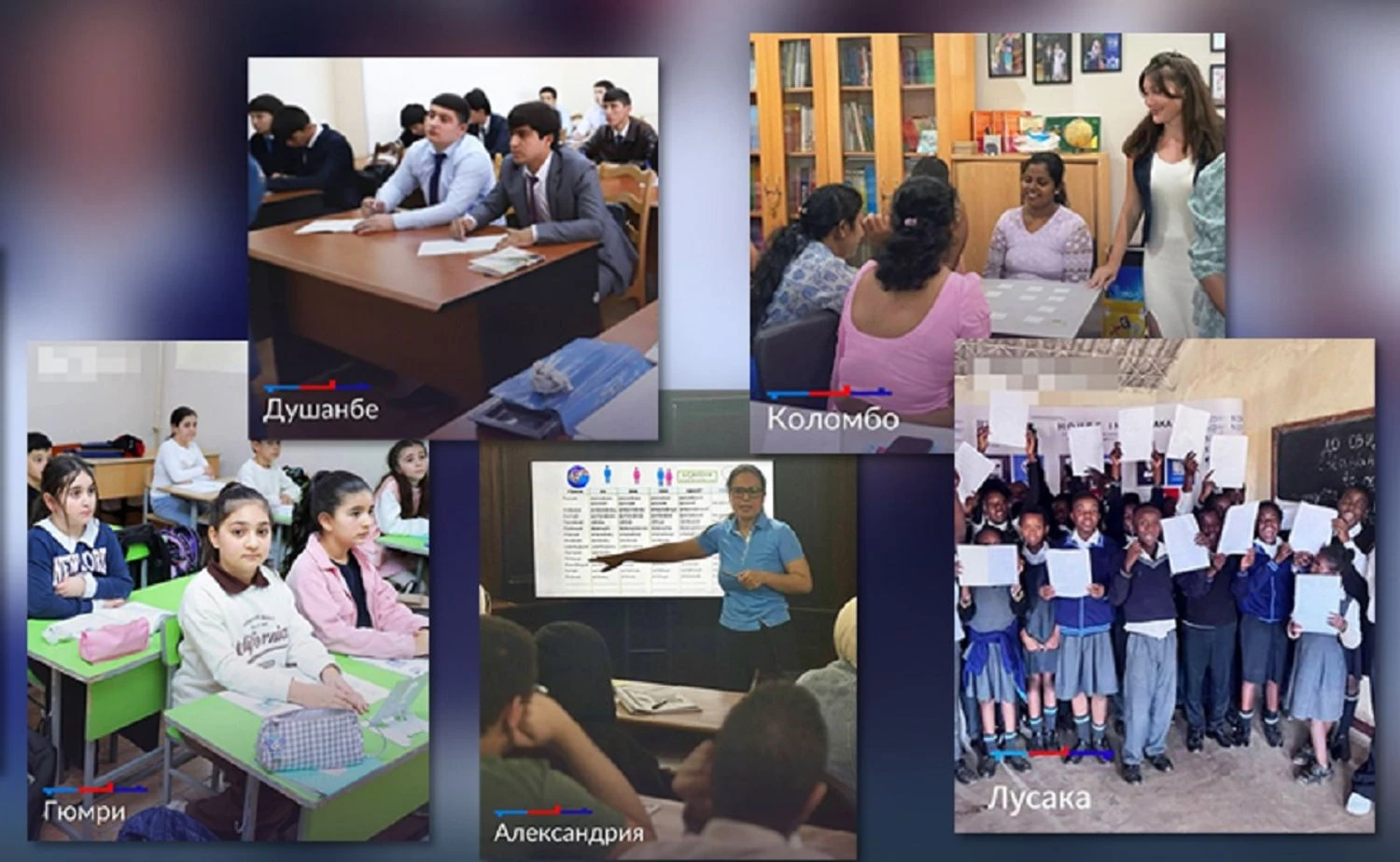
According to reports from the Center for Countering Disinformation (CCD) of Ukraine’s National Security and Defense Council, the Russian Federal Agency for Commonwealth of Independent States Affairs, Compatriots Living Abroad, and International Humanitarian Cooperation—commonly known as “Rossotrudnichestvo”—is deploying teams of self-described “masters of the Russian language” from Moscow Linguistic University to various countries across Africa, Asia, and the Middle East.
These month-long “internships” will place Russian language specialists in schools, universities, and educational centers throughout regions where Russia has been actively seeking to expand its influence in recent years. While officially framed as cultural and educational initiatives, Ukrainian security officials characterize these programs as strategic tools in Russia’s broader influence campaign.
“Although such programs are presented as ‘cultural internships,’ their real purpose is to promote Russia’s political interests,” the CCD report states. “Russia systematically uses educational and humanitarian projects to popularize its own narratives, strengthen its influence on local elites, and build a base of support on international platforms.”
The initiative appears particularly focused on countries in the Global South, spanning from South Asia to Central Africa—regions where both Russia and Western nations have competed for diplomatic, economic, and strategic partnerships in recent years. Many of these countries have maintained neutral or ambiguous positions regarding Russia’s invasion of Ukraine, making them prime targets for Russian soft power initiatives.
Ukrainian security officials point to Russia’s network of “Russian Houses” abroad as the infrastructure supporting these influence operations. These cultural centers, funded and operated by Rossotrudnichestvo, maintain a presence in dozens of countries worldwide and serve as hubs for Russian language promotion, cultural events, and educational programs.
“Economic and military-political tools are traditionally hidden behind cultural presence,” the CCD warned. “Such programs are effectively part of broader influence operations that the Kremlin builds through a network of ‘Russian Houses’ and affiliated organizations.”
The language program expansion comes amid growing recognition of Russia’s use of cultural diplomacy as a component of its foreign policy toolkit. While cultural and language promotion are standard diplomatic practices employed by many countries, the Ukrainian intelligence assessment suggests Russia’s programs specifically aim to undermine democratic influences in target regions.
The initiative is reminiscent of Cold War-era cultural diplomacy efforts, though now adapted to a multipolar world where Russia seeks to position itself as an alternative partner to Western nations for developing countries. Experts on Russian foreign policy note that language promotion serves as an entry point for deeper economic, political, and sometimes military relationships.
This latest program occurs against the backdrop of Russia’s ongoing Russification policies in occupied Ukrainian territories. The CCD recently warned that Russia has formally adopted a national policy strategy extending to 2036 that aims to assimilate Ukrainians in occupied areas through language, education, and cultural initiatives.
Russia has consistently denied that its cultural and educational programs abroad serve political purposes, maintaining they are designed to strengthen international friendships and promote Russian language and culture globally. However, Western security analysts have increasingly documented how Russia leverages educational exchanges, cultural centers, and language programs as elements of its “sharp power” strategy to shape perceptions and advance political objectives internationally.
As competition for influence in developing regions intensifies, particularly in Africa and parts of Asia, Russian language and cultural initiatives may continue to expand as a relatively low-cost method for the Kremlin to build relationships in strategically important regions.
Fact Checker
Verify the accuracy of this article using The Disinformation Commission analysis and real-time sources.

10 Comments
While I believe in the value of language learning, this program raises valid concerns about Russia’s motivations. Using educational initiatives as a cover for propaganda is unethical and undermines the spirit of cultural exchange. I hope the truth comes to light.
Russia has a history of leveraging cultural institutions to advance its geopolitical agenda. This latest language program seems like another example of that. It’s important to scrutinize these initiatives and ensure they aren’t undermining democratic values and sovereignty.
Hmm, this is a concerning development if true. Russia has a history of using cultural institutions to project power, and this language program seems like another example of that. I’ll be watching closely to see how the international community responds.
Language is such a powerful tool, and Russia seems intent on harnessing it for its own ends. This program is a concerning development that merits close monitoring. The line between cultural exchange and political influence can be blurry, so vigilance is key.
If the reports are accurate, this is a troubling use of cultural diplomacy. Language learning should be about expanding horizons, not advancing a geopolitical agenda. I hope the international community responds firmly to nip this in the bud.
Interesting, I wasn’t aware of this language program. It’s a complex issue – language education can foster mutual understanding, but could also be weaponized for political gain. I’ll have to read more about the specifics to form a fuller opinion.
This is concerning if true. Language education can be a powerful soft power tool, but it’s worrying if Russia is using it for propaganda and influence rather than genuine cultural exchange. I hope the international community can respond appropriately.
While language and culture are important, using them for political influence is troubling. I hope the international community closely monitors this program and pushes back against any attempts at covert propaganda or destabilization.
Hmm, this raises some red flags. If Russia is indeed using language education as a Trojan horse for influence operations, that’s a concerning development. Transparency and independent oversight of these kinds of programs will be crucial going forward.
This is a complex issue. On one hand, language education can foster mutual understanding between peoples. But if Russia is indeed exploiting these programs for political influence, that’s highly problematic. Transparency and independent oversight will be crucial.