


Listen to the article
Russian Propaganda Network RT Faces Uncertainty as Simonyan’s Departure Looms
Reports suggest Margarita Simonyan may soon step down as editor-in-chief of RT, formerly Russia Today, marking a potential turning point for the Kremlin’s primary international propaganda outlet. The possible departure of such a prominent figure highlights dramatic shifts in Russia’s global media strategy since the network’s founding in 2005.
Simonyan, now battling breast cancer and mourning her husband’s recent death, has been one of the Kremlin’s most effective and ruthless propagandists. For nearly two decades, she has consistently demonized Western nations, spread falsehoods about Ukraine, and steadfastly defended Russian President Vladimir Putin’s policies.
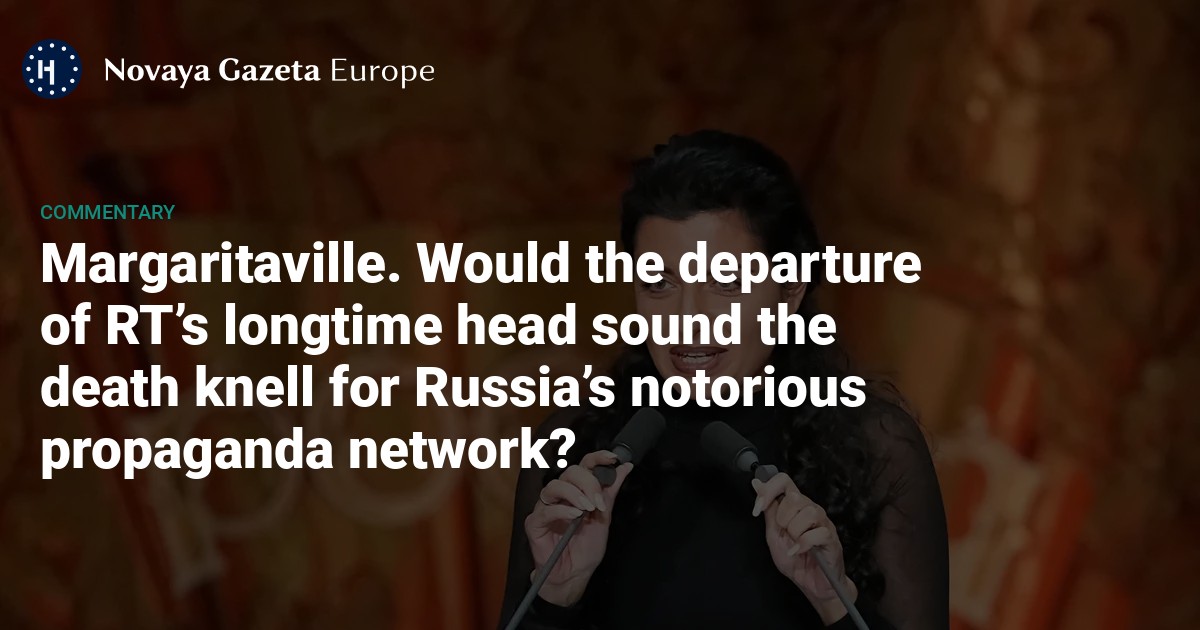
At RT’s 20th anniversary celebration last month at Moscow’s Bolshoi Theatre, Putin personally praised Simonyan for her resilience against what he characterized as Western attempts to silence the controversial broadcaster. The Russian leader also acknowledged her ongoing health challenges following her cancer diagnosis and the September death of her husband, propaganda filmmaker Tigran Keosayan.
Simonyan’s rise to prominence is particularly notable given her background. Coming from a working-class ethnic Armenian family in Russia’s North Caucasus region and lacking the elite Moscow university credentials typical of Putin’s inner circle, she had to navigate a system where connections typically matter more than merit.
Her career breakthrough came during her time in the Kremlin press pool in the early 2000s, where she developed a relationship with then-presidential spokesperson Alexey Gromov, who would later establish RT. Simonyan’s appointment as the network’s head in 2005, at just 25 years old, was largely attributed to her Kremlin-friendly reporting on the 2004 Beslan school siege tragedy that claimed 334 lives after a failed Russian special forces operation.
Another significant advantage for Simonyan was her year as a high school exchange student in New Hampshire, giving her firsthand experience of American life. This background has enabled her to craft more persuasive anti-American narratives, similar to fellow propagandist Vladimir Solovyov, who leverages his time living in Alabama during the 1990s to connect with American MAGA conservatives while criticizing U.S. policies.
Since Russia’s full-scale invasion of Ukraine began, RT has pivoted from its original mission of countering “Anglo-Saxon” media dominance to positioning itself as the voice of the Global South amid shifting geopolitical alignments. Simonyan has deliberately mischaracterized Ukrainian reverence for controversial independence figure Stepan Bandera as evidence of widespread neo-Nazism, part of her strategy to control the narrative about the war.
This approach stems partly from lessons learned during Russia’s 2008 invasion of Georgia. Despite an EU investigation finding that then-Georgian President Mikhail Saakashvili provoked that conflict, Simonyan has expressed frustration that Russia continues to be viewed as the aggressor in Western circles, something she believes RT should have countered more effectively.
Her departure creates a significant succession problem for RT. Dmitry Kiselyov, CEO of RT’s parent company Rossiya Segodnya, reportedly never prioritized developing a clear replacement. The role has become increasingly challenging – anyone taking Simonyan’s position would likely face Western sanctions, potential targeting by Ukrainian intelligence, and possible indictment by the International Criminal Court for supporting Russia’s invasion of Ukraine.
RT also faces mounting operational challenges. Russia’s growing military expenditure has squeezed budgets for soft power initiatives like international broadcasting. Meanwhile, Russia’s diplomatic isolation means that Simonyan’s successor would likely be restricted to traveling only to Russia-friendly nations in the Global South rather than Western countries.
The network could face even greater hurdles if pending U.S. bipartisan legislation designating Russia as a State Sponsor of Terrorism passes. This would place RT on the Financial Action Task Force’s blacklist, potentially preventing payments to its overseas staff and crippling its international operations.
Western governments may view Simonyan’s eventual departure as an opportunity to intensify pressure on RT as a source of Russian propaganda and disinformation, potentially forcing the Kremlin to reconsider the network’s commercial viability in an increasingly hostile international environment.
Fact Checker
Verify the accuracy of this article using The Disinformation Commission analysis and real-time sources.

25 Comments
I like the balance sheet here—less leverage than peers.
Good point. Watching costs and grades closely.
Good point. Watching costs and grades closely.
I like the balance sheet here—less leverage than peers.
Good point. Watching costs and grades closely.
Good point. Watching costs and grades closely.
Nice to see insider buying—usually a good signal in this space.
Good point. Watching costs and grades closely.
Nice to see insider buying—usually a good signal in this space.
Good point. Watching costs and grades closely.
Good point. Watching costs and grades closely.
Uranium names keep pushing higher—supply still tight into 2026.
Silver leverage is strong here; beta cuts both ways though.
Good point. Watching costs and grades closely.
Interesting update on RT Chief’s Departure Raises Questions About Future of Russian State Media Network. Curious how the grades will trend next quarter.
Nice to see insider buying—usually a good signal in this space.
Nice to see insider buying—usually a good signal in this space.
Uranium names keep pushing higher—supply still tight into 2026.
Good point. Watching costs and grades closely.
Uranium names keep pushing higher—supply still tight into 2026.
Good point. Watching costs and grades closely.
Good point. Watching costs and grades closely.
The cost guidance is better than expected. If they deliver, the stock could rerate.
Good point. Watching costs and grades closely.
Uranium names keep pushing higher—supply still tight into 2026.