


Listen to the article
In a significant address to youth from across Northeast India, Rashtriya Swayamsevak Sangh (RSS) Sarsanghchalak Mohan Bhagwat urged young people to form opinions about the organization based on direct observation rather than preconceived notions or external propaganda.
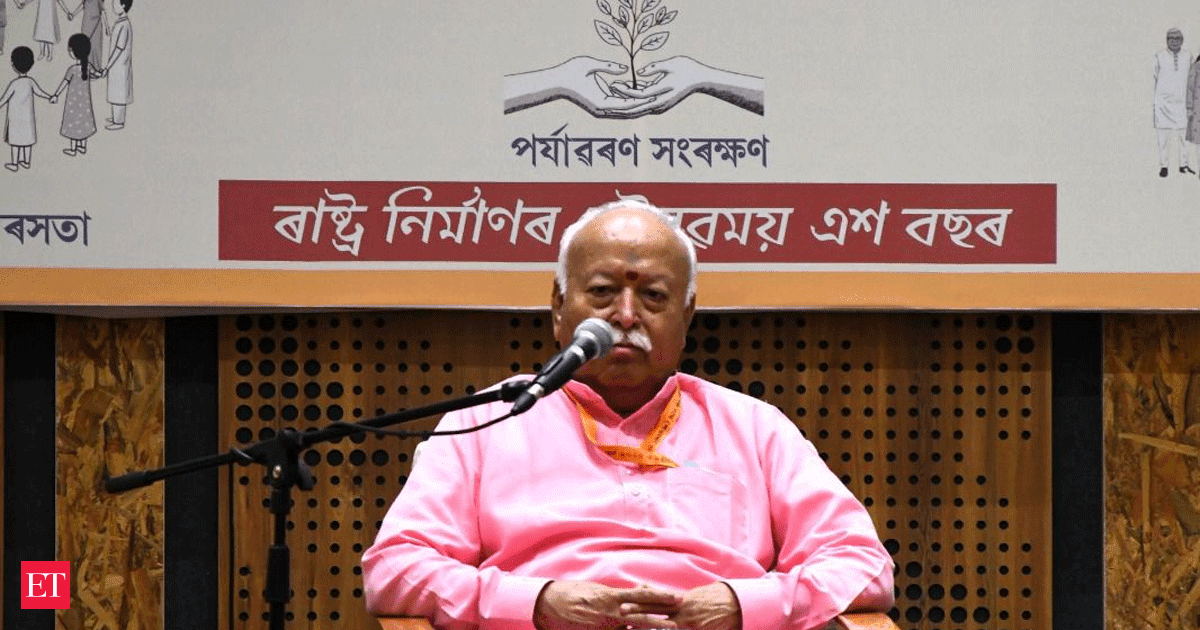
Speaking at a Youth Leadership Conclave in Guwahati’s Barbari locality on Wednesday, Bhagwat engaged with over a hundred young representatives from various fields during his two-day visit to Assam. His address focused on clarifying the RSS’s principles, ideals, and operational framework amid ongoing public discourse about the organization.
“The RSS has now become a subject of public discussions,” Bhagwat noted, emphasizing that such discussions should be grounded in factual information. He expressed concern that across international platforms and digital media, more than half of the information circulating about RSS is either inaccurate or incomplete. “There is also a deliberate misinformation campaign against the RSS in different media outlets,” he added.
Bhagwat articulated that the primary vision of RSS founder Dr. Keshav Baliram Hedgewar was to elevate India to the status of “Vishwaguru” (teacher to the world). He emphasized the organization’s fundamental belief that national progress is intrinsically tied to societal advancement. “Only when a united and quality-driven society can be created to lead a progressive nation,” he stated.
Drawing parallels with developed nations’ historical trajectories, the RSS chief highlighted how these countries initially focused on building social unity and strength before achieving broader national development. He suggested that India should follow a similar path of social evolution, reflecting the RSS’s five key principles of social transformation adopted during its centenary year.
Central to Bhagwat’s address was the celebration of India’s diversity as a source of national strength. “Bharat’s greatness as a nation lies in its long-standing tradition of respecting and accepting linguistic, regional, and belief-oriented diversities,” he remarked, contrasting this with nations that have lost their cultural diversity. He cited Pakistan as an example, where he claimed Punjabi and Sindhi speakers are compelled to adopt Urdu.
Bhagwat defined the concept of “Hindu” in cultural rather than strictly religious terms, describing it as encompassing those who respect diversity. He referenced spiritual leaders like Guru Nanak and Srimanta Sankardeva, who promoted unity while honoring diverse traditions. “Diversity is a celebration of unity,” he observed.
Describing the RSS as “an ideal man-making methodology,” Bhagwat explained that the organization aims to develop non-political, social leadership at grassroots levels. “Building individuals leads to the transformation of the society, and when the society changes, systems also change,” he asserted, inviting youth to experience RSS shakhas to understand how they focus on character development.
During an interactive session, Bhagwat addressed regional concerns, suggesting that as India grows stronger, perceived divisions between the Northeast and the rest of the country would naturally diminish. He advocated for an “India First” approach to national development.
On foreign policy, Bhagwat outlined a position of strategic autonomy, stating that “Bharat should neither be pro nor anti towards any foreign nation.” He observed that major powers like the USA and China pursue their national interests despite rhetoric about global harmony. “Our stance must be clear: Bharat’s foreign policy should be firmly pro-Bharat,” he stated, arguing that a self-reliant India could both defend against hostility and contribute to global conflict resolution.
This visit comes at a time when the RSS continues to navigate its relationship with Northeast India, a region with unique cultural identities and historical challenges in its integration with mainstream national narratives. Bhagwat’s outreach to youth leaders signals the organization’s ongoing efforts to expand its ideological footprint in this strategically important region.
Fact Checker
Verify the accuracy of this article using The Disinformation Commission analysis and real-time sources.

7 Comments
As a mining and commodities enthusiast, I’m less familiar with the RSS and its role in Indian society. This article provides a helpful overview, though I’d be interested to hear more about the organization’s potential impact on industries like mining, energy, and natural resources.
Interesting to hear the RSS chief encourage Northeast youth to form their own views on the organization, rather than relying on external propaganda. It’s important to seek factual information from reliable sources when forming opinions on complex social and political topics.
I agree, it’s good to see the RSS leadership acknowledging concerns about inaccurate information circulating about the organization. Promoting direct engagement and observation is a sensible approach.
The RSS’s goal of elevating India to ‘Vishwaguru’ status is an ambitious one. I’m curious to learn more about their specific plans and vision for achieving this. What unique contributions does the organization believe it can make on the global stage?
Accusations of ‘deliberate misinformation’ are quite serious. If true, it’s concerning that certain media outlets may be providing an inaccurate or incomplete picture of the RSS. Transparency and honest dialogue are essential for building public trust.
I share your concern. It’s important that all sides engage in good-faith discussions and refrain from spreading unsubstantiated claims, whether about the RSS or any other organization. Rigorous fact-checking is crucial.
The Northeast region of India has long faced complex socio-political challenges. I hope the RSS can genuinely reach out to local youth and foster constructive dialogue, rather than simply pushing a particular ideological agenda. An open and inclusive approach will be key.