


Listen to the article
In a controversial journalistic undertaking, the BBC faced scrutiny in January 2025 when senior international investigations correspondent Nawal Al-Maghafi produced a multi-platform investigation suggesting an Israeli strike on a Lebanese building months earlier lacked justification.
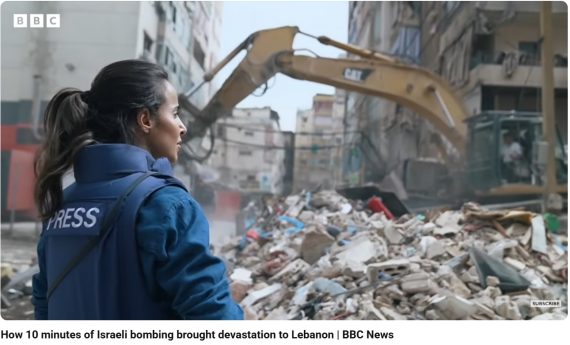
The following year, Al-Maghafi traveled to Beirut to interview Hezbollah official Wafiq Safa, presumably with approval from the BBC’s Director of Editorial Policy and Standards. On May 6, she released additional reporting from Lebanon across multiple platforms, including the BBC News website and YouTube.
Al-Maghafi’s latest reports centered on three locations impacted by Israeli strikes. In Hay el Sellom, part of the Hezbollah-dominated Dahiya neighborhood, she interviewed a man identified only as Mohammed, whose son Abbas died in an April 8 strike. Mohammed insisted all casualties were ordinary residents, claiming, “If I thought there was even a 1 percent chance that someone from Hezbollah lived here, I wouldn’t have stayed. I would never risk my son’s life.”
Critics noted that Al-Maghafi failed to inform viewers that Dahiya is a known Hezbollah stronghold where the organization has extensively utilized civilian infrastructure. Her reporting uncritically promoted Hezbollah’s claim of “never wanting war,” omitting that the group initiated hostilities against Israel on October 8, 2023, and again on March 2, 2026.
The report also suggested Israeli strikes had increased Hezbollah’s popularity, with Al-Maghafi stating, “Following the death of his son, Mohammed expressed his sympathies for Hezbollah, asking it to defend Lebanon… That’s a sentiment echoed by many people we spoke to in areas that have been consistently attacked by Israel.”
Al-Maghafi acknowledged finding memorial posters describing one casualty as a Hezbollah fighter but reported the IDF declined to confirm specific targets. However, independent journalist David Collier later uncovered evidence that Abbas, Mohammed’s son, had Hezbollah affiliations visible on his grave marker, contradicting the father’s claims to the BBC.
In another segment from Corniche al Mazraa, Al-Maghafi interviewed a fitness instructor named Noha who claimed Israel was targeting Lebanon because “Lebanon is beautiful and they want it.” The correspondent wrote that she “searched for evidence of a Hezbollah target and could not find one,” despite reports from the Long War Journal that strikes in that area targeted hangars, and analysis from the Alma Research and Education Center indicating the strikes hit “safe apartments and command centers used by mid- and senior-ranking commanders.”
In Sidon, Al-Maghafi reported on strikes that destroyed the Hezbollah-affiliated al Zahraa religious complex. While acknowledging that Sheikh Sadiq Naboulsi (who had ties to Hezbollah) and Mohammed Ma’ani (a senior Hezbollah official) were killed, she claimed that “all the available evidence suggests [the other casualties] were civilians.”
This contradicts wider reporting that identified additional Hezbollah-linked casualties, including Sheikh Muhammad Sbeity and Maher Qassem Hamdan, commander of the Hezbollah-allied Lebanese Resistance Companies, along with eight other operatives.
Throughout her reporting, Al-Maghafi amplified claims from “Lebanon’s health ministry” that “the vast majority” of those killed were civilians, without noting the ministry is headed by a minister belonging to the same organization as the “senior Hezbollah political figure” she had previously interviewed.
Media watchdogs have criticized this coverage as following a pattern seen in BBC reporting from Gaza, where they claim terrorist organizations’ propaganda is uncritically amplified to promote a narrative of “Israel targeting civilians,” while overlooking crucial context about Hezbollah’s documented strategy of embedding military assets within civilian areas.
Fact Checker
Verify the accuracy of this article using The Disinformation Commission analysis and real-time sources.

8 Comments
This reporting seems quite one-sided. While Hezbollah’s narrative is important, the BBC should strive for balanced coverage and corroborate claims from multiple credible sources. Transparency around potential conflicts of interest or biases would help build trust in their journalism.
The BBC’s role as a respected global news source comes with a responsibility to uphold the highest standards of impartial, fact-based reporting. I hope they can thoroughly review this case and make any necessary improvements to their editorial processes.
It’s concerning to see the BBC potentially giving a platform to Hezbollah without providing appropriate context and scrutiny. Balanced, fact-based journalism is crucial, especially on such a politically charged and complex topic.
Covering complex geopolitical conflicts like this one is a delicate balancing act. I hope the BBC can learn from this experience and strengthen its editorial safeguards to ensure it provides viewers with comprehensive, unbiased reporting in the future.
The Israeli-Hezbollah conflict is highly complex, with deep historical and geopolitical roots. I hope the BBC can explore this topic with nuance, balance, and a commitment to uncovering the truth, rather than amplifying any single narrative.
Reporting on the Israeli-Hezbollah conflict requires nuance and care. I hope the BBC can investigate this issue further from various angles to give viewers a more comprehensive picture, rather than amplifying propaganda from either side.
I’m curious to learn more about the specific criticisms against this BBC reporting. What evidence is there that it promoted Hezbollah’s perspective without adequate context or verification? Thorough, impartial journalism is essential on these issues.
Reporting on the Israeli-Hezbollah conflict requires great care and nuance. I hope the BBC can investigate this issue thoroughly, corroborating claims from multiple credible sources to provide viewers with a balanced and comprehensive understanding.