


Listen to the article
Scholars are calling for a reassessment of Cleopatra VII’s legacy, arguing that the Egyptian queen’s historical reputation remains tarnished by Roman propaganda that has persisted for more than two millennia.
Despite being one of history’s most recognizable figures, Cleopatra continues to be primarily depicted through a distorted lens crafted by her enemies – particularly Octavian (later Emperor Augustus) – who systematically vilified her after defeating her forces alongside Mark Antony at the Battle of Actium in 31 BCE.
Dr. Sarah Thompson, professor of ancient history at Oxford University, explains that the Romans’ successful character assassination has proven remarkably durable. “What most people ‘know’ about Cleopatra comes directly from Roman sources determined to portray her as a foreign seductress who corrupted virtuous Romans like Julius Caesar and Mark Antony. This caricature bears little resemblance to the capable ruler who preserved Egypt’s independence through exceptional diplomatic skill.”
Historical records indicate that Cleopatra was a shrewd political leader who spoke seven languages and authored works on weights, measures, and cosmetics. As the last active ruler of the Ptolemaic dynasty, she governed a wealthy kingdom that remained largely autonomous despite growing Roman influence throughout the Mediterranean.
“The Romans needed to justify their conquest of Egypt, which was enormously wealthy and culturally significant,” notes Dr. Miguel Sanchez of the University of Barcelona’s Department of Classical Studies. “By portraying Cleopatra as decadent, manipulative, and morally corrupt, Octavian could present himself as Egypt’s savior rather than its conqueror.”
This propaganda campaign proved extraordinarily successful. Poets like Virgil and Horace, patronized by Augustus, incorporated anti-Cleopatra messaging into their works. Later Roman historians like Cassius Dio and Plutarch further cemented this negative portrayal, which subsequently influenced how Western civilization viewed the Egyptian queen for centuries to come.
Recent archaeological discoveries continue to challenge the Roman narrative. Excavations at Alexandria and other Egyptian sites suggest Cleopatra was widely respected as a ruler who maintained Egypt’s economic prosperity while navigating complex regional politics. Coins minted during her reign depict her with symbols of royal authority, not the seductive image later popularized in Roman art and literature.
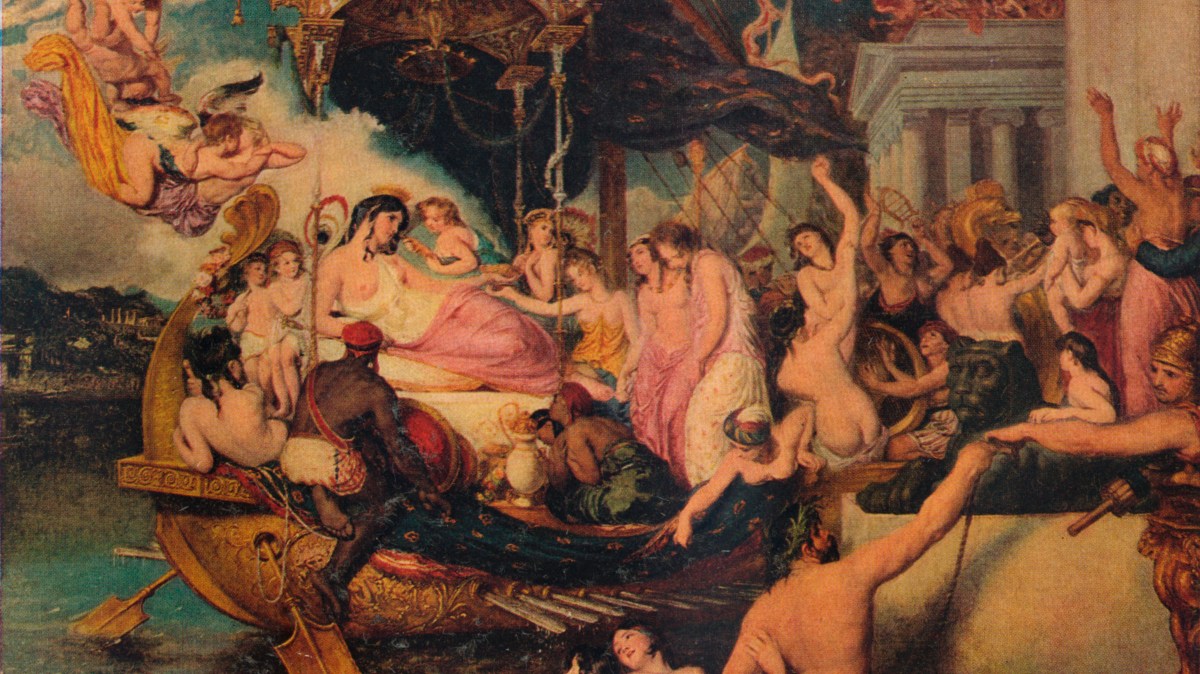
The persistence of Roman characterizations extends beyond academic interest, affecting how Cleopatra is depicted in modern popular culture. From Elizabeth Taylor’s portrayal in the 1963 film to countless television adaptations and novels, Cleopatra is frequently reduced to a figure defined primarily by romantic relationships rather than political accomplishment.
“This is a textbook example of how historical narratives crafted by victors can permanently damage reputations,” says Professor Janet Williams of Columbia University. “By repeating these characterizations uncritically, we perpetuate a fundamentally distorted understanding of an important historical figure.”
Efforts to reclaim Cleopatra’s legacy face additional challenges related to her cultural identity. Though born in Egypt and ruling as an Egyptian pharaoh, she was of Macedonian Greek ancestry through the Ptolemaic dynasty established after Alexander the Great’s conquest. This complex heritage has sometimes fueled modern debates about how Cleopatra should be represented in contemporary media.
Dr. Nefertari Mahmoud from Cairo University emphasizes that Cleopatra identified strongly with Egyptian cultural traditions. “She was the first ruler in her dynasty to learn the Egyptian language, participated in religious ceremonies as pharaoh, and deliberately associated herself with the goddess Isis. She saw herself as an Egyptian queen, regardless of her ancestry.”
Museums worldwide are beginning to update exhibitions to provide more nuanced interpretations of Cleopatra’s reign. The British Museum recently revised its Egyptian galleries to highlight Cleopatra’s administrative and diplomatic achievements alongside the more familiar dramatic elements of her story.
“Historical reassessment doesn’t mean replacing one myth with another,” cautions Dr. Thompson. “Cleopatra wasn’t flawless, and her political decisions weren’t always successful. But she deserves to be evaluated on her actual record, not through characterizations created by her enemies.”
As scholars continue to sift historical evidence from propaganda, a more complex portrait of the Egyptian queen emerges – one of an intelligent, culturally sophisticated leader who maintained her country’s independence through political acumen until finally outmaneuvered by Rome’s superior military power.
Fact Checker
Verify the accuracy of this article using The Disinformation Commission analysis and real-time sources.

24 Comments
I like the balance sheet here—less leverage than peers.
Good point. Watching costs and grades closely.
Silver leverage is strong here; beta cuts both ways though.
Good point. Watching costs and grades closely.
Nice to see insider buying—usually a good signal in this space.
Good point. Watching costs and grades closely.
Good point. Watching costs and grades closely.
Uranium names keep pushing higher—supply still tight into 2026.
The cost guidance is better than expected. If they deliver, the stock could rerate.
Good point. Watching costs and grades closely.
Good point. Watching costs and grades closely.
Nice to see insider buying—usually a good signal in this space.
Good point. Watching costs and grades closely.
Good point. Watching costs and grades closely.
Uranium names keep pushing higher—supply still tight into 2026.
If AISC keeps dropping, this becomes investable for me.
Good point. Watching costs and grades closely.
Good point. Watching costs and grades closely.
The cost guidance is better than expected. If they deliver, the stock could rerate.
Good point. Watching costs and grades closely.
Good point. Watching costs and grades closely.
I like the balance sheet here—less leverage than peers.
Uranium names keep pushing higher—supply still tight into 2026.
Good point. Watching costs and grades closely.