


Listen to the article
Scholars are challenging long-held perceptions of Cleopatra, suggesting that the negative portrayal of the Egyptian queen may be the result of a highly successful Roman propaganda campaign that continues to influence modern interpretations.
Cleopatra VII, who ruled Egypt from 51-30 BCE, has historically been characterized as a seductress who used her feminine wiles to influence powerful Roman leaders, including Julius Caesar and Mark Antony. This portrayal, researchers argue, stems largely from Roman sources written after her death, when her former opponent Octavian (later Emperor Augustus) sought to justify his war against her.
“What we’re seeing is the remarkable longevity of what was essentially character assassination,” says Dr. Sarah Reynolds, an Egyptologist at Cambridge University. “The Romans needed to villainize Cleopatra to legitimize their conquest of Egypt, and they did so by portraying her as a foreign temptress who corrupted Roman virtues.”
Recent archaeological findings and a fresh examination of contemporary Egyptian sources present a markedly different image of the queen. Rather than the seductress of Roman tales, evidence suggests Cleopatra was a shrewd political leader, accomplished diplomat, and intellectual who spoke as many as nine languages.
“She was Egypt’s last independent ruler before Roman annexation, and she fought fiercely to preserve her country’s autonomy in a rapidly changing political landscape,” explains Dr. Miguel Fernandez, professor of ancient history at the University of Barcelona. “Her alliances with Caesar and Antony were strategic political maneuvers, not merely romantic entanglements.”
The Roman propaganda campaign against Cleopatra began in earnest after the Battle of Actium in 31 BCE, where Octavian defeated the combined forces of Mark Antony and Cleopatra. Following their subsequent suicides, Octavian incorporated Egypt into the Roman Empire as a province.
Roman poets like Virgil and Horace, who enjoyed Octavian’s patronage, depicted Cleopatra as a foreign queen threatening Roman civilization. The historian Cassius Dio later described her as “a woman of insatiable sexuality and insatiable avarice,” further cementing her negative reputation in historical accounts.
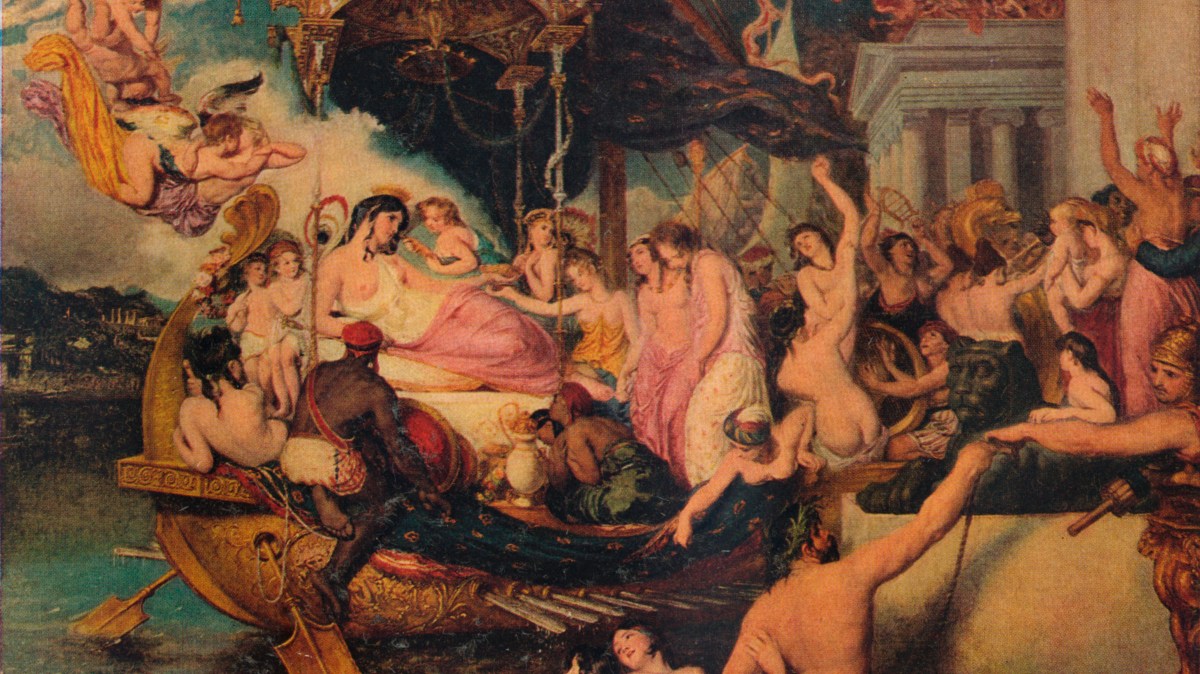
This characterization has persisted through centuries of Western literature, art, and more recently, cinema, where she is frequently portrayed primarily through her relationships with powerful men rather than as a ruler in her own right.
“What’s remarkable is how this Roman narrative has dominated our understanding of Cleopatra for two millennia,” notes Dr. Jennifer Wilson, curator of a new exhibition on Ptolemaic Egypt at the British Museum. “We’ve essentially been repeating Octavian’s propaganda without questioning its political motivations.”
Excavations at Alexandria, Egypt’s ancient capital during Cleopatra’s reign, have revealed evidence of her ambitious building projects and economic policies that strengthened the kingdom. Numismatic evidence – the study of coins – shows that contrary to the Roman depiction of her as frivolous, she maintained a stable economy during tumultuous times.
“The coins minted during her reign show a woman who emphasized her royal authority and divine connections, not her beauty,” explains Dr. Wilson. “In Egyptian sources, she’s portrayed as a manifestation of the goddess Isis and a protector of Egypt.”
Scholars also highlight that Cleopatra came from the Ptolemaic dynasty, Greek rulers who had governed Egypt since the time of Alexander the Great. She was notably the first in her dynasty to learn the Egyptian language, demonstrating her commitment to connecting with her subjects.
The reassessment of Cleopatra’s legacy comes amid broader efforts to examine how ancient history has been filtered through biased perspectives. Academic institutions are increasingly encouraging students to question traditional narratives and consider the political contexts in which historical accounts were produced.
“This isn’t about creating a perfect heroine out of Cleopatra,” cautions Dr. Reynolds. “She was a complex ruler who made difficult choices in challenging times. But we owe it to history to examine her beyond the lens of her enemies.”
As new archaeological discoveries continue and analytical methods advance, our understanding of this enigmatic queen is likely to evolve further, potentially revealing more about the woman behind the myth that has captivated the world for centuries.
Fact Checker
Verify the accuracy of this article using The Disinformation Commission analysis and real-time sources.

10 Comments
This is a good reminder that historical narratives are often shaped by the victors. It’s important to critically examine sources and seek out diverse perspectives when studying figures like Cleopatra. Glad to see efforts to uncover the true complexity of her legacy.
Absolutely. Challenging long-held biases and bringing in new archaeological and Egyptian evidence is crucial for developing a more accurate understanding of Cleopatra and her era.
This is a great example of how important it is to critically examine historical sources and narratives. I’m glad scholars are taking a fresh look at Cleopatra’s story and working to present a more accurate and nuanced portrayal of this influential figure.
Absolutely. Challenging entrenched biases and bringing in new evidence is crucial for developing a more complete understanding of historical figures and events.
Fascinating to see how Roman propaganda has shaped our view of Cleopatra for so long. It’s great that scholars are digging deeper into the evidence to present a more nuanced and balanced portrait of this remarkable queen.
I agree, the Roman need to justify their conquest seems to have led to an unfair and one-dimensional depiction of Cleopatra. It will be enlightening to learn more about her true political acumen and leadership.
It’s fascinating how Roman propaganda can continue to influence our perceptions centuries later. I’m curious to learn more about the recent research that’s shedding light on Cleopatra’s true political skills and leadership, beyond the seductress trope.
Same here. Deconstructing these deep-rooted historical narratives is important work, as it allows us to gain a more balanced and nuanced view of figures like Cleopatra.
The idea that Roman sources may have deliberately villainized Cleopatra to justify their conquest is quite compelling. I look forward to seeing how the new archaeological findings and Egyptian sources reshape our understanding of this powerful queen.
Agreed. It will be fascinating to see how this research challenges the long-standing Roman-centric perspective and uncovers Cleopatra’s true political acumen and legacy.