


Listen to the article
Trump’s Ukraine Peace Plan Sparks Republican Backlash
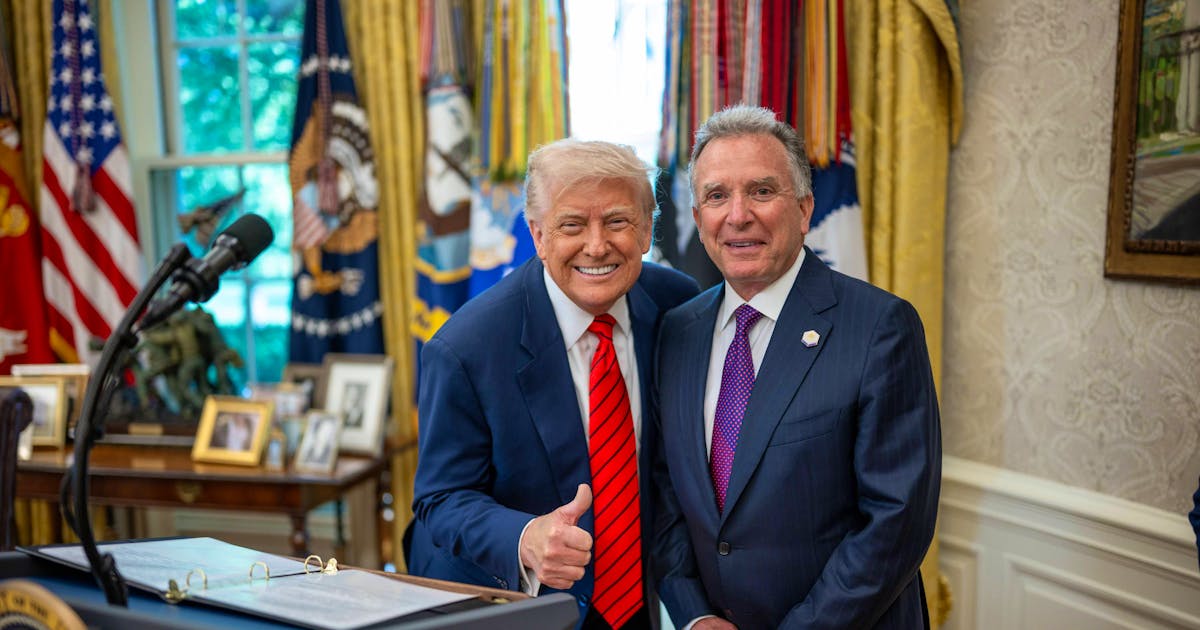
U.S. President Donald Trump and his special envoy Steve Witkoff have unveiled a controversial 28-point plan aimed at ending Russia’s war in Ukraine, reportedly giving Ukrainian President Volodymyr Zelensky until Thursday to accept the terms.
The proposal has triggered fierce criticism, even from within Republican ranks, with many viewing it as largely accommodating Russia’s maximum demands while forcing Ukraine to make significant concessions.
Witkoff, a real estate mogul with no prior diplomatic experience before his appointment as special envoy, reportedly negotiated the plan with Vladimir Putin’s representative for economic cooperation, Kirill Dmitriev. Ukrainian officials have characterized the proposal as essentially reviving the Kremlin’s most sweeping demands.
The backlash from prominent Republicans has been swift and pointed. Senate Minority Leader Mitch McConnell wrote on social media that “Putin has spent the entire year making a fool out of President Trump,” advising the president to “find new advisors” if his current officials are “more interested in appeasing Putin than securing real peace.”
“Rewarding Russian atrocities would be disastrous for America’s interests,” McConnell added.
Republican Congressman Brian Fitzpatrick dismissed the plan as “Russian-made propaganda” that “must be rejected and discarded for what it is: unserious nonsense.” He emphasized that “this moment calls for peace through strength, not appeasement.”
Senator Roger Wicker, a member of the Defense Committee, expressed deep skepticism about the plan’s ability to bring peace. “Ukraine should not be forced to cede its land to one of the world’s most notorious war criminals, Vladimir Putin,” he stated, adding that “the size and formation of the Ukrainian armed forces is a sovereign decision of the government and the people.”
Wicker particularly cautioned against arms control agreements with Putin, whom he described as “a notorious liar and murderer.”
According to multiple media reports, the 28-point plan demands major concessions from Ukraine while offering limited benefits in return. The proposal reportedly requires Ukraine to constitutionally renounce NATO membership and permanently cede territories, including recognizing Crimea and the occupied regions of Donetsk and Luhansk as de facto Russian.
The plan would also require Ukraine to reduce its military force from the current 800,000-850,000 personnel to 600,000, even as Russia has announced plans to increase its military from 1.4 million to 2 million by 2030. Ukraine would remain free of nuclear weapons but would be permitted to join the European Union.
In return, Ukraine would receive what critics describe as only a vague “security guarantee” from the United States against future Russian aggression.
International media outlets have also expressed concern about the plan. Czech news portal Aktualne.cz called it “crazy,” noting that “paradoxically, the only hope for the Ukrainians now lies with Russian President Vladimir Putin, as he could play his usual game of: ‘That’s not enough for me, I want more.'”
Spanish newspaper El País criticized the process, noting the plan has “a fundamental flaw that cannot be overlooked: it was drawn up behind the backs of both the country invaded by Russia more than three years ago and the European community of states.”
President Zelensky, facing immense pressure, reportedly stated that “Ukraine now faces an extremely difficult choice: either a loss of dignity, or the risk of losing a key partner. Either the complex 28-point plan or an extremely harsh winter.”
The situation highlights growing tensions between Trump’s approach to resolving the conflict and the views of traditional Republican foreign policy hawks, who continue to advocate for a stronger stance against Russian aggression in Eastern Europe.
Fact Checker
Verify the accuracy of this article using The Disinformation Commission analysis and real-time sources.

22 Comments
The cost guidance is better than expected. If they deliver, the stock could rerate.
Good point. Watching costs and grades closely.
Good point. Watching costs and grades closely.
Uranium names keep pushing higher—supply still tight into 2026.
The cost guidance is better than expected. If they deliver, the stock could rerate.
Good point. Watching costs and grades closely.
Good point. Watching costs and grades closely.
Nice to see insider buying—usually a good signal in this space.
Nice to see insider buying—usually a good signal in this space.
Exploration results look promising, but permitting will be the key risk.
Good point. Watching costs and grades closely.
If AISC keeps dropping, this becomes investable for me.
Good point. Watching costs and grades closely.
Good point. Watching costs and grades closely.
Exploration results look promising, but permitting will be the key risk.
Good point. Watching costs and grades closely.
Good point. Watching costs and grades closely.
Exploration results look promising, but permitting will be the key risk.
I like the balance sheet here—less leverage than peers.
Good point. Watching costs and grades closely.
If AISC keeps dropping, this becomes investable for me.
Good point. Watching costs and grades closely.