


Listen to the article
The language of violence: How media framing shapes public perception of Gaza
In an era of media fragmentation, the coverage of the Gaza conflict demonstrates how carefully chosen words and narrative framing can profoundly influence public understanding of complex geopolitical events. A recent article in The Nightly by senior journalist Aaron Patrick has sparked controversy for its approach to reporting on executions carried out by Hamas in Gaza City following the recent ceasefire.
Media analyst David Heslin highlights how Patrick’s piece, titled “After the fighting ends, Gazans celebrate a public execution like a sporting match,” employs several problematic framing devices that shift blame and obscure broader context about the devastation in Gaza.
The article opens with a contentious false dichotomy: “The world demanded peace in the Gaza Strip. This is what peace looks like.” This framing suggests that those who advocated for an end to the bombardment of Gaza are somehow responsible for Hamas’s subsequent actions, rather than placing responsibility on either the perpetrators themselves or the conditions that enabled such violence.
Patrick, a Walkley-nominated correspondent with a history at the Australian Financial Review, has previously participated in press tours organized by pro-Israel lobby groups. His reporting appears to minimize Israel’s role in the destruction of Gaza while emphasizing Hamas’s brutality in isolation from the broader context.
“Nobody with a heart looks at the endless stretches of grey rubble now strewn through the territory and sees peace,” notes Heslin in his critique. “Nobody thinks that a pause on the assault of Gaza – a territory that is still besieged and occupied by Israeli forces – and leaving its people to their own devices is a victory won.”
Media experts point to several rhetorical techniques employed throughout Patrick’s reporting that deserve scrutiny. Particularly troubling is the headline’s broad attribution of celebration to “Gazans” as a collective, implying widespread civilian support for the executions rather than actions by armed factions with limited supporters.
This generalization feeds into a dangerous narrative that has persisted throughout the conflict. Since October 2023, some Israeli government officials have made statements suggesting collective punishment is justified because, in their view, there are “no innocents in Gaza.” Such rhetoric has been condemned by human rights organizations as dehumanizing and contrary to international humanitarian principles.
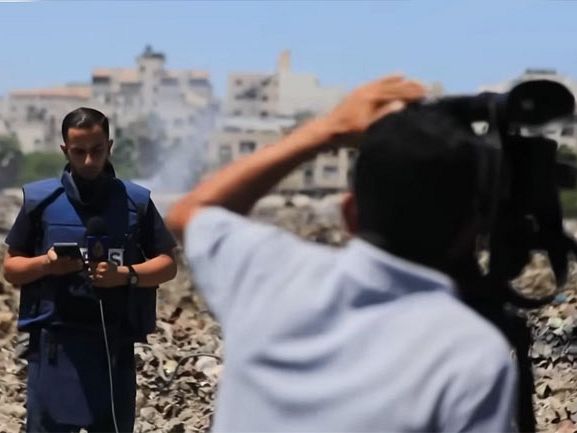
The article also employs subtle language choices to undermine reports of journalist casualties in Gaza. Patrick frames the widely documented killing of Palestinian journalists as merely an “allegation” from “The Committee to Protect Journalists,” countered by Israeli military claims that some journalists were Hamas fighters or sympathizers – insinuations that, even if true in some cases, would not justify extrajudicial killings under international law.
Throughout the conflict, media organizations have faced criticism for their framing devices. Common examples include the routine addition of “Hamas-run Gaza Health Ministry” when reporting casualty figures (despite these figures generally being considered reliable by the United Nations), creating doubt about the death toll without providing evidence for such skepticism.
The consequences of such framing extend beyond pure information transfer. Comments on Patrick’s article reveal readers drawing conclusions that reinforce negative stereotypes about Palestinians and refugees, demonstrating how media coverage can shape public sentiment and potentially influence policy positions.
Media scholars have long documented how language choices in conflict reporting can either illuminate or obscure reality. The persistent use of passive voice when describing Palestinian deaths (“X number were killed”) versus active voice for Israeli casualties (“Hamas killed X”) represents just one example of linguistic patterns that subtly assign or deflect responsibility.
As the situation in Gaza continues to evolve following the ceasefire, with humanitarian concerns remaining paramount amid severe shortages of water, medicine, and food, the role of journalism in providing accurate, contextualized reporting has never been more crucial.
For news consumers, developing critical media literacy skills becomes essential in navigating complex international reporting. Understanding how language frames events, recognizing false equivalencies, and seeking diverse sources of information can help readers form more nuanced perspectives on conflicts where lives – and the truth – are often the first casualties.
Fact Checker
Verify the accuracy of this article using The Disinformation Commission analysis and real-time sources.

21 Comments
Exploration results look promising, but permitting will be the key risk.
Good point. Watching costs and grades closely.
Good point. Watching costs and grades closely.
I like the balance sheet here—less leverage than peers.
Good point. Watching costs and grades closely.
Good point. Watching costs and grades closely.
Interesting update on Propaganda’s Role in Shaping Gaza Conflict Narratives. Curious how the grades will trend next quarter.
Good point. Watching costs and grades closely.
Good point. Watching costs and grades closely.
The cost guidance is better than expected. If they deliver, the stock could rerate.
Silver leverage is strong here; beta cuts both ways though.
Good point. Watching costs and grades closely.
Interesting update on Propaganda’s Role in Shaping Gaza Conflict Narratives. Curious how the grades will trend next quarter.
The cost guidance is better than expected. If they deliver, the stock could rerate.
Good point. Watching costs and grades closely.
Exploration results look promising, but permitting will be the key risk.
Good point. Watching costs and grades closely.
Exploration results look promising, but permitting will be the key risk.
Good point. Watching costs and grades closely.
If AISC keeps dropping, this becomes investable for me.
Exploration results look promising, but permitting will be the key risk.