


Listen to the article
The war after the war: Pakistan’s POWs and postal propaganda
In the aftermath of the December 16, 1971 conflict, the surrender of Pakistan’s Eastern Command led to over 90,000 Pakistani soldiers becoming prisoners of war (POWs) in Indian custody. This military defeat triggered one of South Asia’s most intense political campaigns since the 1947 Partition, as Pakistan scrambled to manage both domestic and international fallout.
For Pakistan, the surrender created a profound national crisis. Domestically, the government faced mounting public anger and renewed calls for military accountability. Military leadership harbored serious concerns that POWs might reveal details of atrocities committed during Bangladesh’s nine-month liberation struggle. The immediate release of these prisoners from Indian camps became a strategic priority to prevent further national humiliation.
Internationally, Pakistan found itself increasingly isolated. Global sympathy tilted heavily toward Bangladesh and India, with international media correctly framing the situation in the context of war crimes committed by an occupying force rather than as a humanitarian concern. Pakistan needed to rapidly construct a counter-narrative to salvage its deteriorating global standing.
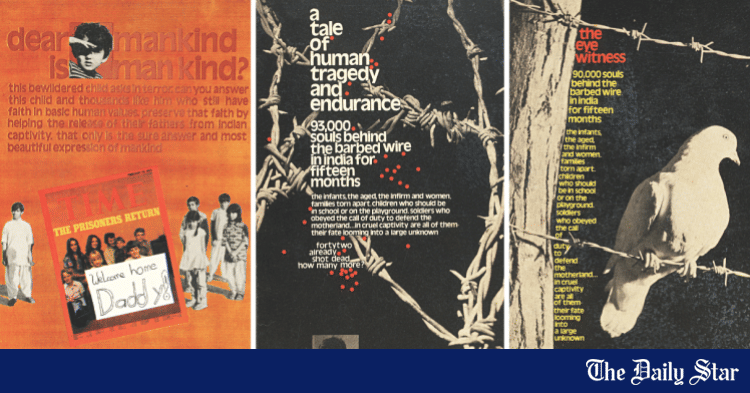
Philatelic evidence confirms that a propaganda campaign was launched almost immediately after the surrender. This desperate measure aimed to address internal political divisions while attempting to reclaim moral standing on the world stage. By mid-1973, Pakistan had implemented a comprehensive philatelic scheme that, while ultimately unsuccessful in achieving its goals, left behind stamps, postal stationery, markings, and postcards that now serve as historical documents of this political campaign.
Since their introduction in 1840, postage stamps have evolved beyond their basic postal function. Even in their early days, governments recognized that stamps, through international postal exchanges, could reach global audiences and disseminate national narratives. The fact that stamps were widely collected ensured that any messaging they carried would be preserved by philatelists worldwide.
The two World Wars demonstrated how effectively philatelic materials could present national narratives to international audiences. This practice expanded during the Cold War, with nations using postal items to advance political positions and counter rival ideologies. By the 1970s, using stamps for propaganda was well-established in international diplomacy.
During the 1971 conflict, Bangladesh’s Mujibnagar Government effectively utilized this diplomatic tool, issuing stamps to present its case as a nation fighting genocide and seeking sovereignty. Initially slow to respond, Pakistan eventually adopted a similar approach after December 1971, attempting to reframe its military defeat as a humanitarian crisis concerning POWs—mirroring Cold War propaganda strategies.
On July 18, 1973, Pakistan Post issued a special Rs 1.25 stamp designed by Mukhtar Ahmed to “raise world conscience” regarding the 90,000 Pakistani POWs. The stamp depicted a gloomy prison camp with uniformed prisoners behind barbed wire, alongside an image of a sad boy waiting for his father’s return. The number “90,000” appeared in pink, with the caption “Prisoners of War in India, Challenge to World Conscience” in white. The First Day Canceller reinforced the message with “90,000 Pakistan POWs Languishing in Indian Camps for Over 15 Months.”
The campaign expanded on August 16, 1973, with two aerogrammes featuring similar imagery—a human hand caught in barbed wire, the Human Rights symbol, and text reading “HELP RELEASE PRISONERS OF WAR 90,000.” A special slogan postmark reading “90,000 POWs in Indian Camps are on World Conscience” was also introduced for canceling stamps and marking mail to foreign addresses.
Private sector entities amplified the government’s message. At least two commercial companies—S.A. Lodhy & Co. and Rajax—issued labels with similar designs, showing Pakistani POWs behind barbed wire with text asking if “world conscience” was “asleep.” Three picture postcards printed by Golden Block Works Ltd. in Karachi carried the same messaging. The consistent language across these materials suggests coordinated production, likely commissioned from a single source and released around July 1973.
This philatelic propaganda campaign represents a fascinating chapter in the post-1971 war period, illustrating how Pakistan attempted to use postal media to reshape international perceptions about its military defeat and subsequent POW situation. Though ultimately ineffective in changing global opinion, these postal artifacts remain valuable historical evidence of a nation’s desperate effort to win the narrative battle after losing the military one.
Fact Checker
Verify the accuracy of this article using The Disinformation Commission analysis and real-time sources.

22 Comments
Curious to learn more about the specific tactics and messaging used in Pakistan’s postal propaganda campaign. What were they trying to achieve, and how effective were their efforts?
The article provides a fascinating glimpse into the high-stakes political maneuvering that followed the military defeat.
Fascinating look at how Pakistan tried to leverage postal propaganda to counter the negative publicity around the POWs and war crimes allegations. It speaks to the importance of information control in modern conflicts.
The article does a great job of highlighting the complexity of the geopolitical dynamics at play in the aftermath of the 1971 war.
Fascinating look at the complex geopolitical fallout from the 1971 conflict. Curious to learn more about Pakistan’s efforts to manage the PR crisis surrounding the POWs and their potential revelations.
It’s interesting how the surrender of the Pakistani forces led to such a significant domestic and international backlash for the government in Islamabad.
The dynamics between Pakistan, Bangladesh, and India during this period seem incredibly fraught. I wonder how the postal propaganda campaign played into the broader information war surrounding the conflict and its aftermath.
Controlling the narrative around the POWs and potential war crimes must have been a top priority for Pakistan’s leadership at the time.
Interesting to see how the information war played out in the context of this conflict. Postal propaganda seems like an unusual tactic, but it speaks to the importance of controlling the narrative during times of crisis.
The article does a good job of highlighting the complex geopolitical dynamics at play in the aftermath of the 1971 war.
The article sheds light on an important but often overlooked aspect of the 1971 conflict – the information war that unfolded alongside the military confrontation. Curious to see how Pakistan’s efforts to manage the POW situation and shape the narrative ultimately played out.
It’s a good reminder that modern conflicts are fought on multiple fronts, with the battle for public opinion and international sympathy being just as critical as the fighting itself.
This article sheds light on an important but often overlooked aspect of the 1971 war – the battle for public opinion and international sympathy that unfolded alongside the military conflict.
It’s a good reminder that modern conflicts are fought on multiple fronts, including the information domain.
The article provides valuable historical context around the political and diplomatic fallout from the 1971 conflict. It’s a useful reminder that wars don’t end when the fighting stops.
Curious to learn more about how the international community responded to Pakistan’s efforts to manage the POW situation and shape the narrative.
This article provides a sobering look at the often-overlooked political and diplomatic dimensions of armed conflicts. The battle for public opinion and international sympathy can be just as important as the fighting itself.
Curious to learn more about how the postal propaganda campaign was received both domestically and internationally, and what impact it had on the overall narrative.
The surrender of over 90,000 Pakistani soldiers must have been a massive blow to national pride. No wonder the government was so determined to control the narrative and prevent further humiliation.
It’s a sobering reminder of the heavy human toll and long-lasting consequences of armed conflict.
Fascinating exploration of the complex political and diplomatic fallout from the 1971 conflict. The article highlights how the battle for public opinion and narrative control can be just as important as the military outcome itself.
Curious to see how the international community responded to Pakistan’s efforts to manage the POW situation and shape the narrative surrounding the conflict.