


Listen to the article
Pro-Palestinian Demonstrations Continue to Draw Nazi Comparisons, Sparking Debate Over Historical Accuracy
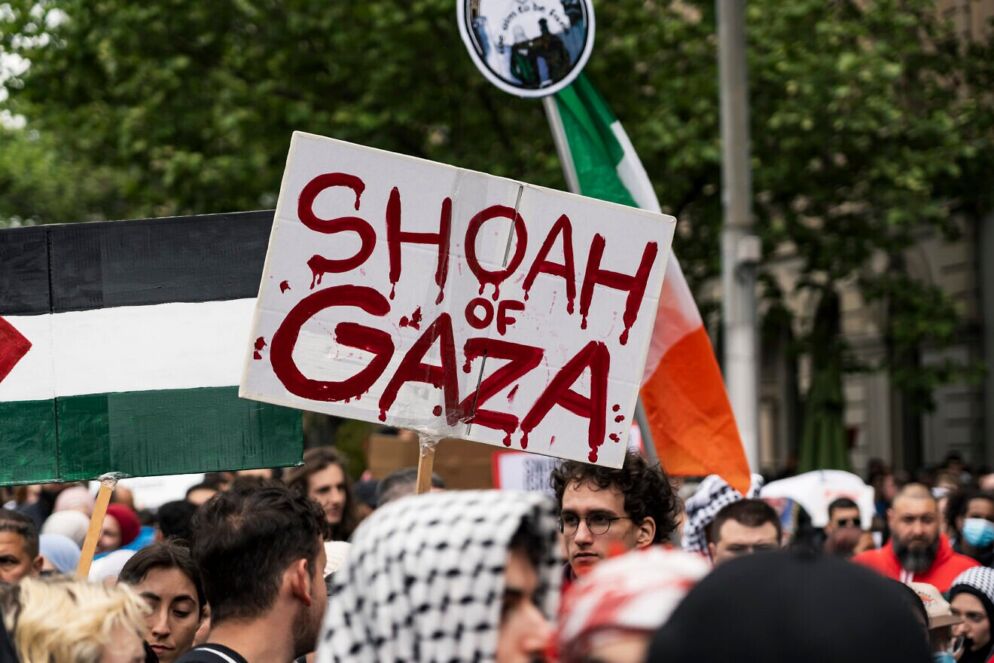
The equation of Israel’s treatment of Palestinians with Nazi Germany’s persecution of Jews has become a potent and divisive propaganda tool at demonstrations worldwide, according to political analysts tracking the ongoing conflict in the Middle East.
The controversial parallel has gained significant traction in recent years, particularly following the October 7 Hamas attack and Israel’s subsequent military response in Gaza. At rallies across major cities, protesters have increasingly labeled Gaza as “the Auschwitz of the 21st century,” characterized Israeli airstrikes as “genocide,” and compared Palestinian refugee camps to the Warsaw Ghetto.
Experts in propaganda and Middle Eastern politics note this represents a deliberate strategy of historical mirroring, not factual analysis. The technique follows a pattern where Palestinian suffering is directly compared to the Holocaust, creating what critics call a false moral equivalence that challenges Israel’s legitimacy on the world stage.
“This is propaganda by analogy,” explains Jan Kapusnak, a political scientist specializing in Middle Eastern issues. “It exploits the trauma of Jewish people – the murder of six million men, women and children – as a weapon against the world’s only Jewish state.”
Central to this narrative construction is the equivalence of the Palestinian Nakba (“catastrophe”) with the Shoah (Holocaust). The Palestinian experience of 1948, when Israel declared independence, is reframed outside its historical context of a war initiated by five Arab armies. Instead, it’s presented as a mirror image of Jewish tragedy – a deliberate ethnic cleansing campaign.
The International Holocaust Remembrance Alliance (IHRA) has specifically identified such comparisons in its working definition of antisemitism. The organization states that “drawing comparisons of contemporary Israeli policy to that of the Nazis” constitutes antisemitism as it desecrates Holocaust victims’ memory while transforming their descendants into villains.
Historians point out significant factual distinctions between these events. The Holocaust represented the systematic attempt to annihilate an entire people, while Israel’s military actions, though causing civilian casualties, target Hamas – an organization designated as terrorist by the United States and European Union that has openly called for Israel’s destruction.
The Palestinian population has grown steadily for decades, contradicting genocide claims. However, in the digital age, images of destruction in Gaza spread instantaneously across social media platforms, often without context or verification, creating a powerful emotional narrative.
Media analysts observe Hamas has effectively leveraged this dynamic. The organization’s strategy places military assets in civilian areas, ensuring that Israeli counterstrikes produce footage that can be weaponized in the information war. For Hamas, civilian casualties become political assets that strengthen their David versus Goliath narrative.
“In reality, the Israel Defense Forces are fighting one of the most complex wars of modern times while striving to protect civilians beyond what international law requires,” argues Kapusnak. “Meanwhile, Hamas controls the narrative through images of suffering that reach millions before any context can follow.”
Some critics suggest Jews should be held to higher standards precisely because of their historical suffering, an argument defenders of Israel call dehumanizing. They contend it unfairly places unique obligations on the Jewish state while denying it the same right to self-defense granted to other nations.
For European audiences, these Nazi comparisons may serve another psychological function. If Israelis can be cast as “Nazis,” then Europe’s historical guilt becomes easier to bear through relativization of the Holocaust’s unique horror.
While legitimate criticism of Israeli government policies remains essential in democratic discourse, experts emphasize that Nazi comparisons and Holocaust inversion cross into antisemitic territory. Such rhetoric not only distorts historical truth but potentially creates environments where antisemitic violence becomes more acceptable.
As demonstrations continue worldwide, the weaponization of Holocaust imagery remains a powerful but deeply controversial tool in shaping public opinion about one of the world’s most intractable conflicts.
Fact Checker
Verify the accuracy of this article using The Disinformation Commission analysis and real-time sources.

8 Comments
While the analogy between Israel and Nazi Germany is provocative, it’s also a dangerous oversimplification that risks trivializing the Holocaust. Nuanced political discourse is important, even on divisive issues.
I agree, we should be cautious about drawing such loaded historical parallels. There are valid criticisms of Israel’s treatment of Palestinians, but equating it to the systematic genocide of the Holocaust is a stretch.
The article raises an important issue about the dangers of historical revisionism, even when used to draw attention to current injustices. We should be wary of propaganda techniques that simplify complex geopolitical realities.
The article highlights how propaganda by analogy can distort public understanding of complex, multifaceted conflicts. While the Israeli-Palestinian issue deserves scrutiny, we must be cautious about drawing simplistic historical parallels.
Propaganda by analogy can be a powerful rhetorical tool, but it often distorts complex realities. I’m curious to hear more factual analysis of the Israeli-Palestinian conflict from experts, without resorting to inflammatory historical comparisons.
Valid point. While emotive language can rally support, it’s crucial to ground political discourse in objective analysis rather than inflammatory analogies. A nuanced, evidence-based approach is needed here.
Equating the Israeli-Palestinian conflict with the Holocaust is a concerning trend. While the plight of Palestinians deserves attention, such provocative analogies risk trivializing the unique atrocities of the Nazi genocide.
I agree, using the Holocaust as a rhetorical device in this way is highly problematic. We should be vigilant about such historical distortions, no matter the intent.