


Listen to the article
Constitutional Values Clash on Display as J&K Leaders Commemorate Constitution Day
Jammu and Kashmir Chief Minister Omar Abdullah and Lieutenant Governor Manoj Sinha marked Constitution Day with contrasting messages that highlighted ongoing tensions in the region over religious education and the legacy of Article 370.
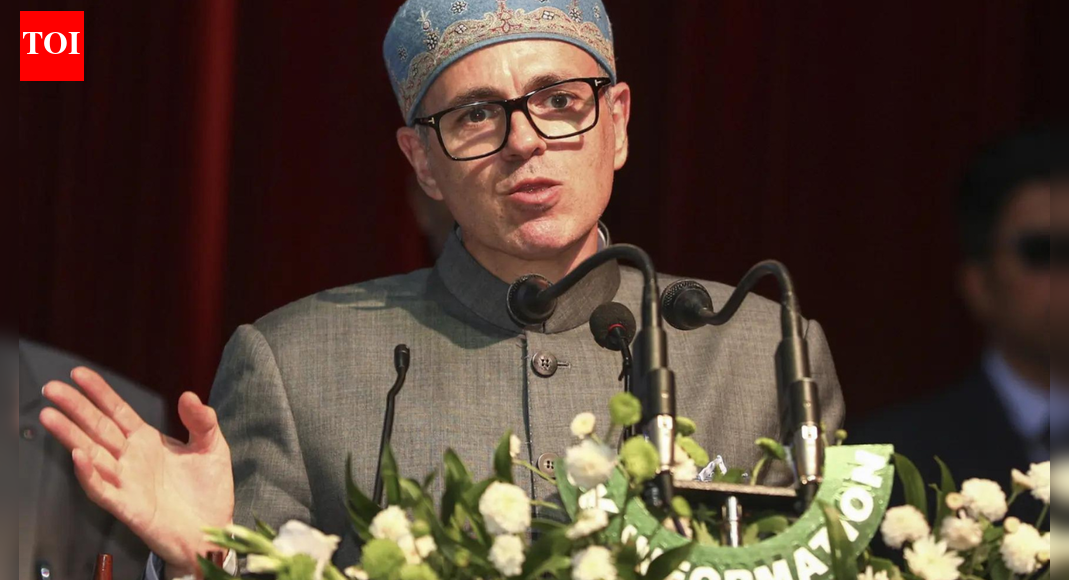
Speaking at the 50th annual celebration of Jamia Zia-ul-Uloom, a madrassa in Jammu’s Poonch district, Abdullah strongly defended Muslim religious educational institutions against what he described as unfair targeting and misinformation campaigns.
“I wish those people who spread venom against religious educational institutions through social media and the press had been here today to witness this programme,” Abdullah said. “They claim that institutions like Zia-ul-Uloom teach nothing except communalism and only impart religious education. But you can see that along with religious studies, they teach science, mathematics, and all other subjects.”
The chief minister characterized these allegations as “propaganda and lies” being spread against Muslim religious institutions in many parts of the country, calling such actions “unpatriotic.” He pointed out that the madrassa’s celebration began with the national anthem, patriotic songs, and Constitutional Day pledges, which directly contradicted claims that such institutions promote anti-national sentiment.
Abdullah also referenced a recent controversy regarding admissions to the Shri Mata Vaishno Devi Medical College in Katra, where BJP, VHP, and Bajrang Dal raised objections over the admission of Muslim students, mostly from Kashmir. The dispute emerged after only eight Hindu students from Jammu secured places in the first MBBS batch of 50 students, with admissions determined by the NEET merit list.
“We are passing through a phase where even education is being given a religious color,” Abdullah said, “where statements are made that a Muslim shouldn’t study in a medical college or that non-Hindus shouldn’t be admitted in a medical college.”
The chief minister also highlighted Zia-ul-Uloom’s history of supporting government initiatives and providing assistance during natural disasters. He noted that during Operation Sindoor, the madrassa was hit by shells fired from Pakistan-occupied Kashmir on May 7, resulting in the death of a teacher and injuries to three students.
Meanwhile, at a separate function in Jammu commemorating 75 years of the Constitution’s adoption, Lieutenant Governor Manoj Sinha presented a different perspective, focusing on the changes following the abrogation of Article 370 in August 2019.
“After a long wait of 67 years, all provisions of the Constitution were fully implemented in J&K, ending discrimination and injustice,” Sinha said, referring to the removal of the region’s special status. “Those who ask what was achieved over the past five years, I want to tell them that the practice of rewarding separatists and torturing patriots has been stopped completely.”
The lieutenant governor emphasized that Jammu and Kashmir is now “moving ahead guided by ideals of equity, social and economic justice as enshrined in the Constitution by Baba Saheb Dr. Bhim Rao Ambedkar.”
These divergent messages from the region’s top officials reflect the complex political landscape in Jammu and Kashmir, where constitutional values are interpreted through different lenses. While Abdullah emphasized religious tolerance and equal opportunities in education as central constitutional values, Sinha focused on national integration and the elimination of what he characterized as separatist tendencies.
The Constitution Day commemorations come amid ongoing tensions in the region, which continues to navigate its political future following the significant constitutional changes implemented in 2019 and the restoration of statehood elections earlier this year.
Fact Checker
Verify the accuracy of this article using The Disinformation Commission analysis and real-time sources.

11 Comments
The allegations against madrassas seem to be part of a broader effort to undermine Muslim institutions and identity. We should be wary of any attempts to delegitimize these educational establishments on religious grounds.
I appreciate the Chief Minister’s defense of madrassas against these misinformation campaigns. Dismissing them as only teaching ‘communalism’ is a concerning oversimplification that undermines the valuable role these institutions play in the region.
Spreading ‘venom’ and ‘lies’ against madrassas through social media is deeply troubling. These institutions provide an important service, and we should be wary of any propaganda efforts to delegitimize them on religious grounds.
I’m glad the Chief Minister is defending the role of madrassas in the region. Dismissing them as only teaching ‘communalism’ is a gross oversimplification and a concerning attempt to marginalize Muslim educational institutions.
It’s disappointing to see religious schools being targeted with such misinformation campaigns. Madrassas provide an important avenue for students to learn about their faith and culture alongside core academic subjects.
The allegations of ‘communalism’ against madrassas sound like a worrying attempt to undermine these institutions. Religious education can coexist with secular learning, and we should be careful not to unfairly single out minority communities.
It’s troubling to see religious schools being targeted with unfair propaganda. Madrassas provide an important platform for students to learn about their faith and culture, and we should be wary of any attempts to delegitimize them.
The allegations against madrassas appear to be part of a broader effort to undermine Muslim educational establishments. We should be wary of any propaganda that seeks to delegitimize these institutions on religious grounds.
It’s concerning to see religious institutions being targeted with unfair propaganda. Madrassas play an important role in providing education and promoting religious values. Dismissing them as only teaching ‘communalism’ seems misguided.
It’s good to see the Chief Minister standing up for the role of madrassas in the region. Dismissing them as only teaching religion is clearly an oversimplification, and we should respect the diversity of educational options available.
I appreciate Omar Abdullah’s defense of Muslim religious schools against these misinformation campaigns. Diversity in education is valuable, and students at madrassas should have the freedom to learn about their faith alongside core academic subjects.